
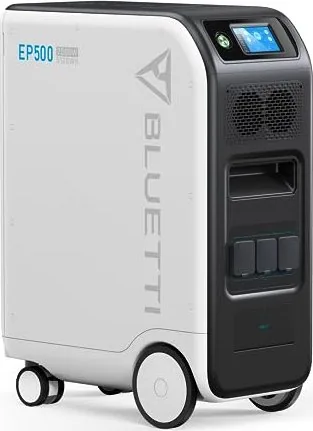
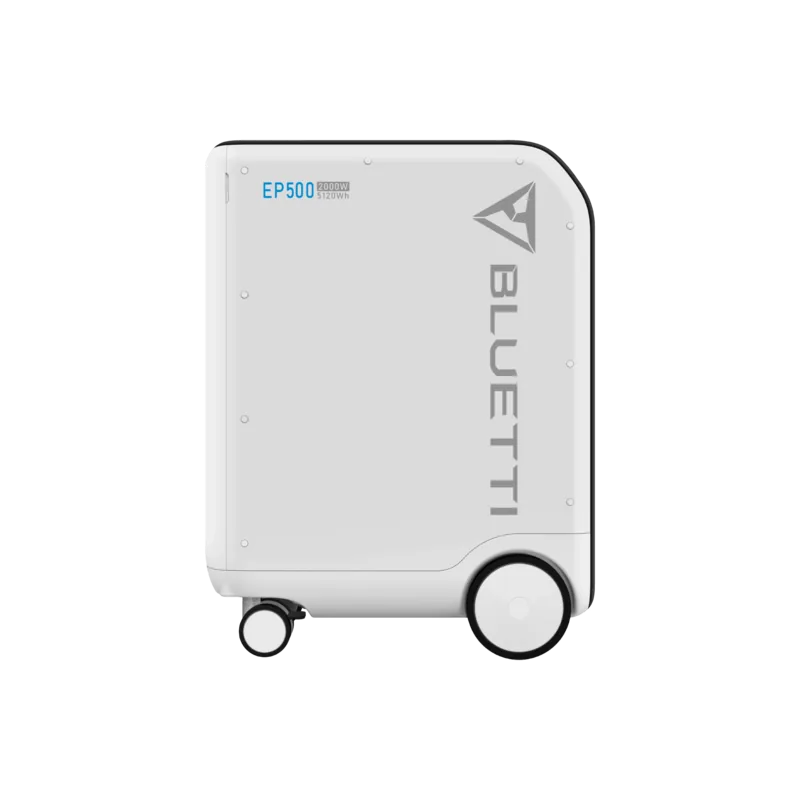
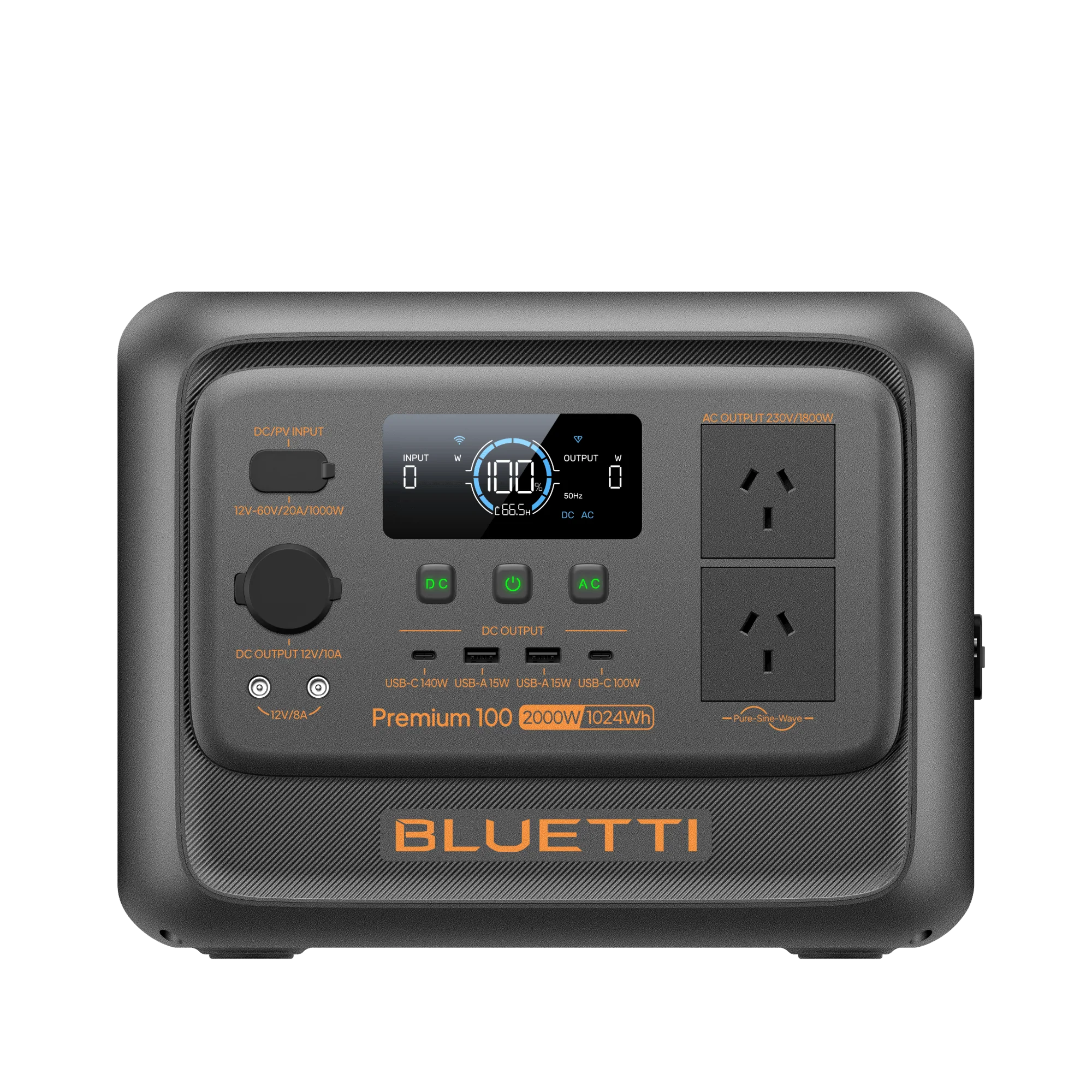
Bluetti EP500 Manual
PDF manual · 44 Pages
English



Quick check
Incorrect answer, please try again.
Chat with your Bluetti EP500 manual using AI
Get instant AI answers from your Bluetti EP500 manual
Ask anything about the Bluetti EP500. Answers come from this manual, with the pages they are based on.
EP500 Maintenance Schedule
Discharge and fully charge the unit at least once every 6 months to preserve battery health.
Turn off the unit and charge it to 50-70% capacity every time before storing it.
Free maintenance reminders
Timed to your purchase date. Always free, unsubscribe anytime.
Ask a Question
Do you recommend EP500?
Yes NoFrequently Asked Questions
The EP500 uses a LiFePO4 battery with a nominal 5120Wh capacity. The unit defaults to a 90% depth of discharge (DoD) to protect battery life, meaning about 90% of the nominal capacity is usable under normal settings.
Is this answer helpful?
Recharge options include AC wall charging (600W), generator, solar via MPPT (up to 1200W), or using CP1 and CP2 simultaneously. Estimated full charge time = 5120Wh / total charge power + 0.5–1 hour for trickle; combined high-power charging significantly reduces time.
Is this answer helpful?
Yes. The EP500 supports multiple UPS modes: Standard (online/offline), PV Priority, Time Control, and Customized. Online UPS supplies load from the unit continuously; offline UPS switches in about 20ms for backup when grid fails (or instant for online mode).
Is this answer helpful?
Yes, two EP500 units (100–120V versions) can be bonded via a Fusion Box for split-phase output to double available power and voltage. Both units must be the same model; Fusion Box and communication/output cables are sold separately.
Is this answer helpful?
Protective features include over/under voltage, over-current, short-circuit, over-temperature, and BMS safeguards. Maintenance recommendations: store at 50–70% charge, cycle fully every six months, keep ventilation clear, avoid moisture, and use only approved accessories.
Is this answer helpful?
Yes, third-party panels with MC4 connectors are supported if combined voltage is within 55–145V and max input power is ≤1200W. For higher open-circuit voltages, a PV step-down module may be required.
Is this answer helpful?
Yes. The unit supports pass-through charging allowing simultaneous charging and powering of loads from AC and DC outputs, though continuous pass-through usage and charging patterns should follow manufacturer guidance to preserve battery lifespan.
Is this answer helpful?
Advantages and Disadvantages
Advantages

- Large 5120Wh LiFePO4 battery provides long runtime for critical loads and frequent device recharges.
- Multiple output types (AC outlets, RV 12V/30A, USB-C PD, USB-A, wireless pads) cover diverse appliance needs.
- Dual charging ports (AC, generator, MPPT solar) support simultaneous inputs up to 1800–1200W combined for fast recharging.
- Configurable UPS modes and app control (Wi‑Fi/Bluetooth) allow tailored grid-tie, PV-priority, and time-of-use strategies.
- Split-phase bonding lets two EP500 units double output power/voltage for higher-capacity installations (100–120V models).
Disadvantages

- Heavy and large (76kg) — mobility limited despite wheels; not suited for frequent lifting or tight spaces.
- Requires licensed electrician for grid-tied installations and optional sub-panel, increasing setup complexity and cost.
- AC continuous output limited to 2000W total; very high-draw appliances may exceed capacity or trigger overload protection.
- PV input voltage and configuration limits (55–145V, max 1200W) may need additional PV step-down modules for some roof arrays.
- Certain features (split-phase fusion box, sub-panel, cables) sold separately, adding to overall system expense.
Product Specification
Type
Solar Generator
Battery
LiFePO4, 5100Wh
Battery Charge Cycles
>3500 until 80% remaining capacity
AC Output
2x Schuko socket (Type-F)
AC Output Power
2000W
AC Peak Output Power
6000W
DC Output
1x Cigarette Lighter (12V/10A/120W), 2x DC 5521 (12V/10A/120W)
USB Output
2x USB-A (15W), 2x USB-C (100W)
Wireless Charging
1x 10W
Charging Methods
Power Adapter, Solar, Car
Charging Inputs
1
Solar Charging Inputs
1
Number of Power Adapters
1x
Battery Expansion Ports
1
Operating Temperature
32 F to 104 F
Weight
167.55 lbs
Dimensions
19.69x11.81x29.92in
Special Features
Transport Handles, App Control, Touchscreen, UPS Function
Manufacturer's Warranty
2 Years
Note
Prices partly include 0%-VAT rates for AT and DE
Product Description
Bluetti EP500 Solargenerator Manual — Product Overview
The Bluetti EP500 Solargenerator is a high-capacity, mobile home energy storage system designed for flexible backup power, off-grid use, and solar integration. Built around a 5120Wh LiFePO4 battery and a robust BMS, the EP500 combines inverter, charger, MPPT solar controller, and multiple outputs into a single plug-and-play unit. With built-in wheels and a «no-installation» approach, it works as a portable UPS for critical loads during outages and as a daily energy hub for homes, cabins, RVs, and remote sites.
Key Features and Practical Uses
The EP500 supports up to 2000W continuous AC output (with surge capability) across multiple AC outlets and a suite of DC and USB outputs including USB-C PD, fast-charging USB-A ports, wireless charging pads, and a 12V/30A RV port. Solar input via MPPT accepts 55–145VDC and up to 1200W, and dual charging ports allow AC and solar (or generator) charging simultaneously to reduce recharge time. The system offers configurable UPS modes (Standard, PV Priority, Time Control, Customized), split-phase bonding (for doubling power with two units, 100–120V versions), and app-based control over Wi‑Fi/Bluetooth for monitoring and firmware updates.
Safety and installation guidance emphasizes licensed electrician involvement for grid-tie setups, proper ventilation, and avoiding wet or flammable environments. The touchscreen interface provides easy access to settings (voltage, frequency, ECO mode, grid input limits) and diagnostics. Built-in protections include over/under voltage, over-temperature, short-circuit, and BMS safeguards. Routine maintenance recommendations include storing at 50–70% charge, periodic full charge cycles, and keeping vents clear.
Who It’s For
The EP500 suits households seeking dependable backup for refrigerators, medical devices, and essential circuits; off-grid enthusiasts who want a portable, high-capacity solar-ready solution; and professionals needing a stable UPS replacement or supplemental power for remote operations. With multi-mode UPS control, split-phase capability, and high solar input, it addresses diverse energy needs while prioritizing battery longevity and safety.
Notes
- Battery chemistry: LiFePO4, 5120Wh nominal capacity, 90% DOD default to prolong life.
- Typical recharge: combined CP1/CP2 charging accelerates full recharge; estimate = 5120Wh / total charge power + 0.5–1h trickle.
- Certifications: PSE, FCC, CE, UN38.3, UL, SAA, RoHS.
- Use only original or approved charging accessories to preserve warranty.
Search for 67,732 Manuals online


Type-in Brand or Model