


Benning TRITEST easy Manual
PDF manual · 39 Pages
English



Quick check
Incorrect answer, please try again.
Chat with your Benning TRITEST easy manual using AI
Get instant AI answers from your Benning TRITEST easy manual
Ask anything about the Benning TRITEST easy. Answers come from this manual, with the pages they are based on.
TRITEST easy Maintenance Schedule
Immediately before and after use, check that the phase tester functions correctly by verifying all LEDs and the buzzer work.
Replace batteries if the device switches off immediately or if LED and acoustic signals become weak.
If the device is stored for a longer period of time, remove the batteries from the device.
Ask a Question
Do you recommend TRITEST easy?
Yes NoFrequently Asked Questions
The TRITEST easy detects alternating electric fields from approximately 200 V AC up to 1,000 V AC (45–65 Hz). It does not detect DC voltage.
Is this answer helpful?
No. The TRITEST easy is a non-contact field detector and cannot replace a two-pole voltage tester. To confirm absence of voltage, always use a certified two-pole tester compliant with DIN EN 61243-3 (e.g., DUSPOL).
Is this answer helpful?
Activate sequence mode, touch the probe to the presumed L1 for ~3 seconds, then contact L2 within 2 seconds when prompted. The probe LED indicates clockwise, counter-clockwise, identical phase, or undetermined sequence via green/red/flash patterns and acoustic signals.
Is this answer helpful?
Large distance to conductor, strong insulation or shielding, recessed socket contacts, protective clothing or insulating standing conditions, mains disturbances, and low battery condition can all impair detection performance.
Is this answer helpful?
It uses 2 × Micro (LR03/AAA) batteries. The device automatically switches off after about 5 minutes of inactivity (Auto-Power-Off) to conserve battery life.
Is this answer helpful?
Yes. The tester has an IP53 rating, offering protection against dust ingress (limited) and water spray, but it is not fully dustproof or waterproof—avoid immersion and severe contamination.
Is this answer helpful?
The TRITEST easy is intended for qualified electricians using safe working procedures. Always hold the device by the red insulated handle, avoid touching the white probe tip, do not operate with the battery compartment open, and be aware that voltages above 30 V AC/60 V DC can be hazardous.
Is this answer helpful?
Advantages and Disadvantages
Advantages

- Non-contact detection of phase and phase sequence from ~200 V to 1,000 V AC
- Clear visual (red/green/yellow LEDs) and acoustic feedback for intuitive use
- Lightweight, pocketable design (approx. 40 g) with AAA battery power
- IP53 protection and automatic power-off to save battery life
- Simple procedure for insulated-cable tracing and three-phase sequence checks
Disadvantages

- Does not detect DC voltage and cannot confirm absence of voltage (not a substitute for two-pole testers)
- Requires sufficiently strong field and close proximity; heavy insulation or shielding may prevent detection
- Performance affected by mains disturbances, recessed contacts, protective clothing or weak batteries
- Limited to field detection (200–1,000 V AC); not a precision measurement instrument
- Must be used by qualified personnel—unsafe for untrained users around live parts
Product Specification
Measuring range
200-1000V
Product Description
Benning Tritest easy non-contact phase tester Manual
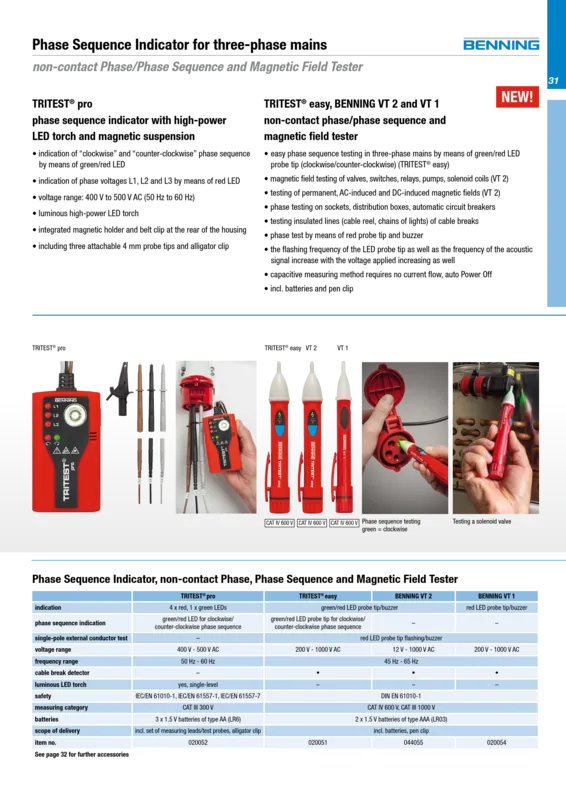
The Benning TRITEST® easy is a compact non-contact phase and phase-sequence tester designed for quick detection of live conductors and the rotational direction of three-phase networks. Lightweight and battery-powered, it senses alternating electric fields from approximately 200 V AC to 1,000 V AC (45–65 Hz) without requiring conductive contact, making it handy for electricians, installers and maintenance personnel who need a fast, portable verification tool.
Key features and how it works
The TRITEST® easy uses a probe tip with LED feedback (red/green) and acoustic signals to indicate presence and strength of an AC field. A blinking yellow LED confirms readiness for phase detection; a dedicated sequence-test mode uses additional LED logic to determine clockwise or counter-clockwise phase rotation. The device increases LED blink and buzzer rate with stronger fields, enabling intuitive assessment of proximity and signal strength. For insulated-cable tracing, run the probe along the insulation from the feed toward the load to localize breaks or faulty sections.
Operation is simple: press and hold the blue on/off button to power up, use the yellow LED readiness indicator, place the probe near the suspected conductor for phase detection, or activate the sequence test and follow the two-step probe contact routine to establish rotation direction. The TRITEST® easy features automatic power-off (approx. 5 minutes) to conserve battery.
Safety and usage notes
The tester is intended for qualified electricians and must be used only within its rated range (200–1,000 V AC) and in earthed circuits (overvoltage categories CAT III 1,000 V / CAT IV 600 V for phase-to-earth checks). It does not detect DC fields and is not a substitute for a two-pole voltage tester for proving absence of voltage. Factors such as distance, heavy insulation, shielding, protective clothing, poor mains quality, recessed contacts, or weak batteries can impair detection. Always hold the tool by the insulated red handle and never touch the white probe tip while testing.
Practical details
The unit runs on 2 × LR03/AAA micro cells, weighs about 40 g (with batteries), and measures roughly 153 × 20 × 25 mm. It’s rated IP53 for protection against dust and water spray and complies with relevant EN safety and EMC standards. Replace batteries when LEDs or tone weaken; remove batteries for long-term storage. Clean with a dry cloth and dispose of batteries and the device per local recycling rules.
Notes
- The TRITEST® easy detects only AC fields above ~200 V — lack of indication does not guarantee absence of dangerous voltage. Use a certified two-pole voltage tester to verify de-energized status.
- Ensure steady positioning during phase-sequence testing; a countercheck that changes sequence is required.
- Do not operate with the battery compartment open.
Search for 67,706 Manuals online


Type-in Brand or Model
Cristyn Ferrari
8 months ago
How reliable is the Benning TRITEST easy for daily non-contact voltage and phase rotation checks, and what battery life can I expect?
Manual.ly
8 months ago
The TRITEST easy is designed for quick, non-contact checks, but battery life depends on usage frequency and how long it is kept switched on or sensing. If you notice reduced function, constant beeping, or the device does not respond, first replace the batteries with a fresh set and ensure the battery cover is seated firmly and the contacts are clean. If the battery compartment is damaged or the unit continues to malfunction after new batteries, stop using it and contact support or your retailer for warranty service or replacement. For safety-critical troubleshooting or when you need full measurement confirmation, use the appropriate certified test equipment, as this tester is not a full 3-phase phase rotation instrument.