
Austria Email EKF Manual
PDF manual · 36 Pages
English



Quick check
Incorrect answer, please try again.
Chat with your Austria Email EKF manual using AI
Get instant AI answers from your Austria Email EKF manual
Ask anything about the Austria Email EKF. Answers come from this manual, with the pages they are based on.
EKF Maintenance Schedule
Lift or turn the safety valve test knob to the Test position to ensure water flows unhindered into the funnel. Ensure the valve closes after release.
Manually actuate the venting mechanism to prevent blockage by limescale and verify water escapes completely during heating cycles.
An authorized installer must check for permanent leaks or failure to open, attempting to clear foreign bodies or replacing the valve if damaged.
A professional must inspect the integrated sacrificial anode to maintain warranty eligibility and replace it if necessary.
In areas with hard water, a professional must remove limescale from the internal tank via the flange opening without using descaling pumps.
Free maintenance reminders
Timed to your purchase date. Always free, unsubscribe anytime.
Ask a Question
Do you recommend EKF?
Yes NoFrequently Asked Questions
The EKF series is offered in four nominal tank volumes: 70 L, 100 L, 120 L and 150 L, covering small to larger household hot-water demands.
Is this answer helpful?
No. Installation, plumbing connections, electrical wiring and initial commissioning must be performed by qualified, licensed specialists to comply with safety standards and warranty conditions.
Is this answer helpful?
The manufacturer recommends the middle position (~65 °C) as a balance between energy efficiency, hygiene and reduced limescale. The thermostat can be restricted to a maximum of 65 °C to prevent accidental scalding.
Is this answer helpful?
Measured standby energy consumption at 65 °C over 24 hours is approximately: 70 L = 1.08 kWh, 100 L = 1.23 kWh, 120 L = 1.48 kWh, 150 L = 1.79 kWh, depending on model and insulation quality.
Is this answer helpful?
Regular maintenance includes monthly safety-valve checks, professional anode inspection every 2 years, and descaling/cleaning by a technician every 1–2 years in hard-water areas. Use only original spare parts to preserve warranty.
Is this answer helpful?
Pressure-tight installation requires a tested membrane safety-valve or safety-valve combination (shut-off, test, non-return, drain and safety valve) and proper drainage for expansion water. No shut-off valve may be placed between the safety valve and cold-water inlet.
Is this answer helpful?
A residual-current device (RCD) with tripping current IΔn ≤ 30 mA must be installed upstream. An all-pole disconnect with 3 mm contact opening is required in the supply line and the factory wiring must not be altered except per documented rewiring options by a qualified electrician.
Is this answer helpful?
Advantages and Disadvantages
Advantages

- Low standby energy consumption due to high-quality CFC-free PU foam insulation.
- Straightforward front-panel controls: thermostat knob, remote thermometer, and indicator lamp.
- Multiple capacity options (70–150 L) to suit household hot-water needs.
- Safety features include temperature limiter (110 °C) and mandatory membrane safety-valve connection.
- Flexible electrical wiring options for 230 V single-phase and 3~400 V three-phase in larger models.
Disadvantages

- Installation and initial commissioning require licensed professionals—no DIY allowed.
- Periodic professional maintenance needed (anode check, scale removal) to retain warranty.
- Sensitive to water quality; minimum conductivity and filtration recommended to avoid corrosion.
- Warranty voided by improper connections, mixed-metal installations or non-original parts.
- Temperature accuracy limited by thermostat hysteresis and piping losses (±10 K possible).
Product Specification
Energy efficiency class
C
Rated power
2kW (230V)
Temperature control
50-185°F
Design
closed (pressure resistant)
Mounting type
Wall mounting
Connection
1/2"
Special features
Frost protection
Noise level
15dB(A)
Product Description
Austria Email Flat-Tank Water Heater EKF — Manual Overview
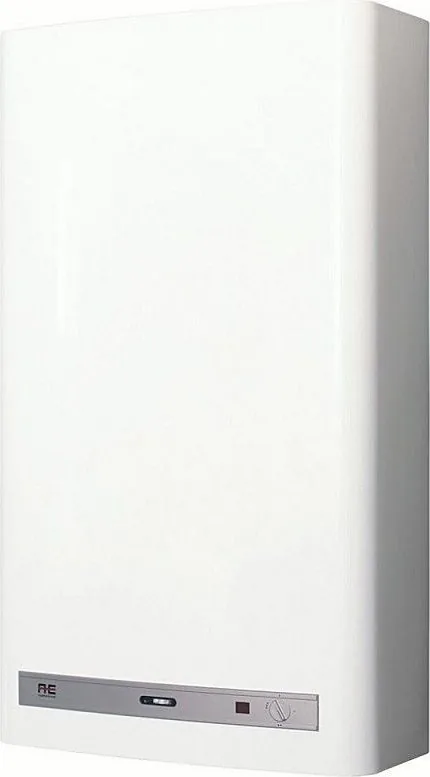
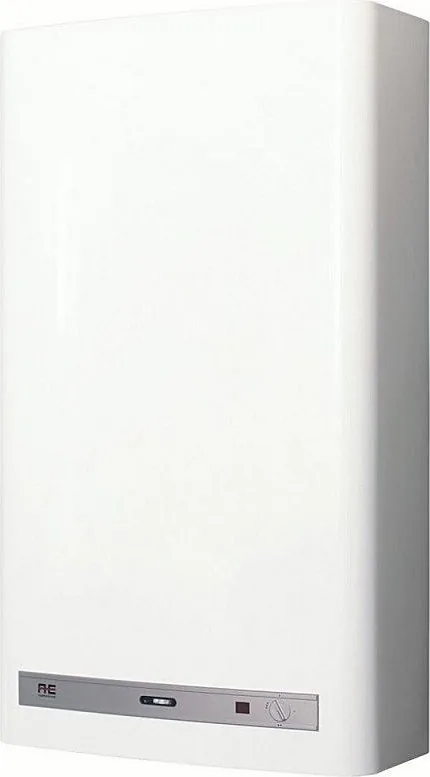
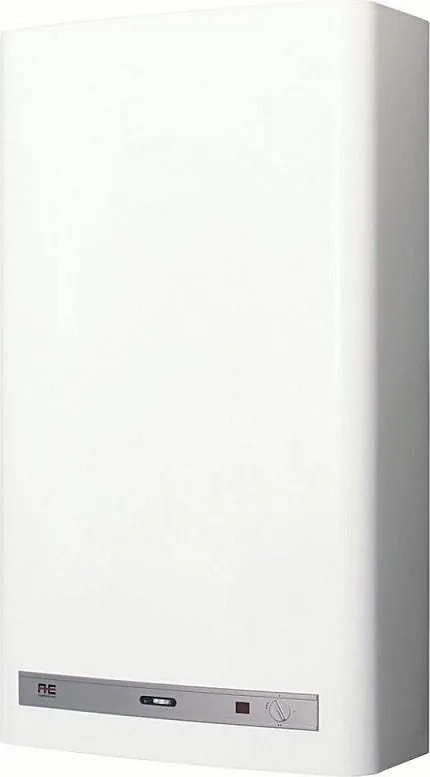
The Austria Email Flat-Tank Water Heater EKF is a compact, wall-mountable electric storage tank designed for domestic hot water supply. Engineered with an enamelled internal boiler and CFC-free PU foam insulation, the EKF series (70, 100, 120, 150 L) balances efficient heat retention with straightforward operation. A front control panel houses the thermostat knob, remote thermometer and heating indicator lamp for easy monitoring and adjustment.
Key features and operation
The heater warms potable water via an electric immersion heater and maintains temperature using an adjustable thermostat with four marked positions: frost protection (~30 °C), hand-warm (~40 °C), recommended economical position (~65 °C) and high temperature (~85 °C). The thermostat includes hysteresis (~±7 K), and the temperature readout can vary by ±10 K due to piping losses. Standby energy consumption is low thanks to high-quality PU insulation; measured 24h standby losses at 65 °C are 1.08–1.79 kWh depending on capacity.
The EKF supports multiple wiring/heat-up configurations (single- and three-phase for larger models) and includes factory-set 6‑hour heat-up wiring for 230 V. Safety features include a safety temperature limiter (cuts off at 110 °C), mandatory membrane safety valve combination for pressure-tight connection, and a requirement for a residual-current device (IΔn ≤ 30 mA) upstream of the circuit. Installation, electrical connection and first commissioning must be performed by qualified professionals.
Practical guidance
Choose the tank capacity based on household hot water needs (guideline tables included: baths, showers, dishwashing, etc.). For energy savings and reduced scale, set the thermostat only as high as required — 65 °C is recommended as a balance between hygiene, energy use and limescale control. In hard-water areas, consider pre-filtration or limiting max temperature to 65 °C. Routine maintenance includes periodic safety valve testing, inspection/replacement of the sacrificial anode every two years, and scale removal by a professional every 1–2 years if required.
Installation and safety notes
Mount vertically using the supplied wall rail or place on level floor supports where applicable; account for filled weight. The tank must be installed in frost-free, accessible locations with appropriate drain arrangements for safety-valve discharge. Factory wiring must not be altered except via specified rewiring options by qualified technicians. Use original spare parts and follow local codes and manufacturer instructions to maintain warranty.
Notes
- Models: EKF-70, EKF-100, EKF-120, EKF-150
- Standby kWh/24h (65 °C): 70L=1.08; 100L=1.23; 120L=1.48; 150L=1.79
- Service: electrical and plumbing work must be by licensed specialists
- Warranty contingent on correct installation, documented anode checks, and use of original parts
Search for 67,706 Manuals online


Type-in Brand or Model