
ASRock Rack X570 Manual
PDF manual · 26 Pages
English



Quick check
Incorrect answer, please try again.
Chat with your ASRock Rack X570 manual using AI
Get instant AI answers from your ASRock Rack X570 manual
Ask anything about the ASRock Rack X570. Answers come from this manual, with the pages they are based on.
Ask a Question
Do you recommend Rack X570?
Yes NoFrequently Asked Questions
This motherboard uses a Mini ITX form factor with dimensions of 6.7 inches by 6.7 inches or 17.02 cm by 17.02 cm.
Is this answer helpful?
It supports AMD Ryzen 3rd Generation Series Processors. The TDP is a maximum of 105W.
Is this answer helpful?
There are four 260-pin DDR4 SO-DIMM slots available for memory expansion.
Is this answer helpful?
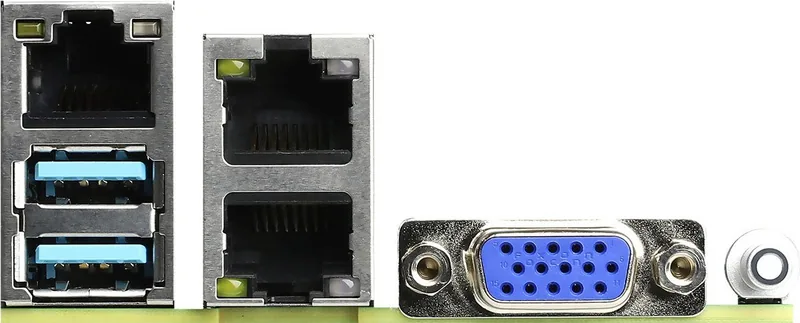
Yes, it features an ASPEED AST2500 controller with 16MB DDR4 VRAM and a D-Sub VGA port.
Is this answer helpful?
Yes, the ASRock Rack Instant Flash utility allows BIOS updates using a USB flash drive directly from POST.
Is this answer helpful?
It includes 2x OCuLink, one M.2 socket for NGFF 2280, and SATA ports for standard drives.
Is this answer helpful?
Yes, it supports various Linux distributions including RedHat Enterprise, SUSE, and Ubuntu versions.
Is this answer helpful?
Advantages and Disadvantages
Advantages

- Dual 10G Base-T LAN ports provide high-speed networking capability for data centers.
- Mini ITX form factor allows deployment in compact server chassis efficiently.
- Integrated IPMI and BMC enable comprehensive remote server management tools.
- Supports AMD Ryzen 3rd Gen processors for high performance computing tasks.
- ASRock Rack Instant Flash allows BIOS updates without entering an operating system.
Disadvantages

- Single PCIe expansion slot limits total card expansion options significantly.
- Requires DDR4 SO-DIMM modules which are different from standard server RAM.
- OCuLink connectors require specific cables which are less common.
- Memory capacity is capped by SO-DIMM slot specifications and limits.
- Specific thermal management is needed for dense deployment environments.
Product Specification
Socket
AMD AM4
Chipset
AMD X570
Header Lighting
N/A
Audio
N/A
Graphics
ASPEED AST2500 - Onboard
Wireless
N/A
RAID Level
0/1/10 (X570)
Multi-GPU
N/A
Lighting
N/A
BIOS
1x 32MB (256Mb)
USB Layout
Left
Product Description
ASRock Rack X570 Server Powerhouse
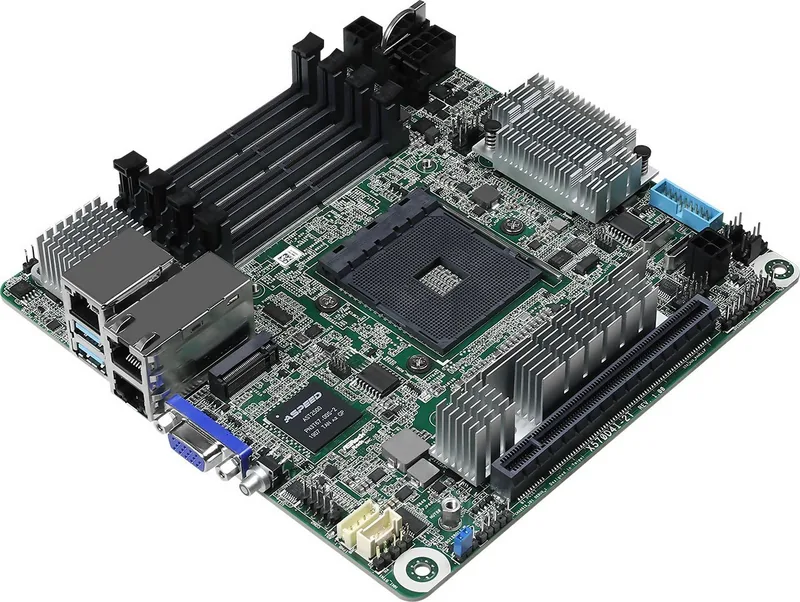
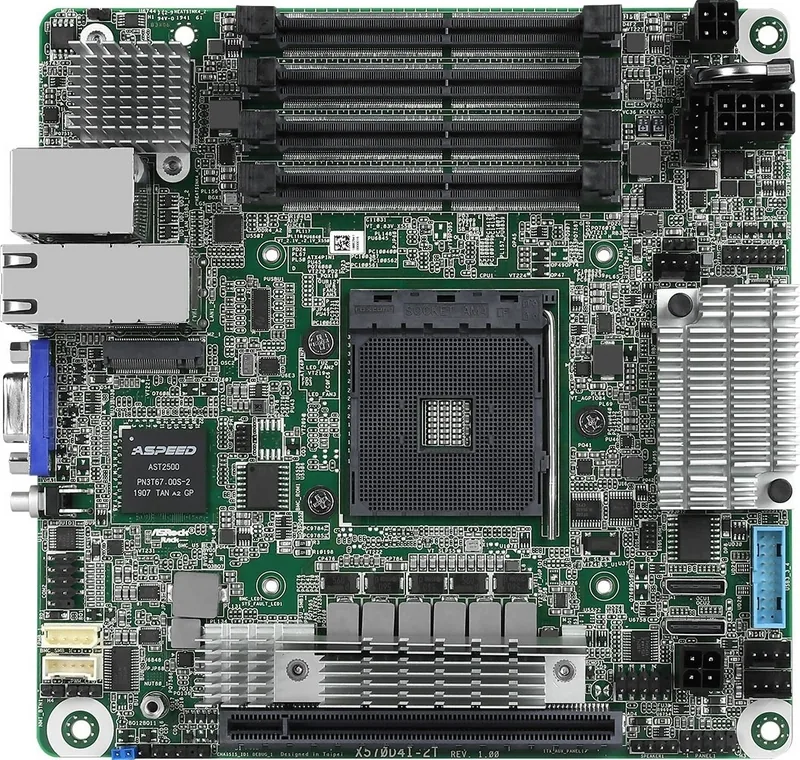
The ASRock Rack X570D4I-2T represents a significant leap in Mini ITX server design. Compact yet powerful, this board utilizes the AMD X570 chipset to deliver robust performance suitable for enterprise environments. It supports AMD Ryzen 3rd Generation Processors, ensuring high compute efficiency for demanding applications. The motherboard is built for endurance, featuring stringent quality control standards typical of ASRock Rack products. While the ASRock Rack X570 Manual provides step-by-step installation details, this summary covers the critical specifications regarding hardware capabilities and performance benchmarks for users seeking reliable infrastructure.
Connectivity remains a strong focus for this chassis, targeting modern networking standards. Users benefit from dual 10G Base-T LAN ports powered by Intel X550-AT2 chips. These ports support teaming operations, which can double transmission bandwidth for critical data transfers. An additional dedicated IPMI LAN port facilitates remote management without impacting network traffic on the primary connections. Storage options include an OCuLink connector for high-speed NVMe or SATA drives. There is also a versatile M.2 socket supporting Gen4 PCIe speeds up to 64 Gb/s for SSDs.
Management tools are embedded directly into the hardware to simplify administration. The ASPEED AST2500 controller enables a full suite of out-of-band management features for remote operations. Administrators can monitor fan speeds, voltages, and temperatures in real-time via the BMC interface. This capability simplifies maintenance in clustered server setups and ensures system health is maintained proactively. The board also includes ASRock Rack Instant Flash for BIOS updates without requiring an OS, streamlining the maintenance cycle significantly.
System reliability is further enhanced through comprehensive hardware monitoring features. The board measures CPU, PCH, DDR, LAN, and storage temperatures to prevent overheating issues. Voltage monitoring tracks critical rails like VCPU and VSOC to ensure stable power delivery. Supported operating systems include various Windows Server versions and several Linux distributions. This extensive compatibility ensures the platform fits diverse deployment needs ranging from virtualization to traditional enterprise tasks.
Memory expansion utilizes four DDR4 SO-DIMM slots supporting dual channel technology. It allows up to 32GB per DIMM, enabling a substantial total capacity. Expansion slots feature a single PCIe 4.0 or 3.0 x16 slot for graphics or network cards. This flexibility allows users to upgrade the system as needs evolve. The board design prioritizes airflow and thermal efficiency to handle high workloads continuously.
Installation requires careful handling of static electricity and component alignment to avoid damage. Ensure the power supply is disconnected during hardware assembly to prevent physical injury or component destruction. The Mini ITX form factor measures 6.7 by 6.7 inches, fitting into compact server cases while maintaining full functionality. Screw holes must be aligned correctly to secure the board without over-tightening. For enthusiasts and professionals alike, this platform balances size with high-end specs necessary for modern data centers.
Technical Notes
Remember to check the supported CPU list on the official website. The M.2 slot supports both SATA and PCIe options. Power connectors require an ATX 12V cable for stability. The IPMI LAN port is reserved for management use.
Search for 67,706 Manuals online


Type-in Brand or Model