
ASRock Apollo Lake Manual
PDF manual · 53 Pages
English



Quick check
Incorrect answer, please try again.
Chat with your ASRock Apollo Lake manual using AI
Get instant AI answers from your ASRock Apollo Lake manual
Ask anything about the ASRock Apollo Lake. Answers come from this manual, with the pages they are based on.
Ask a Question
Do you recommend Apollo Lake?
Yes NoFrequently Asked Questions
It is best for compact desktops, office machines, lightweight media PCs, and embedded or legacy-focused systems. Its low-power Apollo Lake platform and rich I/O make it practical for stable, everyday use.
Is this answer helpful?
The board is offered in J3455 and J3355 variants, using Intel Apollo Lake processors. The J3455B-ITX uses a quad-core J3455, while the J3355B-ITX uses a dual-core J3355.
Is this answer helpful?
It supports up to 16GB of DDR3/DDR3L memory through two SO-DIMM slots. It is designed for non-ECC, unbuffered modules, and 2GB DRAM modules are not supported.
Is this answer helpful?
Yes. It provides HDMI and D-Sub outputs with independent display controllers, so users can run two screens at once. HDMI also supports up to 4K resolution, depending on the display setup.
Is this answer helpful?
The motherboard includes two SATA3 6.0 Gb/s connectors. They support common storage modes such as AHCI, NCQ, and hot plug, making it easy to connect SSDs or hard drives.
Is this answer helpful?
Yes. It includes PS/2, serial, and parallel ports, which is useful for older keyboards, mice, printers, and specialized business or industrial devices.
Is this answer helpful?
It offers UEFI setup, fan and temperature monitoring, boot and security controls, and update tools like Instant Flash and Internet Flash. These features help keep the system easy to maintain.
Is this answer helpful?
Advantages and Disadvantages
Advantages

- Compact Mini-ITX design fits small cases and streamlined builds without sacrificing core connectivity.
- HDMI and D-Sub outputs support dual displays, with HDMI capable of 4K playback for media-friendly setups.
- Legacy ports such as PS/2, serial, and parallel expand compatibility with older equipment and industrial gear.
- UEFI tools, fan control, Wake-on-LAN, TPM support, and hardware monitoring improve manageability and security.
Disadvantages

- Maximum memory is limited to 16GB, so it is not intended for heavy multitasking or demanding workloads.
- Only two SATA3 connectors are available, which restricts internal storage expansion.
- The platform uses DDR3/DDR3L SO-DIMM memory, which is older than current desktop memory standards.
- PCIe expansion is limited, and the onboard graphics are designed for efficiency rather than high-end gaming.
Product Specification
Chipset
System-on-Chip (SoC)
Cooling Header
1x CPU Fan 3-Pin, 1x Fan 3-Pin
Lighting Header
N/A
Wireless
N/A
RAID Level
N/A
Multi-GPU
Multi-GPU
Power Connectors
1x 24-Pin ATX
Lighting
N/A
Special Features
Audio+solid capacitors, passively cooled
USB Specification
Link
Product Description
ASRock Apollo Lake Mini-ITX Motherboard Overview
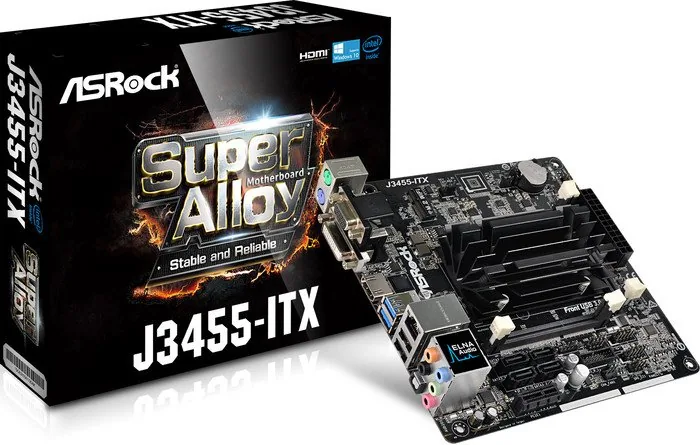
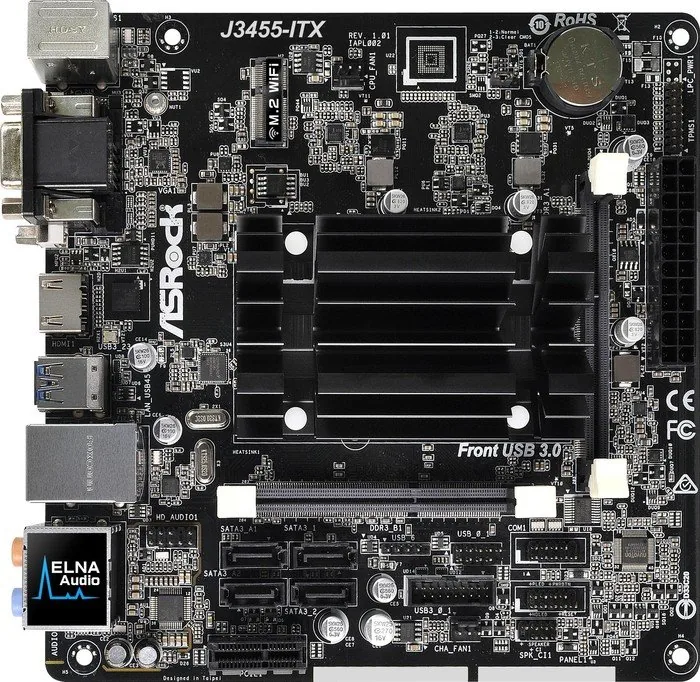
The ASRock Apollo Lake family, represented by the J3455B-ITX and J3355B-ITX boards, is built for compact systems that still need dependable everyday performance. Powered by Intel Apollo Lake processors, these motherboards are aimed at small desktops, office PCs, media players, and embedded-style builds where space, stability, and low power use matter as much as raw speed. The ASRock Apollo Lake Manual reflects that practical focus by covering everything from layout and installation to BIOS tuning and driver management.
One of the biggest strengths is versatility. The boards support dual-channel DDR3/DDR3L SO-DIMM memory up to 16GB, giving enough room for light multitasking, productivity work, and home entertainment. Graphics are handled by integrated Intel HD Graphics 500, with HDMI and D-Sub outputs for dual-display setups. HDMI can reach 4K resolution, which makes the platform a smart fit for sharp video playback and modern monitor use.
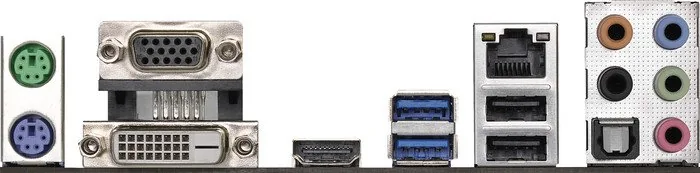
Connectivity is another highlight. The rear panel includes USB 3.0, USB 2.0, legacy PS/2 ports, serial and parallel connectors, HDMI, VGA, and Gigabit LAN. That mix is especially appealing for users who still rely on older peripherals, industrial devices, or point-of-sale equipment. Storage support is straightforward but useful, with two SATA3 ports for SSDs or hard drives. A PCI Express slot also leaves room for expansion when a specialized card is needed.
Audio and firmware features round out the experience. The onboard Realtek codec delivers 7.1-channel HD audio, while ASRock's UEFI tools provide fan control, power options, security settings, and convenient update paths. Features like Wake-on-LAN, TPM support, and hardware monitoring make the board feel ready for long-term, low-maintenance use. It is not a flashy board, but it is a capable one.
For builders, the Mini-ITX layout keeps cases tidy and efficient. The solid capacitor design, protective features, and support for system monitoring add confidence for builds that are expected to run for long hours. It is a strong choice for users who want a compact platform with a thoughtful mix of modern output options and legacy compatibility.
Notes
- Best suited for compact, efficient systems
- Ideal for users needing legacy I/O and stable operation
- Check memory compatibility before buying modules
- BIOS settings offer strong control over power and boot behavior
Search for 67,706 Manuals online


Type-in Brand or Model