
ARKA myAQUA 190/380 Manual
PDF manual · 16 Pages
English



Quick check
Incorrect answer, please try again.
Chat with your ARKA myAQUA 190/380 manual using AI
Get instant AI answers from your ARKA myAQUA 190/380 manual
Ask anything about the ARKA myAQUA 190/380. Answers come from this manual, with the pages they are based on.
myAQUA 190/380 Maintenance Schedule
Use the integrated flush valve for 5 minutes to prevent limescale and dirt accumulation on the membrane.
Thoroughly rinse both the fine filter and carbon filter before connecting them to the membrane housing.
If the unit is not used for more than 2 weeks, rinse it for 30-60 minutes before using again.
Ask a Question
Do you recommend myAQUA 190/380?
Yes NoFrequently Asked Questions
The ARKA myAQUA® 190 produces up to 190 liters per 24 hours and the ARKA myAQUA® 380 up to 380 liters per 24 hours under recommended conditions (cold water and sufficient pressure).
Is this answer helpful?
A minimum feed pressure of 3 bar is recommended. The system reaches nominal capacity around 4 bar. Pressures below 3 bar reduce pure water output; below 2 bar, retention rates may also decline.
Is this answer helpful?
Flush the system regularly (a 5-minute rinse after each use is recommended), replace prefilters and membrane per indicated intervals, rinse new cartridges before installation, and perform a 30–60 minute flush after inactivity longer than two weeks.
Is this answer helpful?
No. Only connect to cold water with temperatures up to 30°C. Hot water can damage the membrane, cause premature wear and lower retention performance.
Is this answer helpful?
Yes. Resin filters (RF300, RF500) and a multi-filter (MF500) are available as an optional fourth stage to reduce silicates, nitrates and other dissolved solids (TDS).
Is this answer helpful?
Typical wastewater ratio is about 1:3–4 (one part pure water to three or four parts waste). Actual efficiency depends on feed pressure and installation specifics.
Is this answer helpful?
Thoroughly rinse the fine and carbon prefilters, run the system for 30–60 minutes to flush out the membrane preservative, and discard that initial output to the drain before collecting osmosis water.
Is this answer helpful?
Advantages and Disadvantages
Advantages

- High rejection rates: removes up to 98–99% of salts, pollutants and bacteria.
- Simple maintenance: integrated flush valve and easy cartridge replacement.
- Good capacity: 190 L and 380 L per day models for hobby and small pro setups.
- Compact aquarium-focused design with included mounting hardware.
- Expandable with optional resin/multi-filters for advanced TDS reduction.
Disadvantages

- Requires minimum 3 bar water pressure for rated performance.
- Only cold-water connection allowed (max 30°C).
- Initial membrane purge wastes 30–60 minutes of water.
- Waste water ratio around 1:3–4 reduces overall efficiency.
- Some tap adapters may not be included and need purchase.
Product Specification
Suitability
Freshwater, Seawater
Product Description
ARKA myAQUA Osmoseanlage Manual — ARKA myAQUA® 190/380
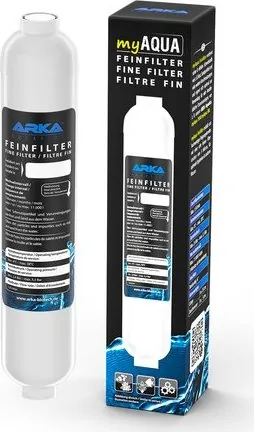
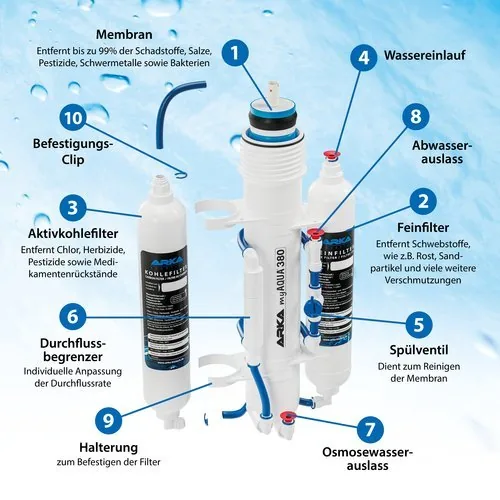
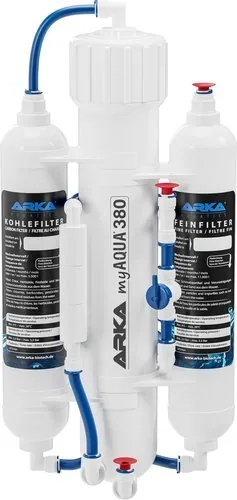
The ARKA myAQUA Osmoseanlage Manual introduces the ARKA myAQUA® 190 and 380 reverse osmosis systems designed for aquarium use. These compact units filter up to 98–99% of salts, pollutants, bacteria and heavy metals using a three-stage filtration process: a 5-micron fine filter, an activated carbon filter, and an ultrafine TFM polyamide/polysulfone membrane. With daily output ratings of up to 190 L and 380 L respectively, the systems are suited for hobbyists and small professional setups that require highly purified water.
Product overview and features
The system relies on household water pressure (recommended 3–8 bar) to push tap water through the prefilters and membrane. A flow limiter maintains the waste-to-pure-water ratio at about 1:3–4. The included flushing valve allows easy membrane cleaning and routine rinsing. Temperature operating range is 1–30°C; the membrane’s pore size is 0.0001 micron, ensuring removal of microscopic contaminants. Scope of delivery includes membrane and housing, filter cartridges, tubing, brackets and basic connectors.
Installation and use
Mount the supplied wall brackets, install the membrane in the housing following flow direction markers, and securely connect provided tubing using the push-fit fittings and blue safety clips. Before first use, thoroughly rinse the fine and carbon filters and run the unit for 30–60 minutes to purge membrane preservative; discard initial effluent. Connect only to cold water (max 30°C) and ensure minimum water pressure of 3 bar for proper performance. Route both permeate and waste to a drain during setup and testing.
Maintenance and optional upgrades
Maintenance is straightforward: regular flushing (a recommended 5-minute flush after each use) prevents scale and fouling. Replace prefilters and membrane per indicated intervals; always rinse new cartridges before installation. Protect the membrane from drying and freezing. If unused for more than two weeks, flush for 30–60 minutes prior to reactivation. Optional resin or multi-filters can be added as a fourth stage to reduce silicates, nitrates and residual TDS.
Notes
- Ensure correct water pressure (3–8 bar) and cold-water connection only.
- Discard the first flush water after membrane installation for 30–60 minutes.
- Protect membrane from freezing or drying.
- Optional resin filters available (RF300, RF500) and a multi-filter MF500.
Pros and Cons
Pros:
- High rejection rates: up to 98–99% salt and contaminant removal.
- Simple maintenance: integrated flush valve and easy cartridge changes.
- Decent capacity: models produce up to 190 L or 380 L per day.
- Compact and aquarium-focused design with included mounting hardware.
- Expandable: optional resin/multi-filters for advanced TDS reduction.
Cons:
- Requires minimum 3 bar water pressure for rated performance.
- Not suitable for hot water supply (max 30°C only).
- Initial membrane purge wastes 30–60 minutes of water.
- Produces waste water at a 1:3–4 ratio (consumption vs. waste).
- Some adapters for tap connection may not be included.
Top results / key takeaways
- Filtration effectiveness: Removes up to 98–99% of salts, pollutants, bacteria and heavy metals; suitable for both freshwater and marine aquaria.
- Flow & capacity: ARKA myAQUA® 190 and 380 deliver up to 190 L and 380 L per day, with a waste-to-pure ratio around 1:3–4.
- Operating requirements: Requires cold water only (≤30°C) and recommended water pressure ≥3 bar for rated output.
- Maintenance routine: Regular 5-minute flush after use, rinse new cartridges, and 30–60 minute flush after prolonged inactivity.
- Upgrade path: Optional resin and multi-filters (RF300, RF500, MF500) provide extra TDS, silicate and nitrate reduction.
FAQ
-
Question: What daily output can I expect from ARKA myAQUA models? Answer: The ARKA myAQUA® 190 supplies up to 190 L/24h and the 380 up to 380 L/24h under recommended conditions (cold water, adequate pressure).
-
Question: What water pressure is needed for proper operation? Answer: A minimum of 3 bar is required; the unit reaches nominal capacity at about 4 bar. Pressures below 2–3 bar reduce output and retention performance.
-
Question: How often should I flush or maintain the system? Answer: Flush for about 5 minutes after each use to avoid fouling. Replace prefilters and membrane per manufacturer intervals, rinse replacements before installing, and if unused over 2 weeks, flush 30–60 minutes before use.
-
Question: Can I connect the system to hot water or outdoor taps? Answer: No — only cold water up to 30°C. Hot water can damage the membrane and reduce retention rates.
-
Question: What additional filters are available and why add them? Answer: Optional resin filters (RF300, RF500) and a multi-filter (MF500) can be added as a fourth stage to remove silicates, nitrates and lower TDS levels for sensitive aquarium environments.
-
Question: Is a lot of water wasted during filtration? Answer: The unit typically wastes water at a ratio of about 1:3–4 (pure:waste). Efficiency depends on feed pressure and system configuration.
-
Question: What should I do before first use? Answer: Thoroughly rinse the fine and carbon filters, run the system 30–60 minutes to flush membrane preservative, and discard that initial output to drain.
Search for 67,706 Manuals online


Type-in Brand or Model