
Alpitronic Hypercharger HYC_50 Manual
PDF manual · 76 Pages
English



Quick check
Incorrect answer, please try again.
Chat with your Alpitronic Hypercharger HYC_50 manual using AI
Get instant AI answers from your Alpitronic Hypercharger HYC_50 manual
Ask anything about the Alpitronic Hypercharger HYC_50. Answers come from this manual, with the pages they are based on.
Hypercharger HYC_50 Maintenance Schedule
Periodically check the plug contacts for contamination or traces of burns.
Turn the main switch from On to Off and test the secondary side voltage-free.
With the station off, check resistance between supply earth and all accessible non-insulated parts.
Ensure the interior is clean with no condensation, check plug holders and seals for damage.
Randomly or completely test tightening torques on terminals and mechanical screw connections.
Replace the air filter inserts regularly to maintain proper ventilation.
Free maintenance reminders
Timed to your purchase date. Always free, unsubscribe anytime.
Ask a Question
Do you recommend Hypercharger HYC_50?
Yes NoFrequently Asked Questions
The HYC_50 delivers up to 50 kW using two 25 kW power modules; power can be supplied via one outlet or shared between two outlets, limited by a nominal device current of 90 A and the cable/vehicle limits.
Is this answer helpful?
Supported interfaces include CCS1/2, CHAdeMO and GB/T. Available outlet combinations depend on configuration and market; some pairings are not supported. Consult configuration tables when ordering to ensure the desired outlet combination.
Is this answer helpful?
Installers must provide proper protective earthing and an RCD Type B (or B+) where residual DC currents exceed 6 mA; a recommended residual current rating is IΔN = 300 mA. Follow local regulations and ensure correct protective devices, cable cross-sections and grounding.
Is this answer helpful?
Authentication options include RFID/NFC cards, contactless credit card terminal (optional), backend/app remote start via OCPP, vehicle-based Plug & Charge or auto-charge (vehicle identification). Kiosk mode can allow sessions without authentication if enabled.
Is this answer helpful?
Regular maintenance includes plug contact inspections, air filter replacement, screw torque checks, main switch testing and protective measure verification. Typical intervals are half-yearly to yearly depending on the item (e.g., air filters yearly, plug checks every 6 months).
Is this answer helpful?
Yes. The unit is rated IP55 and IK10 for outdoor use. Storage ranges from -40 °C to +55 °C; operating range is -30 °C to +40 °C (derating up to +55 °C). Ensure airflow clearance and avoid reintroducing exhaust air into intake paths.
Is this answer helpful?
Technicians can access a diagnostic web interface (default IP 192.168.1.100) or use Ethernet/mobile network connectivity. The station supports OCPP for backend integration, remote start/stop and parameter updates; service access is protected and intended for qualified personnel.
Is this answer helpful?
Advantages and Disadvantages
Advantages

- Modular 2x25 kW architecture enabling up to 50 kW and easy serviceability.
- Supports multiple DC interfaces (CCS, CHAdeMO, GB/T) and simultaneous dual-vehicle charging.
- Rugged IP55/IK10 enclosure for indoor/outdoor use across wide temperature range.
- Integrated surge protection (Type 1+2+3) and OCPP/backend compatibility for remote control.
- Optional contactless payment and customizable branding for deployment flexibility.
Disadvantages

- Nominal current limited to 90 A which can constrain peak power on some configurations.
- Requires trained technicians for installation and repairs; not suitable for DIY installation.
- Outer supply cable diameter must be 24–35 mm, limiting certain supply cable choices.
- Residual DC leakage requires Type B/B+ RCD and appropriate earthing, adding installation cost.
- CHAdeMO and some special configurations limited to specific outlet combinations.
Product Specification
Charging Mode
IEC 61851-1 (Mode 4)
Number of Phases
3-phase
Voltage
150-1000V (DC)
Connector Type
Type 2, CCS2, CHAdeMo
Authorization
App, QR Code, RFID
Special Features
Display, Touchscreen, Residual Current Device, Energy meter calibrated and certified (MID)
Color
grey
Product Description
Alpitronic Hypercharger — Powerful, Flexible EV Fast Charging
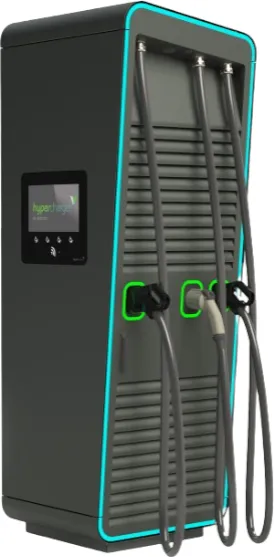
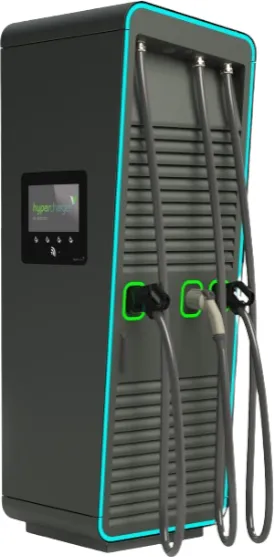
The Alpitronic Hypercharger HYC_50 is a compact DC fast charging station designed for robust public and private installations. Built to deliver up to 50 kW via modular 2x25 kW power units, the HYC_50 supports one or two DC outlets (CCS, CHAdeMO, GB/T depending on configuration) and allows simultaneous charging of two vehicles while keeping galvanic isolation between mains and vehicles. Its IP55-rated, IK10 enclosure and operational range from -30 °C to +40 °C (with derating up to +55 °C) make it suitable for indoor and outdoor use.
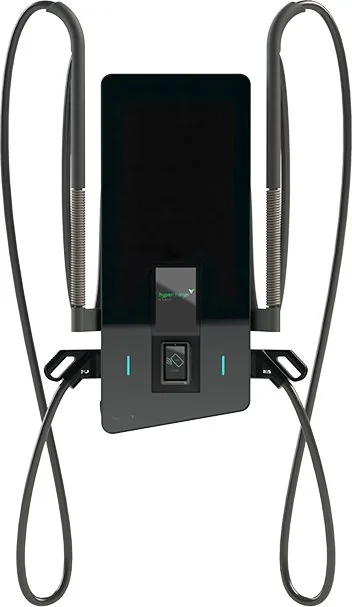
The unit offers flexible mounting options (wall or stand), standard cable lengths (2.7 m or optional 4.45 m with cable management) and customization of the front bezel for branding. It includes a touchscreen HMI, optional contactless credit-card terminal, RFID/NFC reader for user authentication, Ethernet diagnostics, and OCPP-compatible backend integration for remote start/stop and load management. Safety and maintainability are emphasized through modular replaceable power modules, front-access service hatch with door contacts, clear maintenance intervals, and integrated surge protection (Type 1+2+3).
Installation is engineered for professional electricians: the HYC_50 requires proper mechanical anchoring (M12 bolts or recommended anchors), supply cables with 25–50 mm² conductors, and a protective earth rated per local requirements. The unit supports TT and TN networks but requires RCD Type B (or B+) when residual DC currents may occur; recommended residual current rating is 300 mA. A five-minute discharge wait is required after power-off before accessing high-voltage components. Diagnostics and parameterization are available through a web interface at the default IP 192.168.1.100.
Operationally, users authenticate via RFID/NFC, credit card, app/backend remote start, or vehicle-based Plug & Charge. The touchscreen guides plug selection and shows real-time charging metrics — voltage, current, power, state of charge, energy delivered, and session time. Dual-outlet management allows dynamic parallel charging with power sharing based on cable/vehicle capabilities and temperature sensors to prevent overheating.
Maintenance and service are simplified: periodic checks cover plug contacts, air filters, screw torque, main switch function, protective measures and overvoltage protection status. The modular design allows trained technicians to replace power modules or components safely following the prescribed safety and ESD procedures. Disposal follows WEEE directives and separate collection of electronic waste and packaging.
Notes:
- Standard configuration: 50 kW (2x25 kW), nominal current limited to 90 A.
- Charging interfaces: CCS1/2, CHAdeMO, GB/T (combinations vary by outlet and market).
- Safety: IP55, IK10, integrated SPD, recommended RCD Type B/B+ (IΔN=300 mA).
- Environmental: -40 °C…+55 °C storage; operation -30 °C…+40 °C (derating above +40 °C).
Short operational tips
- Observe the 5-minute HV discharge time after power-off before servicing.
- Use only approved cables and avoid adapters or Y-cables.
- Ensure correct earthing and RCD selection per local rules.
- Follow prescribed maintenance intervals (filters, plug inspections, torque checks).
Search for 67,706 Manuals online


Type-in Brand or Model