
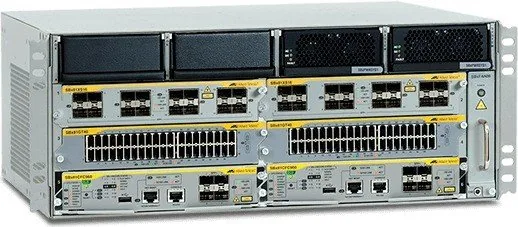
Allied Telesis SwitchBlade x8100 Manual
PDF manual · 25 Pages
English



Quick check
Incorrect answer, please try again.
Chat with your Allied Telesis SwitchBlade x8100 manual using AI
Get instant AI answers from your Allied Telesis SwitchBlade x8100 manual
Ask anything about the Allied Telesis SwitchBlade x8100. Answers come from this manual, with the pages they are based on.
Ask a Question
Do you recommend SwitchBlade x8100?
Yes NoFrequently Asked Questions
It is designed as a modular enterprise switch chassis for building high-availability Layer 3+ networks. It supports flexible line cards, redundant control, and scalable uplinks for core and aggregation roles.
Is this answer helpful?
It uses redundant control options, load-sharing power supplies, passive backplane design, and hot-swappable hardware. These features help keep the network running during maintenance or component failure.
Is this answer helpful?
Both are controller fabric cards, but the CFC960 is the higher-capacity option. It supports more advanced scaling and can provide greater backplane bandwidth when used with compatible line cards.
Is this answer helpful?
Yes. With the correct PoE line cards and power supplies, the chassis can deliver PoE and PoE+ for devices such as IP phones, cameras, and wireless endpoints, with power budgeting per port.
Is this answer helpful?
VCStack Plus can combine two chassis into one virtual unit. This creates a resilient core with simplified management, strong failover behavior, and the ability to place chassis apart for distributed designs.
Is this answer helpful?
Yes. The master controller distributes software and keeps cards synchronized. The platform also supports AlliedWare Plus management and can integrate with AMF for automation, backup, and recovery.
Is this answer helpful?
Advantages and Disadvantages
Advantages

- Modular chassis design supports mixed line-card deployments and future expansion.
- Dual controller support improves uptime and enables near hitless failover.
- Hot-swappable PSUs, fans, and cards help reduce maintenance disruption.
- VCStack Plus and AMF features simplify resilient core and centralized management.
Disadvantages

- Requires careful planning because card placement and software matching matter.
- Advanced architecture may be more complex than a fixed-port switch to deploy.
- PoE and control modules must be installed in the correct bays to operate properly.
- Higher-capacity setups can demand more power, cooling, and rack planning.
Product Specification
Function
Switch, Empty Enclosure
Type
Standalone, Rackmount (via mounting brackets), with module slot
Network connections
6x Expansion slots
Speeds
6x Expansion slots (10Gb/s x16)
Cooling
active, 1x preparation for fan module
Dimensions (WxHxD)
18.90x6.93x15.28in, 4U
Weight
31.75lbs
Color
light gray
Features
Metal housing, removable mounting brackets, firmware updates possible, redundant power supply, 4x power supply hot-plug capable, primary power supply not included
Product Description
Allied Telesis SwitchBlade x8100 Rackmount Switch Chassis: Built for High-Availability Networks
The Allied Telesis SwitchBlade x8100 Rackmount Switch Chassis, 6x Module Slot, 4U Manual highlights a modular core platform designed for enterprise environments that need speed, uptime, and room to grow. Rather than focusing on a fixed-port design, this chassis approach lets teams build a network around the traffic mix they actually have, whether that means copper, fiber, 10GbE, or PoE+ access.
A major strength of the SwitchBlade x8100 family is its resilience. Dual controller fabric cards, redundant power options, and hot-swappable components are all intended to keep the system running during maintenance or hardware changes. That makes it especially attractive for organizations where interruption is costly, such as campuses, data centers, and distributed business networks.
The platform also stands out for its internal architecture. Traffic is handled through a passive backplane and a distributed switching design, allowing line cards to process packets locally while sharing forwarding information across the chassis. This helps preserve wire-speed performance and supports advanced features like stacking, routing, and failover coordination. In practical terms, the chassis is engineered to keep data moving efficiently even as the network grows more complex.
Another key advantage is flexibility. The x8100 can be paired with different control cards, including the CFC400 and the more capable CFC960, giving administrators options based on scale and feature needs. With support for VCStack Plus, two chassis can operate as a single virtual unit, creating a powerful core with simplified management and strong disaster recovery potential.
For operations teams, the AlliedWare Plus software environment adds familiar CLI management plus web-based tools. Combined with AMF support, the chassis can fit into automated network workflows that reduce manual setup, streamline upgrades, and improve recovery times. In short, this is not just a switch chassis—it is a foundation for building a resilient, centrally managed network core.
Notes
- Best suited for medium to large enterprise networks
- Ideal where redundancy and modular expansion matter
- Useful for core, aggregation, and resilient distributed designs
Search for 67,732 Manuals online


Type-in Brand or Model