
ABB DLR/S 8.16.1M Manual
PDF manual · 220 Pages
English



Quick check
Incorrect answer, please try again.
Chat with your ABB DLR/S 8.16.1M manual using AI
Get instant AI answers from your ABB DLR/S 8.16.1M manual
Ask anything about the ABB DLR/S 8.16.1M. Answers come from this manual, with the pages they are based on.
DLR/S 8.16.1M Maintenance Schedule
If devices become dirty, clean them using a dry cloth or a cloth dampened with a soapy solution. Never use corrosive agents or solutions.
Operate lamps at 100% brightness for a recommended period (e.g., 20-100 hours) to ensure stable operating values and optimal service life before dimming is used.
Ask a Question
Do you recommend DLR/S 8.16.1M?
Yes NoFrequently Asked Questions
Up to sixty-four DALI devices can be connected to the single DALI output of this controller unit efficiently.
Is this answer helpful?
Yes, fourteen independent light scenes are supported and recallable via KNX telegrams for customized lighting scenarios.
Is this answer helpful?
Yes, manual operation is available via front panel buttons unless specifically disabled by a KNX parameter setting.
Is this answer helpful?
Yes, reaction to voltage failure is parameterizable to determine behavior when bus voltage drops unexpectedly.
Is this answer helpful?
Supported with customizable curves including pre-warning phases and basic brightness retention after activation.
Is this answer helpful?
Coded messages are sent via KNX communication objects to report lamp and ballast malfunctions clearly.
Is this answer helpful?
Advantages and Disadvantages
Advantages

- Supports up to 64 DALI devices across 16 lighting groups for scalable installation.
- Enables constant light control using integrated sensors for energy efficiency.
- Offers manual operation buttons for local device control and troubleshooting.
- Facilitates master-slave dimming setups with adjustable brightness offsets.
- Includes fourteen programmable light scenes accessible via KNX telegrams.
Disadvantages

- Requires dedicated software tool for DALI addressing and group assignment tasks.
- Overlapping lighting groups function is not supported by the controller unit.
- Configuration requires specific KNX interface hardware and ETS software access.
- Manual operation is disabled if blocked by specific communication object setting.
- Fault messages may take up to 45 seconds to reset upon remediation.
Product Specification
Type
Actuator
Standard
KNX
Function
Switch Actuator (on/off), Dimming Function
Topology
Bus
Dimensions
4.25 x 3.54 x 2.54 in
Features
IP20
Product Description
Intelligent Lighting Solutions
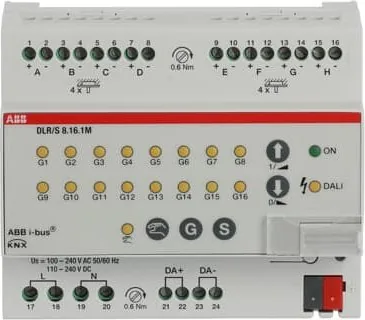
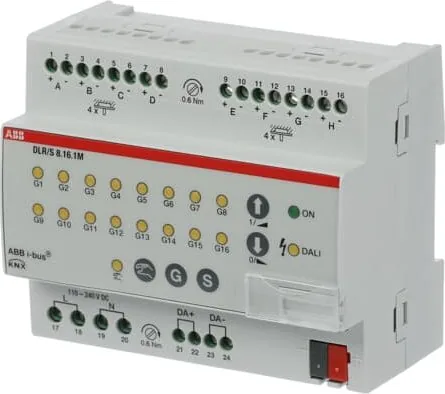
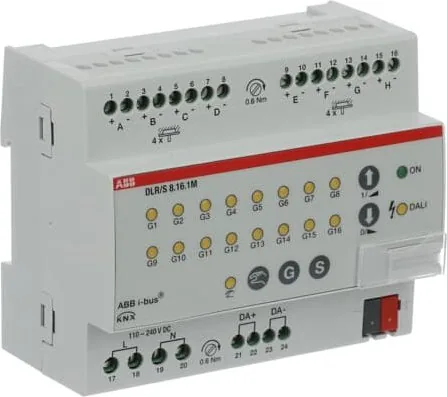
Modern building automation relies heavily on efficient lighting management. The ABB DLR/S8.16.1M DALI Light Regulator 8-fold, 6TE REG, Switch Actuator with Dimmer Manual provides essential guidance for this integrated solution. This controller connects digital illumination standards with KNX installation protocols. It supports up to sixty-four DALI devices across sixteen distinct lighting groups. Energy conservation is prioritized through constant light control features paired with eight light sensors. Automatic detection adjusts artificial brightness to match daylight conditions perfectly. Users gain enhanced comfort alongside operational cost reductions. Intelligent algorithms ensure optimum working environments remain stable regardless of external weather changes.
Key Functionalities
Versatile scene recalls occur via bit telegrams frequently. Fourteen independent light scenes allow custom settings stored quickly. Staircase lighting functions offer pre-warming phases and warning signals automatically. Master-slave operations facilitate complex dimming setups with offset controls for secondary strips. Fault monitoring ensures individual lamp status reports reach the central system efficiently. Manual overrides exist for emergency adjustments directly on the device faceplate. Software tools assist in configuring addresses without complex engineering knowledge initially.
Technical Specifications
Robust mounting occurs on thirty-five millimeter rails consistently. Protection classes ensure safety against dust and water ingress effectively. Power consumption remains low while maintaining high performance metrics. Communication objects enable status feedback loops throughout the network architecture. Voltage failure reactions are parameterizable to suit specific site requirements. Burn-in functions guarantee initial lamp longevity and stability over time. Replacement units can be addressed automatically if configured correctly beforehand. Comprehensive diagnostics help identify ballast malfunctions instantly for quick repairs.
Implementation Details
Benefits stem from flexible grouping capabilities inherent to design. Lighting circuits adapt to room usage changes without rewiring infrastructure. Calibration processes involve both artificial light and natural daylight parameters. Overhead sensors capture accurate readings without glare interference effectively. System reliability increases with internal buffering during power fluctuations. Installation experts utilize push-in terminals for secure electrical connections quickly. Regular maintenance keeps performance optimal across extended project lifecycles. Integration with existing KNX networks streamlines whole-building control strategies effectively. Smart solutions drive sustainability goals forward in modern commercial structures globally.
Final Notes
Commissioning requires proper configuration tools and physical access points. Programming happens through specialized interfaces designed exclusively for this hardware platform. Data transfer occurs securely between controllers and central management units. Visualization systems receive real-time updates regarding operational status continuously. Troubleshooting procedures utilize detailed error logs stored within internal memory registers. Future expansion plans accommodate additional modules without disrupting current operations significantly. Regulatory compliance meets international safety standards for electronic equipment deployment worldwide.
Search for 67,706 Manuals online


Type-in Brand or Model