
Zoomion Voyager 76 EQ Manual
PDF manual · 8 Pages
English



Quick check
Incorrect answer, please try again.
Chat with your Zoomion Voyager 76 EQ manual using AI
Get instant AI answers from your Zoomion Voyager 76 EQ manual
Ask anything about the Zoomion Voyager 76 EQ. Answers come from this manual, with the pages they are based on.
Ask a Question
Do you recommend Voyager 76 EQ?
Yes NoFrequently Asked Questions
It is well suited to the Moon, including craters and maria, plus Jupiter's disk, major cloud belts, and four Galilean moons. Saturn's rings may be visible under favorable conditions. Bright star clusters and some nebulae can also be explored.
Is this answer helpful?
Start with the H20 mm eyepiece. It provides the lowest magnification and widest field of view, making it easier to find and center an object. Once the target is centered and focused, try the H12.5 mm eyepiece for a closer view.
Is this answer helpful?
The included 2x Barlow lens doubles the effective focal length, which doubles the magnification of an eyepiece. Use it selectively because higher magnification makes the image dimmer and can emphasize atmospheric turbulence.
Is this answer helpful?
During daylight, center a distant stationary object in the main telescope using the H20 mm eyepiece. Then use the finder adjustment screws to center the same object in the finder. Check alignment after moving or reassembling the telescope.
Is this answer helpful?
Confirm that the large front cover is removed and an eyepiece is installed. Start at low magnification, focus on a distant target, and avoid excessive magnification. Dark or blurry views can result from high power, poor focus, or unstable air.
Is this answer helpful?
Yes. The telescope accepts eyepieces with a 1.25-inch, or 31.75 mm, barrel diameter. Different eyepiece focal lengths provide different magnifications and fields of view.
Is this answer helpful?
Only use a securely fitted full-aperture solar filter placed over the telescope's front opening. Never look at the Sun through the telescope without this protection. Avoid eyepiece solar filters, as they are unsafe.
Is this answer helpful?
Advantages and Disadvantages
Advantages

- Compact 76 mm reflector with a 900 mm focal length suited to beginner lunar and planetary observing.
- Includes three 1.25-inch eyepieces, a 2x Barlow lens, a 5x finder scope, tripod, and equatorial mount.
- Can show lunar craters, Jupiter's major moons and cloud belts, and Saturn's rings in favorable conditions.
- Standard 1.25-inch focuser supports many compatible eyepieces from other manufacturers.
Disadvantages

- High magnification combinations can produce dim, unsteady images and are limited by atmospheric conditions.
- Finder scope must be aligned after setup or transport before targets can be located reliably.
- The equatorial mount requires assembly, balancing, and practice compared with a simple tabletop telescope.
- Primarily intended for visual observing; high-quality astrophotography is challenging with this setup.
Product Specification
Type
Reflector (mirror telescope)
Design
Newtonian
Magnification
140x
Clear aperture
3 in
Focal length
35.43 in, f/11.8
Resolution in arcseconds
1.8
Mount
Equatorial
Eyepiece barrel diameter
1.25 in
Included eyepieces
0.16 in, 0.47 in, 0.79 in
Weight
24.25 lb
Product Description
Zoomion Voyager 76 EQ Manual: A Beginner Telescope for Exploring the Night Sky
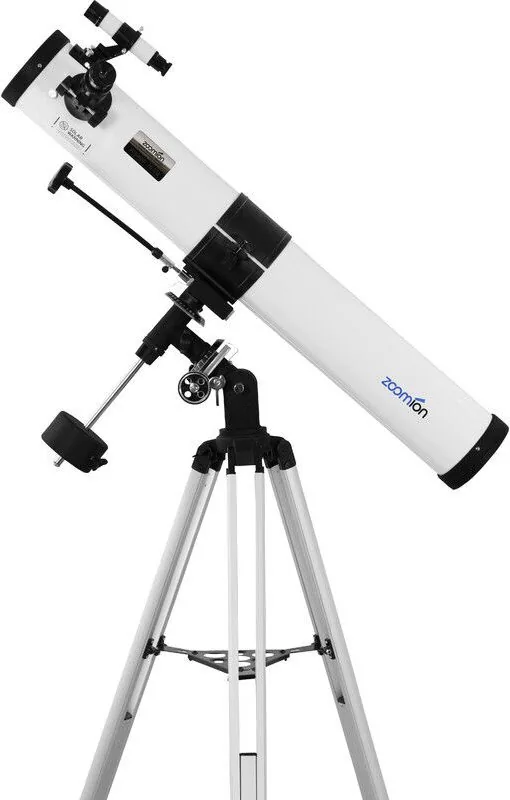
The Zoomion Voyager 76 EQ is a compact reflector telescope designed to make amateur astronomy approachable. Its 76 mm optical-glass mirror and 900 mm focal length provide a practical starting point for observing bright solar-system objects and selected deep-sky targets. The Zoomion Voyager 76 EQ Manual helps new observers understand the setup, accessory choices, focusing process, and basic use of the equatorial mount.
This telescope is built for memorable first views of the Moon. Lunar craters, dark maria, and the dramatic boundary between light and shadow can be seen with strong contrast, especially around the crescent and quarter phases. The Voyager 76 EQ can also reveal Jupiter as a small disk, its major cloud belts, and the four Galilean moons: Io, Europa, Ganymede, and Callisto. Under favorable conditions, Saturn's rings are visible as well.
Optical System and Included Accessories
The package includes three 1.25-inch eyepieces: H20 mm, H12.5 mm, and SR4 mm. These options let users change magnification according to the target and observing conditions. With a 900 mm focal length, the 20 mm eyepiece provides about 45x magnification, while shorter eyepieces deliver closer views with a narrower, dimmer field.
A 2x Barlow lens is also included. It doubles the telescope's effective focal length and can increase magnification when paired with an eyepiece. However, higher power is not always better. Very high magnification can make images darker and more sensitive to atmospheric turbulence. For many targets, beginning with the H20 mm eyepiece provides the widest field of view and makes locating objects much easier.
Equatorial Mount and Finder Alignment
The Voyager 76 EQ uses an equatorial mount with a counterweight and slow-motion controls. Once assembled and balanced, this arrangement supports smoother manual tracking of objects as they move across the sky. The tripod includes an accessory tray for keeping eyepieces and small items close at hand.
Before nighttime observing, align the 5x finder scope during daylight using a distant stationary object, such as a tower or chimney. Center the object in the main telescope at low magnification, then adjust the finder until it points at the same target. Accurate finder alignment is essential for locating the Moon, planets, and other celestial objects efficiently.
Notes for Better Observations
Use the telescope outdoors, remove the large front cover, and allow time for careful focusing. Stars will remain point-like even in large instruments; the Moon and planets are more rewarding beginner targets. The telescope accepts standard 1.25-inch eyepieces from other brands. Never observe the Sun without a securely fitted full-aperture solar filter, and children should use the telescope with adult supervision.
Search for 67,706 Manuals online


Type-in Brand or Model