
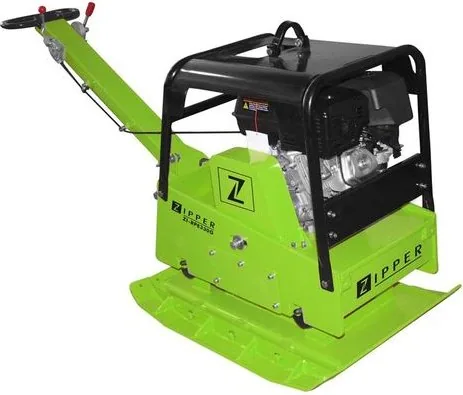
Zipper ZI-RPE330G Manual
PDF manual · 40 Pages
English



Quick check
Incorrect answer, please try again.
Chat with your Zipper ZI-RPE330G manual using AI
Get instant AI answers from your Zipper ZI-RPE330G manual
Ask anything about the Zipper ZI-RPE330G. Answers come from this manual, with the pages they are based on.
ZI-RPE330G Maintenance Schedule
Verify fuel level before every start-up to ensure proper operation.
Check oil level before every start and top up if necessary to prevent engine damage.
Control all operating elements before every start-up for safety.
Check the machine for damaged parts before every start-up.
Ensure all nuts and bolts are securely tightened as vibrations can loosen them.
Replace engine oil after the first 20 operating hours, then every 100 hours thereafter.
Check V-belt flexibility every 50 hours; replace or retighten if flexibility exceeds 10-15mm.
Clean the air filter every 50 hours using compressed air or a soft brush.
Drain and refill exciter oil after the first 50 hours, then every 200 hours.
Check spark plug condition and gap every 100 hours.
Replace the V-belt after 300 operating hours or 1 year, whichever comes first.
Replace the air filter after 300 operating hours or 1 year, or sooner if performance drops.
Ask a Question
Do you recommend ZI-RPE330G?
Yes NoFrequently Asked Questions
Use unleaded gasoline RON 95 for fuel. Recommended engine oil is 15W40 (or SAE30 comparable). Exciter oil is SAE 80W-90 with a capacity of 450 ml. Always top up engine oil to the upper dipstick mark before starting.
Is this answer helpful?
Change engine oil after the first 20 operating hours, then every 100 hours. Change exciter oil after the first 50 hours, then every 200 hours. Intervals assume normal operating conditions and may need shortening under heavy use.
Is this answer helpful?
Operate only outdoors or in well-ventilated areas, never indoors. Wear PPE (hearing protection, gloves, safety boots). Never bypass safety guards or labels, avoid slopes over 20°, and keep clear of trenches, edges and buried utilities to prevent accidents.
Is this answer helpful?
Turn the fuel valve ON, set ignition switch ON, close the choke for cold starts, set throttle to half, pull the starter cord to start, then open choke and increase throttle. For normal shutdown idle at low throttle ~3 minutes, switch ignition OFF, then close fuel valve.
Is this answer helpful?
Inspect engine oil level, fuel tank level, exciter oil level, air filter condition, loose or damaged parts, and ensure guards are fitted. Verify no leaks in the fuel system and that all fasteners are secure.
Is this answer helpful?
Check V-belt tension and condition, inspect clutch for wear, confirm throttle setting and engine power, and ensure the underside of the base plate is clean. Replace or retension belts and repair clutch components as needed.
Is this answer helpful?
For short moves use the transport wheel and hand grip on level ground. For lifting use appropriate hoisting gear and two people. For storage >30 days drain fuel and oil tanks, protect the cylinder with a few drops of oil, replace spark plug, cool and store in a dry, ventilated, frost-free location.
Is this answer helpful?
Advantages and Disadvantages
Advantages

- Powerful 1-cylinder 4-stroke G390F engine (8.2 kW) for strong compaction performance.
- High centrifugal force (38 kN) and 3,750 vpm deliver deep, effective compaction.
- Large fuel tank (6.5 L) and robust plate dimensions (890 x 670 mm) for extended work.
- Comprehensive maintenance guidance with clear service intervals and procedures.
- Pre-assembled delivery with plate extensions, transport wheel and spare parts set.
Disadvantages

- Guaranteed sound power level LWA 109 dB(A) — requires strict hearing protection.
- Machine weight ~300 kg may complicate handling, lifting and transport logistics.
- Not suitable for wet, frozen, highly clayey or asphalt surfaces; restricted slope use (max 20°).
- Vibration exposure risk — long continuous use may cause circulatory issues in hands.
- Warranty void if non-original spare parts are used or safety devices are altered.
Product Specification
Power
10.99HP, 11HP, 4-stroke, G200F
Work surface
35.04x26.38in
Compaction pressure
8542.91lb
Tank capacity
1.72gal Petrol
Noise level
108dB(A)
Weight
661.39lb
Product Description
Zipper ZI-RPE 330G Petrol Rammplatte Manual
The Zipper ZI-RPE 330G is a heavy-duty petrol plate compactor built for efficient compaction of small to medium surfaces: pathways, driveways, terraces, small foundations and paving sub-bases. Driven by a 1-cylinder, 4-stroke OHV engine (G390F) with 389 cm³ displacement and 8.2 kW output, the machine combines robust power with practical service features: a 6.5 L fuel tank, recommended 15W40 engine oil, and a 450 ml exciter oil reservoir. With a plate size of 890 x 670 mm, a centrifugal force of 38 kN and up to 3,750 vpm, it achieves deep, reliable compaction (up to 90 cm compaction depth under suitable conditions).
The unit is delivered largely pre-assembled with plate extensions, a transport wheel, and all small parts included. Core components accessible for maintenance include the engine, fuel tank, exciter, V-belt and clutch, air filter and spark plug. The manual emphasizes pre-start checks (engine oil, fuel, exciter oil), a careful break-in for the first 20 hours, and routine maintenance intervals: engine oil change after 20 h then every 100 h, exciter oil after 50 h then every 200 h, V-belt inspection every 50 h, and air filter service every 50 h.
Safety and correct use are central: operate outdoors only, never in confined or explosive atmospheres, avoid wet or frozen ground, and never remove guards or safety labels. The machine is designed for single-person operation from the rear; operators must wear PPE (hearing protection, gloves, safety shoes) and observe limits for slope (max 20°) and proximity to trenches, edges, or utilities. Special engine-safety rules cover refuelling precautions, exhaust/muffler burn risks, and ventilation to avoid carbon monoxide exposure.
Practical operation guidance covers choke and starter procedure, throttle settings, direction control, emergency stop and routine shutdown. Transport and storage instructions include safe lifting practices, use of the transport wheel for short distances, and long-term storage steps (drain fuel, oil cylinder preservation, cover and dry storage). Troubleshooting sections list common faults and checks (fuel, ignition, oil level, air filter, V-belt) to isolate issues before consulting a technician.
Maintenance actions are described step-by-step: exciter oil drain and refill, engine oil drain and refill, air filter cleaning or replacement, V-belt tensioning or replacement, clutch inspection, and spark plug cleaning and gap setting. Disposal, spare parts ordering, explosion drawings and warranty terms are included in the manual for responsible ownership and service continuity.
Notes:
- Follow the initial 20-hour running-in recommendations and change engine oil afterward.
- Always check engine and exciter oil levels before starting.
- Use only approved spare parts to preserve warranty.
Search for 67,706 Manuals online


Type-in Brand or Model