
WISI Orbit OA 38 G Manual
PDF manual · 12 Pages
English



Quick check
Incorrect answer, please try again.
Chat with your WISI Orbit OA 38 G manual using AI
Get instant AI answers from your WISI Orbit OA 38 G manual
Ask anything about the WISI Orbit OA 38 G. Answers come from this manual, with the pages they are based on.
Ask a Question
Do you recommend Orbit OA 38 G?
Yes NoFrequently Asked Questions
The OA 38 G is optimized for geostationary satellites commonly used in Europe, such as Astra (19.2°E) and Eutelsat/Hot Bird. With optional multifeed brackets and additional LNBs, it can receive multiple nearby orbital positions.
Is this answer helpful?
Use a galvanized steel mast 40–76 mm in diameter with a minimum wall thickness of 3.2 mm. Ensure the clamped (inserted) length is at least one-sixth of the mast's free length, secure connections against twisting, and follow windload guidance for your mounting height.
Is this answer helpful?
Perform a midday shadow test (12:00–13:00): if sunlight casts a shadow on the reflector when aligned, the chosen location is obstructed. Also inspect for trees, buildings, overhangs, or balcony ceilings that could block the satellite path.
Is this answer helpful?
Use a low-loss coaxial cable such as the WISI MK series and correctly install F-type connectors (e.g., DV...). Strip the cable carefully to avoid shorting the shield to the inner conductor and seal the F-connector to prevent moisture ingress.
Is this answer helpful?
Connect a satellite receiver and TV for visual tuning or use a selective measuring device. Set elevation and azimuth while watching for a target channel (e.g., ARD) or maximizing the measuring device reading. Finally, fine-tune LNB rotation for polarization decoupling and tighten all fittings.
Is this answer helpful?
Yes, the aerial system must be correctly grounded according to applicable standards. Some installations less than 1.5 m from the building and more than 2 m below the roof edge may be exceptions; consult a qualified electrician or dealer for compliance and safety.
Is this answer helpful?
The OA 38 G has specified windload ratings depending on mounting height. To ensure safe operation in windy areas, install on a properly sized galvanized mast, secure against rotation, and follow the recommended clamped length and mounting hardware guidelines.
Is this answer helpful?
Advantages and Disadvantages
Advantages

- High gain (37 dB) delivers strong reception for focused satellite targets.
- Aluminum reflector and light-gray finish offer low weight and weather resistance.
- Supports multi-feed options (2 or 4 LNBs) for multi-satellite setups.
- Narrow 3-dB beam provides good signal discrimination and reduced interference.
- Relatively lightweight (≈3.8 kg) and compatible with standard galvanized masts.
Disadvantages

- Narrow beam requires precise alignment and clear line of sight to the satellite.
- Requires a robust mast (40–76 mm, ≥3.2 mm wall) to meet windload recommendations.
- Installation needs careful sealing of F-connectors to avoid moisture issues.
- May need optional brackets and extra LNBs for multi-satellite reception (additional cost).
- Grounding and safety compliance may require professional assistance.
Product Specification
Diameter
31.50in
Reflector material
Aluminum, powder-coated
Elevation
16-50°
Mast clamp
1.26-2.36in
Color
gray
Weight
8.38lbs
Product Description
WISI OA 38 G lichtgrau Manual
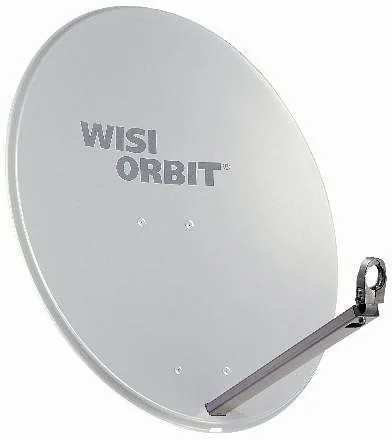
The WISI OA 38 G lichtgrau is a compact, high-performance offset satellite antenna designed for reliable home and small-installation reception. Built with an aluminum reflector and a sturdy galvanized steel feed structure, this model balances gain, wind resistance, and ease of installation. With a 37 dB gain and a narrow 3-dB aperture angle, the OA 38 G provides focused reception ideal for receiving satellites such as Astra and Eutelsat, even in moderately challenging signal environments.
Design and build
The OA 38 G features a weather-resistant, light-gray finish that blends discreetly with many building exteriors. The reflector is crafted from aluminum for low weight and stable performance. The mount and mast recommendations call for a galvanized steel mast (40–76 mm diameter, minimum 3.2 mm wall thickness) to withstand wind loads. Proper clamped length, anti-rotation measures, and grounding per standards are emphasized to ensure long-term safety and signal stability.
Installation and alignment
Position the dish where it has an unobstructed line of sight to the satellite—midday sun (12:00–13:00) can be used as a quick shadow test: if sunlight casts a shadow on the reflector at noon, choose a different location. Typical installation uses standard low-loss coaxial cable (e.g., WISI MK series) with correctly mounted F-connectors. Seal F-connectors to protect against moisture. Use a TV and satellite receiver for visual alignment or a selective measuring device for precise tuning (example: set the device to the ARD transponder frequency parameters to optimize signal). Adjust elevation and azimuth, then fine-tune LNB polarization for maximum signal.
Performance and accessories
The OA 38 G caters to single and multi-LNB setups; optional multi-feed brackets (for 2 or 4 LNBs) allow reception of multiple satellites. The antenna’s gain and narrow beam make it suitable for focused satellite targets like Astra 19.2° and Hot Bird. Windload ratings and weight (approx. 3.8 kg) make it robust yet manageable for typical rooftop and mast installations.
Maintenance and safety notes
Ensure proper grounding according to local standards; avoid using water or gas pipes as masts. Maintain minimum clearances from power lines. Regularly check fasteners, connector seals, and the integrity of the mast clamping length and anti-rotation fittings. Use corrosion-resistant mounting hardware and periodically inspect the reflector surface and LNB sealing to prevent signal degradation.
Notes:
- Use quality low-loss coaxial cable (WISI MK recommended).
- Seal F-connectors to prevent moisture ingress.
- Verify free line of sight at midday to avoid shading issues.
- Follow grounding and safety regulations for outdoor aerial systems.
- Optional multifeed brackets enable multi-satellite reception.
Search for 67,706 Manuals online


Type-in Brand or Model