
Waldorf DVCA1 Manual
PDF manual · 11 Pages
English



Quick check
Incorrect answer, please try again.
Chat with your Waldorf DVCA1 manual using AI
Get instant AI answers from your Waldorf DVCA1 manual
Ask anything about the Waldorf DVCA1. Answers come from this manual, with the pages they are based on.
Ask a Question
Do you recommend DVCA1?
Yes NoFrequently Asked Questions
It is a dual VCA Eurorack module used to control, shape, and amplify audio or control signals. It can also add tone movement through its Colour filtering and support stereo-style patching.
Is this answer helpful?
Yes. Audio is typically connected through the AC input for DC blocking and filtering, while control signals like LFOs or envelopes are best sent to the DC input.
Is this answer helpful?
Colour controls a two-pole low-pass filter that changes the tone as the VCA closes. It can make sounds warmer, darker, and more animated, similar to a low-pass gate effect.
Is this answer helpful?
The DVCA1 can add up to 13.5 dB of gain when fully opened. This is useful for boosting quiet signals, driving a patch harder, or creating intentional distortion.
Is this answer helpful?
There are three modes: independent, parallel, and anti-parallel. These let you keep channels separate, mirror controls across both sides, or create reverse movement for panning effects.
Is this answer helpful?
Installation is straightforward, but power orientation matters. The system should always be switched off before connecting the ribbon cable, and the red stripe must align correctly.
Is this answer helpful?
Advantages and Disadvantages
Advantages

- Dual VCA design supports independent control, stereo patching, and linked performance setups.
- AC and DC inputs provide flexibility for audio signals, control voltage, and filtered or unfiltered routing.
- Colour filtering adds musical tone shaping and low-pass-gate-like behavior with fast response.
- Gain control can boost the signal up to 13.5 dB, making the module act like a true amplifier.
Disadvantages

- Power connection must be handled carefully; reversing the ribbon cable can damage the module.
- High gain settings may cause clipping, so level management is important.
- The linked modes add flexibility, but they also make the module more complex for beginners.
- The AC and DC inputs are not intended to be used together on the same channel in normal operation.
Product Specification
Type
Filter
Channels
2
Format
Eurorack
Product Description
Waldorf DVCA1: A Flexible Dual VCA for Creative Eurorack Patches
The Waldorf DVCA1 stands out as more than a standard voltage controlled amplifier. In the spirit of the Waldorf DVCA1 Manual, it reveals a module built for musical shaping, stereo movement, and detailed control over both level and tone. Designed as a dual VCA for Eurorack systems, it offers two identical channels that can work independently or be linked for broader routing and performance ideas.
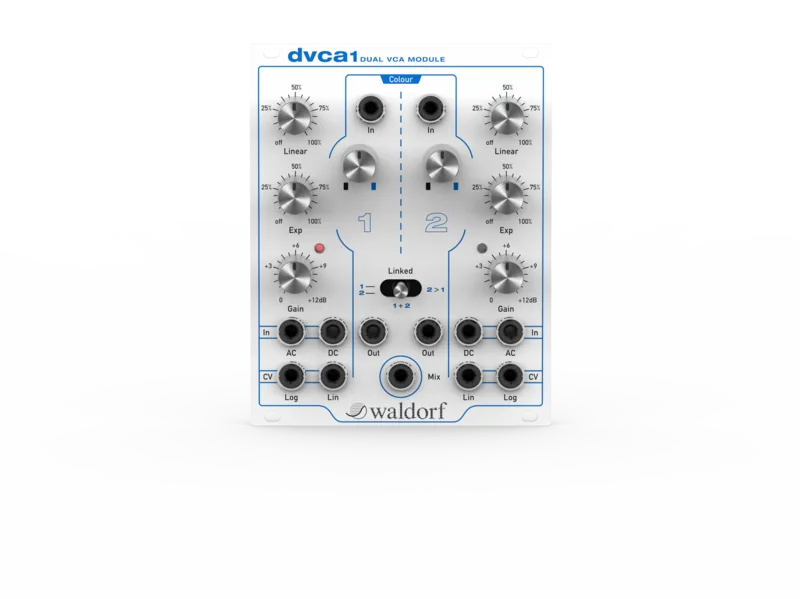
At its core, the DVCA1 is about expressive gain control. Each channel supports both linear and exponential modulation, letting you choose between smooth utility-style control and more dramatic, punchy dynamics. That flexibility makes the module useful for audio and control signals alike. When used with audio, the AC input adds DC blocking and routes the signal through a two-pole low-pass filter, giving the DVCA1 a characterful edge that moves beyond clean amplification.
One of the most appealing features is the Colour section. This filter-like control follows the level behavior of the VCA, so the sound can become darker as it gets quieter. That creates a lively, organic response reminiscent of a low-pass gate, but with faster reaction and a more precise electronic feel. For many patchers, this means evolving plucks, animated percussion, and warm animated timbres without needing extra modules.
The gain stage also deserves attention. With up to 13.5 dB of boost, the DVCA1 can act as a true amplifier rather than simply an attenuator. This opens room for stronger drive, intentional clipping, and more confident level matching inside a modular rig. The red LED near the gain control adds a helpful warning when the signal approaches distortion.
Link modes expand the module’s usefulness even further. Independent, parallel, and anti-parallel operation make it easy to build stereo patches, synchronized dynamics, or auto-panning behavior from a single modulation source. In a compact 20HP layout, the DVCA1 packs a lot of practical value into a small space.
Notes
- Best suited for users who want both clean control and tonal shaping
- Works especially well with LFOs, envelopes, and stereo patches
- Careful power connection is essential before installation
- High gain settings can add useful saturation, but clipping is possible
Search for 67,732 Manuals online


Type-in Brand or Model