
UniPi V1.1 Manual
PDF manual · 12 Pages
English



Quick check
Incorrect answer, please try again.
Chat with your UniPi V1.1 manual using AI
Get instant AI answers from your UniPi V1.1 manual
Ask anything about the UniPi V1.1. Answers come from this manual, with the pages they are based on.
Ask a Question
Do you recommend V1.1?
Yes NoFrequently Asked Questions
It extends a Raspberry Pi with relays, digital inputs, analog inputs and output, 1Wire, UART, and I2C. It is commonly used for automation, monitoring, and control projects where standard GPIO is not enough.
Is this answer helpful?
It supports several Raspberry Pi models, but some functions, especially the older P5-based connections, are tied to earlier Pi hardware. Compatibility should be checked carefully before installation.
Is this answer helpful?
Yes, in single-supply mode UniPi can feed the Raspberry Pi, but this is limited and not always recommended. For heavier loads or multiple peripherals, separate power supplies are safer.
Is this answer helpful?
The digital inputs are designed for 5-24V DC signals with short pulse handling and LED status indication. They can also be configured for external power sources using jumpers.
Is this answer helpful?
Version 1.1 improves analog output behavior so PWM duty cycle matches the expected 0-10V logic. It also supports EEPROM-stored calibration values for more consistent analog measurement.
Is this answer helpful?
The board includes an RTC module, but backup battery support depends on adding a CR2032 battery. Without it, time retention during power loss is reduced.
Is this answer helpful?
Advantages and Disadvantages
Advantages

- Combines relays, analog I/O, 1Wire, UART, and I2C in one board.
- Galvanically isolated inputs help improve safety and noise resistance.
- Works well for home automation and light industrial control projects.
- EEPROM stores calibration data, supporting more accurate analog readings.
Disadvantages

- Power wiring requires care, especially when choosing single or dual supply mode.
- Some headers and features depend on older Raspberry Pi models or advanced setup.
- Relay and output limits are modest, so heavier loads need external hardware.
- UART has no protection, so careless wiring could damage connected devices.
Product Specification
Platform
Raspberry Pi 1 B, Raspberry Pi 1 B+, Raspberry Pi 2, Raspberry Pi 3
Format
N/A
Manufacturer
UniPi Technology
Function
Multi-I/O-Board
Connectivity
Platform GPIO-Port, MCP23008
Miscellaneous
Power supply, 1x barrel jack, 12V/200mA
External connections
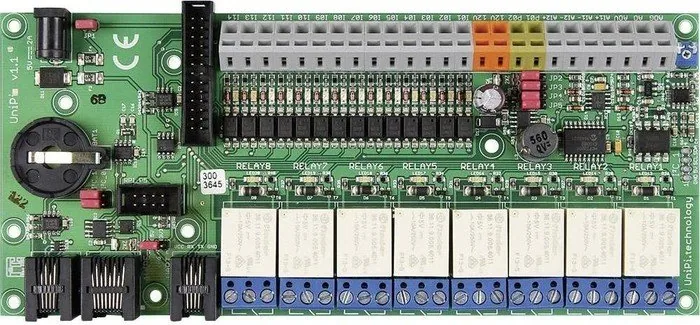
14-Pin digital in (galvanically isolated/optocoupler), 4-Pin analog in, 3-Pin analog out (PWM), 8x Relays (250V/5A), 1x UART Port (RJ-45), 1x I2C Port (RJ-45)
Wireless
N/A
LAN
N/A
Supported standards
I2C
Features
RTC, RTC backup battery
Dimensions (WxHxD)
7.80x0.47x3.39in
Package contents
1x Board, 1x connection cable, 3x spacers, 3x screws, 8x jumpers
Product Description
UniPi V1.1 Add-On Board: Practical Automation for Raspberry Pi
UniPi V1.1 is a versatile add-on board designed to turn a Raspberry Pi into a compact automation controller. Built for makers, hobbyists, and industrial-minded users alike, it combines relays, isolated digital inputs, analog I/O, and multiple communication interfaces in one board. If you are looking for a reliable way to connect sensors, switches, and external devices to a Raspberry Pi, the UniPi V1.1 Add-On Board Manual reveals a platform that balances flexibility with real-world control.
What Makes It Stand Out
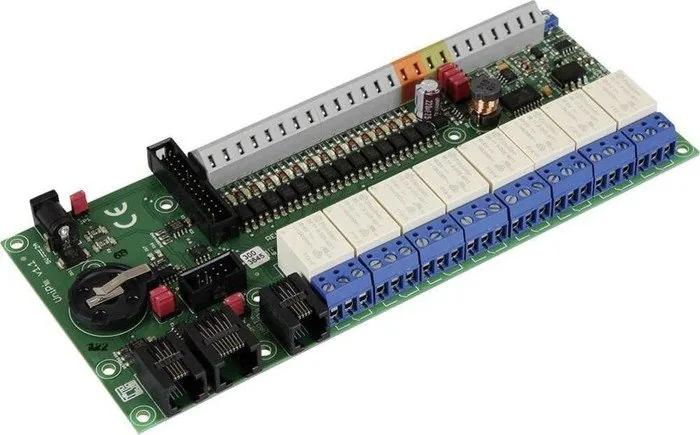
At the heart of UniPi V1.1 are eight relays, 12+2 digital inputs, two 0-10V analog inputs, one 0-10V analog output, a 1Wire master, UART access, I2C connectivity, and an onboard RTC module. That combination makes it especially useful for home automation, basic PLC-style tasks, monitoring systems, and custom control projects. The digital inputs are LED-indicated and galvanically isolated, while the relays are suited for switching common loads within their rated limits.
UniPi is also built with Raspberry Pi compatibility in mind. It supports several Pi models and provides a structured GPIO map that helps users connect devices without guesswork. For projects that rely on stable timing or power resilience, the real-time clock and EEPROM add practical value by preserving key settings and keeping time even when the main system is offline.
Power, Wiring, and Version 1.1 Improvements
Power planning is an important part of the design. UniPi can run from a single shared supply or from separate supplies for the board and the Raspberry Pi, with the dual-supply option recommended for heavier setups. The board includes an internal 12V step-up line for the inputs, but external powering is also supported through jumper configuration for better isolation.
Version 1.1 introduces a more intuitive analog output behavior, where PWM duty cycle now matches the expected 0-10V output logic. That small but meaningful change simplifies control and makes integration easier. The EEPROM also stores analog calibration coefficients, improving precision and helping the board maintain consistent readings across installations.
Why It Appeals to Builders
What makes UniPi attractive is not only its hardware list, but the way those parts fit together. It is a compact bridge between the Raspberry Pi world and the physical world of sensors, relays, and industrial signals. For automation projects that need more than standard GPIO, UniPi V1.1 offers a clear upgrade path.
Notes
- Check jumper settings before powering the board.
- Use external relays/contactors for loads above rated limits.
- A CR2032 battery is needed for RTC backup.
- The I2C_0 header is mainly for advanced users and older Pi models.
Search for 67,706 Manuals online


Type-in Brand or Model
Hans Müller
8 months ago
How difficult is the setup of the UniPi board for a garage, and is the software already fully mature?
Manual.ly
8 months ago
The board can require some hands-on work, especially at first. Several customers find the initial setup not completely straightforward because the available software and configuration may still feel a bit rough. The good news is that with careful installation, configuration, and some troubleshooting (following the provided documentation and guides), it can run stably. We recommend setting everything up step by step, double-checking network and wiring, and allowing time for initial adjustments. If you run into issues, support can help you identify configuration problems so you can get it working reliably.