
UNI-T UTD1025CL Manual
PDF manual · 122 Pages
English



Quick check
Incorrect answer, please try again.
Chat with your UNI-T UTD1025CL manual using AI
Get instant AI answers from your UNI-T UTD1025CL manual
Ask anything about the UNI-T UTD1025CL. Answers come from this manual, with the pages they are based on.
UTD1025CL Maintenance Schedule
Inspect the oscilloscope, probes, and accessories for mechanical damage before operation. Replace any damaged items immediately.
Wipe dust with a soft cloth or dampen cloth with water/mild agent. Do not use corrosives or abrasives. Ensure device is dry before powering on.
Fully charge the battery pack for at least four hours before storing the oscilloscope to prevent discharge damage.
Ask a Question
Do you recommend UTD1025CL?
Yes NoDo you recommend UTD1025CL?
Yes NoFrequently Asked Questions
The UTD1025CL offers a 25 MHz analog bandwidth with up to 200 MS/s sampling in its acquisition modes, suitable for low-to-moderate frequency analog and digital signals.
Is this answer helpful?
Set the probe’s physical attenuation switch (1×/10×/100×/1000×) to match the probe, then select the same probe factor in the channel menu and perform probe compensation using the built-in 1 kHz square-wave output before taking precise measurements.
Is this answer helpful?
Use Peak Detect to capture narrow or asynchronous pulses and AVG mode (with an appropriate averaging count) to reduce random noise; note that higher AVG counts slow the display update rate.
Is this answer helpful?
Yes: connect the scope to a PC via USB, run UNI-T control software, and use the Program Update action to apply firmware packages that match your model and hardware version; you can also export saved bitmaps and waveform records.
Is this answer helpful?
The built-in DMM measures DC/AC voltage, DC/AC current (with current module for higher ranges), resistance, diode, continuity, and capacitance, and supports auto/manual ranging and relative measurements.
Is this answer helpful?
Autoset analyzes the input signal and automatically adjusts vertical scale, timebase and trigger settings to display a stable waveform; use it for quick setup on signals around 20 Hz or higher and standard duty cycles.
Is this answer helpful?
Use only supplied or specified insulated probes and the provided power adaptor, avoid exceeding rated input voltages (observe CAT ratings), inspect accessories for damage, disconnect unused leads, and have qualified personnel handle repairs or fuse replacement.
Is this answer helpful?
Advantages and Disadvantages
Advantages

- Portable handheld oscilloscope + DMM with color display and battery operation.
- Autoset and full-autoset quickly configure vertical, timebase, and trigger for common signals.
- Multiple acquisition modes (normal/peak detect/AVG), FFT and math functions for versatile analysis.
- Integrated multimeter supports voltage, current (with modules), resistance, diode, continuity, and capacitance.
- USB PC connectivity for control, firmware updates, and exporting bitmaps/waveforms.
Disadvantages

- 25 MHz bandwidth and 200 MS/s (aggregate) limit capture of high-speed or fine-edge signals.
- High AVG settings reduce update rate and can make dynamic events appear sluggish.
- Record depth and stored-screen capacity are limited compared with full bench scopes.
- Accurate measurements require manual probe compensation and matching probe attenuation in menus.
- Firmware updates require matching model/hardware versions and a stable USB/PC connection to avoid failures.
Product Description
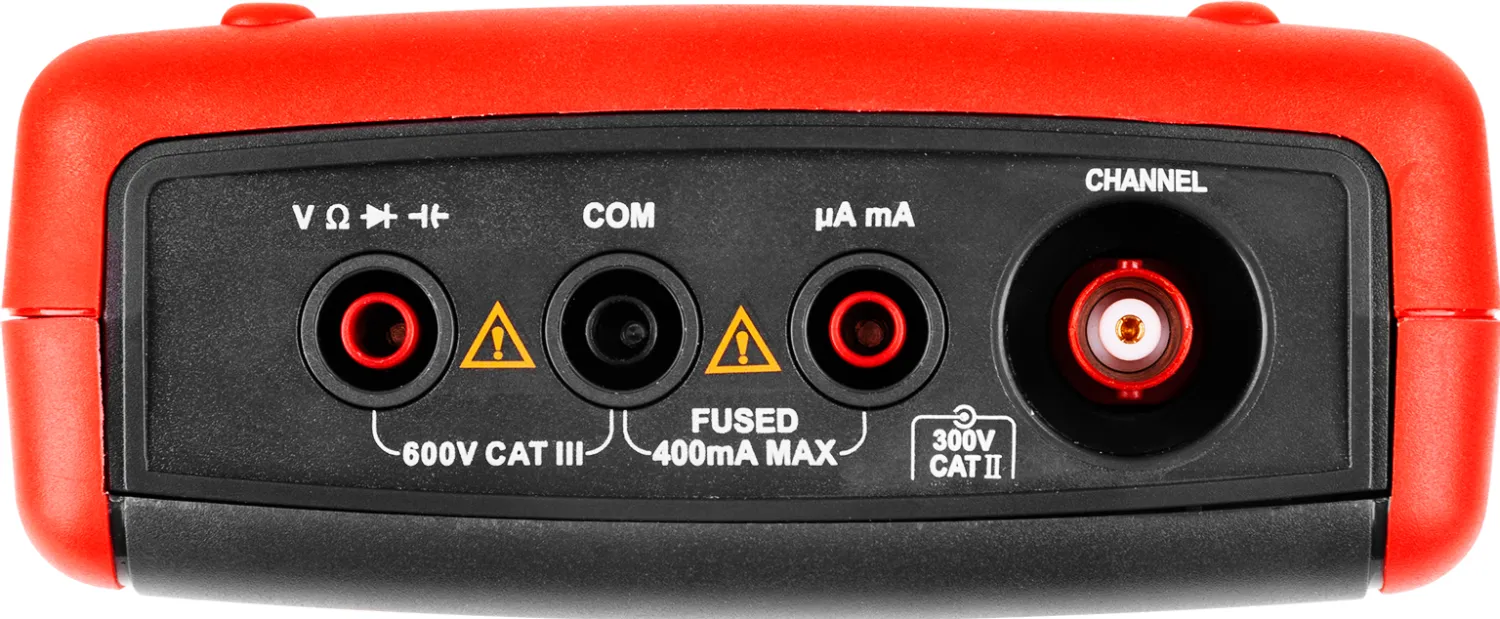
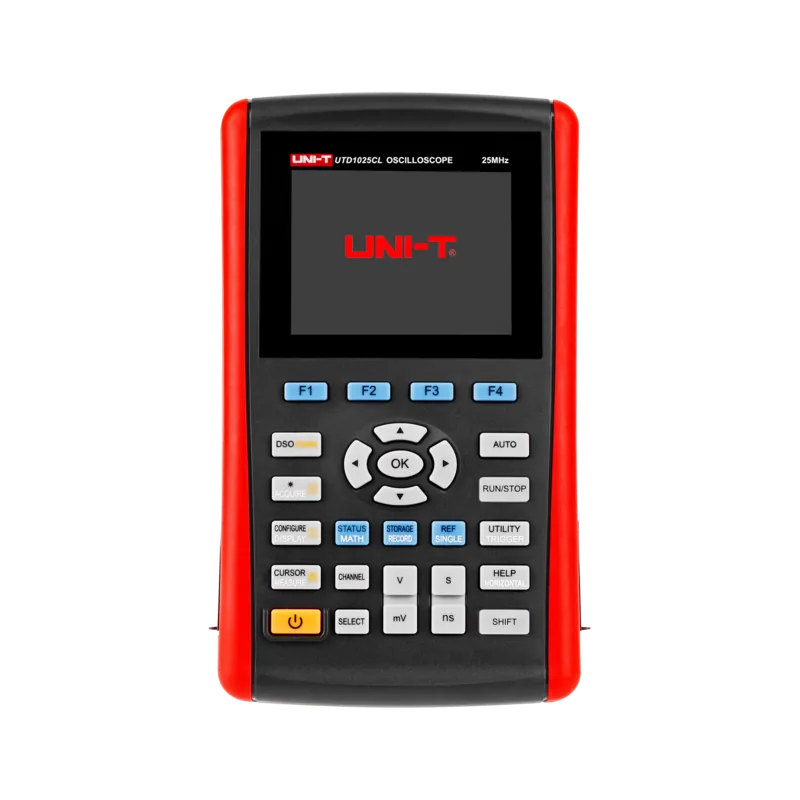
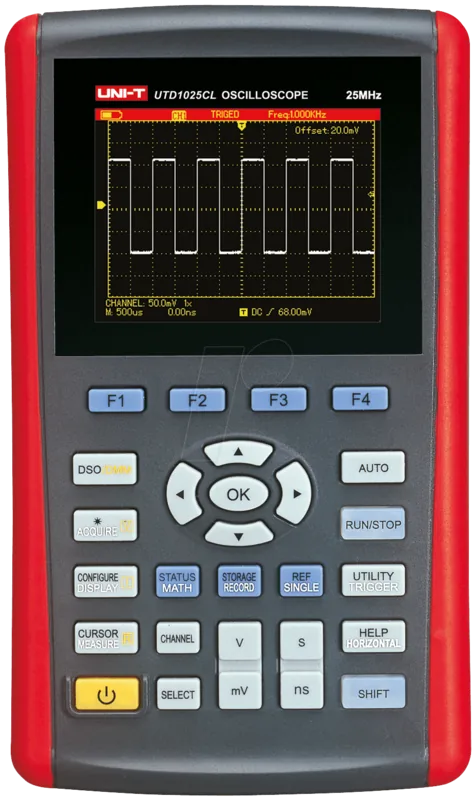
UNI-T UTD1025CL Digital Oscilloscope Manual Overview ## Powerful handheld scope for field and bench The UNI-T UTD1025CL Digital Oscilloscope is a compact, battery-powered handheld instrument that merges oscilloscope and multimeter functions for fast, portable troubleshooting. With a 25 MHz bandwidth, up to 200 MS/s sampling, and a high-contrast color LCD, it’s designed to capture and analyze common analog and digital signals quickly. The unit includes probe compensation output, removable probes, USB connectivity for PC control, and a suite of automatic features to speed measurements. ## Key capabilities and workflow The UTD1025CL offers single- and dual-purpose operation: real-time waveform capture with edge, pulse-width, video and slope triggers, plus an integrated DMM for voltage, current, resistance, diode, continuity and capacitance checks. Autoset and full-autoset deliver instant vertical/timebase/trigger adjustments for typical signals, while sample/peak-detect/AVG acquisition modes and persistence options make it easier to visualize pulses, noise and slow-changing signals. FFT is available for spectral analysis. Built-in recording and storage let you capture screens and waveform records to internal memory and export BMP files via USB. The frequency counter, cursor measurements, automatic parameter measurements (Vpp, Vrms, rise/fall times, duty cycle, etc.), and math functions make routine diagnostics and analysis straightforward. ## Design and usability highlights The front panel groups channel, trigger, horizontal and acquisition controls with SHIFT-modified secondary functions for compact operation. Probe attenuation settings are selectable to match 1×/10×/100×/1000× probes. The oscilloscope supports battery operation (typical runtime ~8 hours for UTD1000CL models) and DC adaptor charging. Multilingual on-screen help, adjustable backlight, and an ergonomic menu make it practical for field use. Firmware can be updated via USB using UNI-T PC software. ## Typical use cases Engineers and technicians will appreciate the UTD1025CL for quick circuit checks, signal integrity troubleshooting, power-supply ripple and noise inspection, transient capture, and basic spectral analysis in workshops, labs, or field service. ## Final notes • Always match probe attenuation in the channel menu to the physical probe setting and perform probe compensation before precise measurements. • Observe safety warnings: do not exceed rated input voltages, use provided insulated accessories, and follow CAT II/III and voltage limits. • Use AVG and peak-detect acquisition modes appropriately: AVG reduces noise but slows updates; peak-detect reveals narrow pulses. ## Pros and cons based on features and behavior ### Pros - Portable combined oscilloscope and multimeter with long battery runtime and color display. - Autoset, full-autoset, and built-in help speed up setup for typical signals. - Multiple acquisition modes (normal, peak detect, AVG), FFT, math, and recording for flexible analysis. - Multimeter functions include up to 10 A measurement (with module) and capacitance/continuity/diode tests. - USB connectivity for PC control, firmware updates, and bitmap export. ### Cons - 25 MHz bandwidth limits capture of higher-speed digital signals and fast edges. - AVG mode and high averaging counts slow display updates and responsiveness. - Limited memory depth and screen recording count compared with bench-class scopes. - Some functions require manual probe compensation and careful attenuation setup to avoid measurement errors. - Firmware updates and PC integration require correct model/hardware matching and care to avoid failed updates.
Search for 67,732 Manuals online


Type-in Brand or Model