
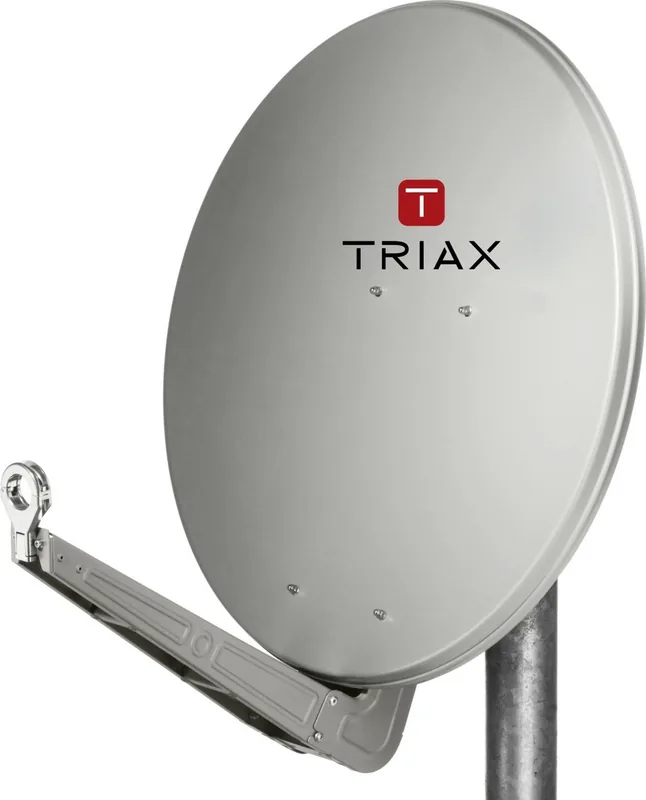


Triax Hit FESAT 85 Manual
PDF manual · 8 Pages
English



Quick check
Incorrect answer, please try again.
Chat with your Triax Hit FESAT 85 manual using AI
Get instant AI answers from your Triax Hit FESAT 85 manual
Ask anything about the Triax Hit FESAT 85. Answers come from this manual, with the pages they are based on.
Ask a Question
Do you recommend Hit FESAT 85?
Yes NoFrequently Asked Questions
The Hit FESAT 85 covers the satellite reception band 10.7–12.75 GHz, suitable for standard Ku-band satellite services and compatible with common universal LNBs.
Is this answer helpful?
Use a mast or mounting bracket rated for the dish size and wind load (mast diameter and embedment per manufacturer guidance). Ensure the mast’s free length and fixation meet load specifications; recommend using masts with adequate diameter and stable mounting to prevent excessive bending moments.
Is this answer helpful?
Start with the elevation shown on the scale for your location, aim the dish toward the satellite azimuth, then fine-tune by monitoring a signal meter or receiver. Adjust azimuth (horizontal) and elevation (vertical) incrementally until peak signal is reached, then tighten all wing nuts and fasteners.
Is this answer helpful?
Yes. The antenna system should be grounded according to applicable standards (e.g., EN 60065) by a qualified electrician to protect against lightning and electrical hazards and to comply with safety and warranty requirements.
Is this answer helpful?
Yes. Triax offers multifeed upgrade sets and multifeed rails to accommodate multiple LNBs. Options include MFU-1 sets and MFS multifeed rails; practical multifeed reception typically supports up to three LNBs on this dish with proper spacing and alignment.
Is this answer helpful?
Perform an annual inspection to check and retighten all screws, wing nuts, and mountings. Verify cable integrity and weather seals on the LNB and connectors. Recheck alignment after severe weather and ensure corrosion protection remains intact.
Is this answer helpful?
Advantages and Disadvantages
Advantages

- High gain (≈38.3 dBi) and narrow beamwidth ideal for distant satellites and low interference.
- Preassembled rear section and integrated cable routing speed up and simplify installation.
- Durable aluminum reflector and corrosion-protected parts for long outdoor service life.
- Clear elevation/azimuth scales and 40 mm feed holder compatible with standard LNBs.
- Optional multifeed accessories enable reception of multiple satellites with one dish.
Disadvantages

- Requires proper mast sizing and secure mounting to meet wind-load and safety requirements.
- Roof or high-mast installation necessitates fall protection and professional grounding.
- Weight (~9 kg) and size demand two-person handling during mounting for safety.
- Annual inspections and occasional retightening of fasteners are required for reliability.
- Multifeed setups may need additional alignment effort and accessory purchases.
Product Specification
Diameter
33.46in
Reflector material
Aluminium
Offset angle
21.1°
Elevation
15-45°
Mast clamp
1.57-3.50in
LNB holder
1.57in
Color
grey
Weight
20.94lb
Manufacturer warranty
5 years
Product Description
Triax Hit FESAT 85 light grey Manual
The Triax Hit FESAT 85 in light grey is a robust offset parabolic satellite dish designed for single and multi-user installations, delivering reliable reception across the 10.7–12.75 GHz satellite band. Built with an aluminum reflector and a 40 mm aluminum feed holder, the Hit FESAT 85 combines weather-resistant materials and a preassembled rear section for fast, dependable installation. Its 0.85 m diameter reflector and optimized offset angle provide high gain (approx. 38.3 dBi at 10.95 GHz) and a narrow beamwidth for strong, focused reception—ideal for locating distant satellites and minimizing interference.
Key features and usage
The unit ships with the reflector and a preassembled rear section that includes the mast mount, feed arm and holder. The feed arm and rear section include integrated cable routing for neat, protected cabling. Elevation and azimuth scales simplify alignment, while the feed holder accepts standard universal LNBs. Recommended mounting points include roofs, walls, or masts; ensure clear line-of-sight to the target satellite and compliance with local wind-load and grounding rules. For multi-satellite reception, optional multifeed accessories are available to support multiple LNBs.
Assembly is straightforward: attach the rear section to a suitably sized mast, unfold and secure the feed arm, mount the LNB centrally in the feed holder, route and terminate cables, then fit the reflector over the rear unit and tighten the specified screws. Final alignment is made by adjusting azimuth and elevation while monitoring signal level with a meter or receiver. Tighten all wing nuts and fasteners after achieving optimum signal and recheck periodically (recommended annual inspection).
Design and safety notes
Materials and coatings are selected for corrosion protection and outdoor longevity. Wind-load ratings are given for the Hit FESAT family (Hit FESAT 85: 600 N at q = 800 N/m²). Installation must follow safety standards (EN 50083-1, EN 60065), avoid power lines, and use appropriate masts and fastenings. Grounding by a qualified electrician and safe working practices for roof work are recommended to maintain warranty and ensure long-term performance.
Notes
- Preassembled rear section reduces installation time.
- Use the elevation scale as a starting point; fine-tune with a signal meter.
- Inspect and retighten fasteners annually to maintain alignment and safety.
Search for 67,706 Manuals online


Type-in Brand or Model