
Triax AE 75 Manual
PDF manual · 8 Pages
English



Quick check
Incorrect answer, please try again.
Chat with your Triax AE 75 manual using AI
Get instant AI answers from your Triax AE 75 manual
Ask anything about the Triax AE 75. Answers come from this manual, with the pages they are based on.
Ask a Question
Do you recommend AE 75?
Yes NoFrequently Asked Questions
The AE 75 Twin is designed for the standard satellite reception band of 10.7–12.75 GHz, covering most DVB-S/S2 broadcasts when paired with a compatible universal LNB.
Is this answer helpful?
Yes. The Twin configuration and 40 mm feed holder accept dual-output LNBs or two LNBs with appropriate multifeed accessories, enabling two independent receivers or dual-tuner usage.
Is this answer helpful?
The AE 75 Twin has a windload rating of about 480 N (q = 800 N/m²). Use a suitably sized mast and stable mounting surface, ensure minimum mast embedment/pipe insertion, and follow local wind and height guidelines to avoid exceeding bending moments.
Is this answer helpful?
Yes. The antenna uses corrosion-protected components and includes a weatherproof LNB cover. Proper installation and periodic checks help maintain its weather resistance over time.
Is this answer helpful?
Installation should be performed by trained personnel, especially for roof mounting and electrical grounding. Grounding per applicable standards must be carried out by a qualified technician to ensure safety and compliance.
Is this answer helpful?
You can receive multiple satellites using optional multifeed kits and multifeed rails. Recommended accessories allow reception of satellites spaced about 4.5–6°, or slim solutions for tighter spacing; performance depends on satellite spacing and LNB arrangement.
Is this answer helpful?
Advantages and Disadvantages
Advantages

- High gain (≈37.3 dBi at 10.95 GHz) for stable reception in 10.7–12.75 GHz band
- Preassembled rear section and feed arm for faster installation
- 40 mm feed holder accepts universal LNBs and Twin configurations
- Corrosion-protected parts and integrated cable routing improve durability
- Supports multifeed upgrades for receiving multiple satellites
Disadvantages

- Requires trained installer for safe roof or mast mounting
- Windload (480 N) demands suitable mast and secure mounting
- Narrow beamwidth needs precise alignment and clear line-of-sight
- Annual maintenance and screw retightening required for longevity
- Grounding and electrical safety must be handled by professionals
Product Specification
Participants
2
Satellite positions
1
Satellite dish
29.53 in (Triax Hit FESAT 75)
LNB
1x Twin
Multiswitch
no
Receiver
no
Product Description
Triax AE 75 Twin light gray RAL 7035 Manual
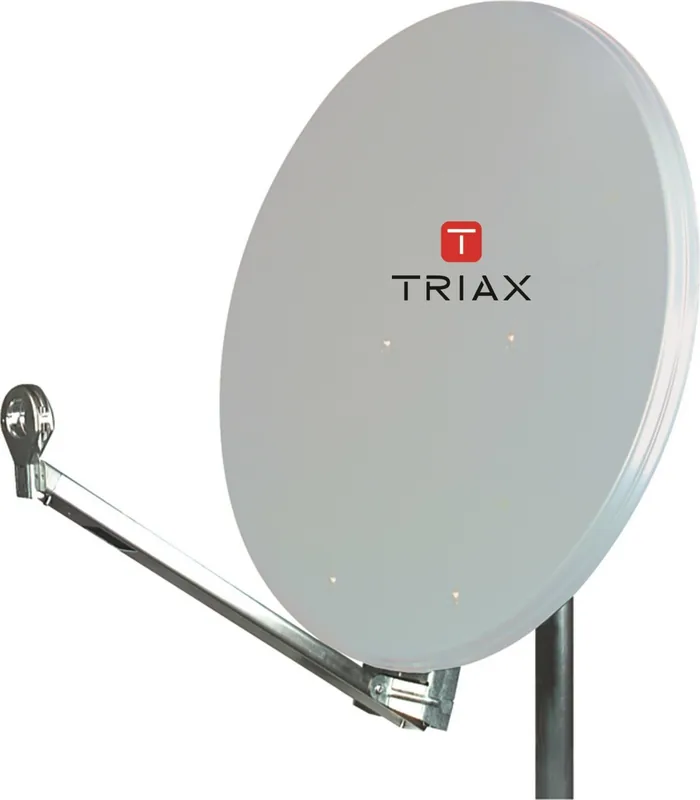
The Triax AE 75 Twin in light gray RAL 7035 is a robust offset parabolic satellite antenna designed for reliable reception in residential and small multi-user installations. Built around a 0.75 m aluminum reflector and a 40 mm feed holder, this model supports the common 10.7–12.75 GHz satellite band and accommodates universal LNBs such as Triax CS and TI series. The Twin configuration enables dual-output LNBs or two independent receivers, making it ideal for households with multiple TVs or for small multi-dwelling setups.
Engineered for straightforward installation, the AE 75 Twin ships partly preassembled: a rear assembly with mast bracket, foldable feed arm and feed holder, plus the reflector. The design includes integrated cable routing through the feed arm and rear section, an elevation scale for quick initial aiming, and corrosion-protected components to withstand outdoor conditions. The antenna’s nominal diameter and offset geometry provide focused gain (approx. 37.3 dBi at 10.95 GHz) with a narrow beamwidth for clear reception of geostationary satellites.
Installation and alignment are practical for trained installers. Recommended mounting points include roofs or walls with clear southern sightlines toward the desired satellite. The mast and mounting hardware must match the antenna’s size and wind-load requirements; the AE 75 Twin’s specified windload (at q = 800 N/m²) is 480 N. During setup, the feed arm is unfolded and secured, the LNB is mounted centrally with downward-facing connectors, and coax routing is completed through the feed arm. Final azimuth and elevation tweaks are done using a satellite meter or by monitoring signal level on a connected receiver. All mounting screws and wing nuts should be retightened after aiming and checked annually for long-term safety.
Durability and compliance are emphasized: the antenna meets relevant guidance for safe outdoor electrical installation and must be grounded by a qualified technician. The manual highlights safety measures—avoid installation during storms, maintain distance from power lines, and ensure secure fall protection on roofs. The AE 75 Twin supports multi-satellite reception via optional multifeed accessories (multifeed rails and additional feedholders) for receiving satellites spaced about 4.5–6° apart, or slim solutions for tighter spacing.
With a compact footprint (approx. 75 x 80 cm) and a weight around 6.5 kg, the Triax AE 75 Twin balances manageable handling with high-performance reception. It’s suitable for users who need dependable satellite TV distribution to two tuners or want a future-ready antenna platform with upgrade options.
Notes
- Designed for 10.7–12.75 GHz satellite reception; use appropriate universal LNBs.
- Requires proper grounding and professional handling for roof installations.
- Annual inspection of fasteners and sealings recommended.
- Compatible multifeed accessories available for multi-satellite setups.
Search for 67,706 Manuals online


Type-in Brand or Model