
Telesteps Combi Line 3.0M Manual
PDF manual · 42 Pages
English



Quick check
Incorrect answer, please try again.
Chat with your Telesteps Combi Line 3.0M manual using AI
Get instant AI answers from your Telesteps Combi Line 3.0M manual
Ask anything about the Telesteps Combi Line 3.0M. Answers come from this manual, with the pages they are based on.
Combi Line 3.0M Maintenance Schedule
Wipe away dirt, filings, paint spots, glue etc. from telescopic tubes and rungs after every use before closing. Use a rag with solvent.
Spray silicon into the telescopic tubes after cleaning and wipe dry to prevent dust adhesion.
Replace these parts when they start to wear out as they are subject to normal wear and tear.
Visually check that stiles, tubes, fixings, rungs, feet, caps, locking catches are not damaged, loose or corroded and function correctly.
Ask a Question
Do you recommend Combi Line 3.0M?
Yes NoFrequently Asked Questions
Its biggest advantage is versatility. It can be used as a freestanding step ladder or as a leaning ladder, so one product can handle several types of indoor and outdoor light-duty work.
Is this answer helpful?
The maximum load is 150 kg. That makes it suitable for many routine tasks, but it should still be used carefully and only for jobs that match its intended purpose.
Is this answer helpful?
As a step ladder, it should be fully opened and set at about 70 degrees. As a leaning ladder, it should be placed at roughly 65 to 70 degrees against a firm, level surface.
Is this answer helpful?
The locking catches keep the telescopic sections from moving unexpectedly. Before climbing, every open section must be fully locked, because an unlocked ladder can become unstable and unsafe very quickly.
Is this answer helpful?
Keep the tubes and rungs clean, remove paint, dust, glue, and other dirt after use, and make sure the ladder is dry before storage. Clean telescopic tubes may also be treated with silicone spray.
Is this answer helpful?
It is best used in clean, controlled conditions. Heavy dirt, mud, paint, or wet environments can interfere with the telescopic function and make the ladder harder to maintain over time.
Is this answer helpful?
Advantages and Disadvantages
Advantages

- Dual-function design works as both a freestanding step ladder and a leaning ladder, adding flexibility for different tasks.
- Telescopic construction folds into a compact size, making storage and transport much easier.
- Automatic locking and visible safety checks support more confident setup before climbing.
- 150 kg maximum load makes it suitable for many light professional and household jobs.
Disadvantages

- The telescopic mechanism needs regular cleaning to avoid dirt buildup that can affect smooth operation.
- It is not ideal for dirty, wet, or harsh work environments that may clog or damage the tubes.
- Safe use depends on strict setup rules, including angle, locking, and surface stability.
- Repairs must be handled by authorized service only, which limits quick DIY fixes.
Product Specification
Type
Telescopic multi-purpose ladder
Material
Aluminum
Steps
2x 8 (+2 steps)
Working height
max. 165.35in
Load capacity
max. 330.69lb
Features
Anti-slip feet, Spreader lock
Weight
42.99lb
Product Description
Telesteps Combi Line 3.0M 2-Piece Telescopic Multi-Purpose Ladder 2 x 8 Steps Manual
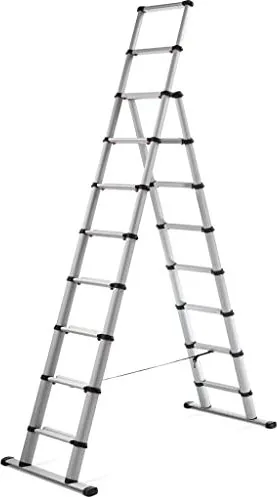
The Telesteps Combi Line 3.0M 2-piece telescopic multi-purpose ladder 2 x 8 steps is built for users who want one ladder that can do more than one job. It combines the practicality of a freestanding step ladder with the reach of a leaning ladder, making it a smart choice for maintenance, decorating, inspection work, and everyday projects around the home or workplace.
What makes this design stand out is its telescopic structure. The ladder expands from a compact carrying size into a full-height working ladder, then folds back down again when the job is done. That compact format is especially useful if storage space is limited or if the ladder needs to be transported between locations. The detachable carry handle also makes it easier to move and balance.
Safety and control are central to the ladder’s design. The locking catches are intended to keep each section secure during use, while the spreader mechanism helps stabilize the ladder in freestanding mode. The manual clearly emphasizes checking every lock before climbing, which reflects how important correct setup is for telescopic equipment. With a maximum load of 150 kg, it supports a wide range of light-duty tasks while still demanding careful handling.
The ladder can be used in two main ways. In step-ladder mode, it should be fully opened and locked before standing on it. In leaning-ladder mode, it must be positioned at the correct angle and placed against a firm, level surface. These details matter because they help preserve the ladder’s stability and reduce the risk of slipping or unwanted movement.
Maintenance is another major part of the product story. The telescopic tubes and rungs need to stay clean so the mechanism continues to slide smoothly. Dirt, paint, glue, and other contamination can affect performance over time, so regular wiping and proper drying are essential. Rubber feet and end caps also play an important role in grip and protection, and they should be inspected often.
Notes
- Always confirm that every locking catch is fully engaged before use.
- Keep the ladder dry, clean, and stored in its compact closed position.
- Use only for suitable light work and avoid rough or dirty environments.
Overall, this ladder is a versatile, space-saving solution for users who value portability, flexibility, and disciplined safety practices.
Search for 67,732 Manuals online


Type-in Brand or Model