
Supermicro X12STN-H Manual
PDF manual · 115 Pages
English


Quick check
Incorrect answer, please try again.
Chat with your Supermicro X12STN-H manual using AI
Get instant AI answers from your Supermicro X12STN-H manual
Ask anything about the Supermicro X12STN-H. Answers come from this manual, with the pages they are based on.
Ask a Question
Do you recommend X12STN-H?
Yes NoFrequently Asked Questions
The X12STN family supports 11th‑Generation Intel Core U‑series processors across SKUs: Core i7 (X12STN‑H), Core i5 (X12STN‑E), Core i3 (X12STN‑L) and Celeron (X12STN‑C), providing low‑power 15W TDP operation with varying graphics and vPro support.
Is this answer helpful?
The board supports up to 64GB total via two DDR4 SO‑DIMM slots (up to 32GB per SODIMM) and official support extends to DDR4‑3200 Non‑ECC memory; matched modules and correct installation are recommended for stability.
Is this answer helpful?
Expansion includes three M.2 sockets (B‑Key for SATA/PCIe and SIM support, E‑Key for wireless/CNVi, and M‑Key for NVMe PCIe Gen4 x4), plus one SATA 6Gb/s port; use appropriate M.2 key/module combinations for desired interfaces.
Is this answer helpful?
Yes—standard SKUs support wide industrial ranges (e.g., −40°C to 60°C) and WOHS variants extend non‑conformal SKUs up to 85°C; confirm the specific model’s thermal rating and thermal solution for your use case.
Is this answer helpful?
It offers HDMI 2.0b (up to 4096×2304@60Hz), HDMI 1.4b (up to 4096×2160@30Hz), DP1.4a via Type‑C (supports high res up to 7680×4320 depending on CPU/GPU) and a dual‑channel 48‑bit LVDS connector for legacy panels.
Is this answer helpful?
Select SKUs (X12STN‑H/E) support Intel vPro/AMT for remote management; all SKUs offer TPM 2.0 for platform security and BIOS options for power, secure boot and recovery functions.
Is this answer helpful?
The board accepts 12–24V DC via an 8‑pin power connector; ensure a stable supply with adequate current, surge protection and correct connector wiring. WOHS and thermally constrained builds need proper thermal planning.
Is this answer helpful?
Advantages and Disadvantages
Advantages

- High integration: supports 11th‑Gen Intel U CPUs, up to 64GB DDR4, dual 2.5GbE and multiple M.2 slots.
- Rich multimedia: Intel Iris Xe/UHD graphics with HDMI 2.0b, HDMI 1.4b, DP1.4a (Type‑C) and LVDS support.
- Industrial ready: wide 12–24V input, fanless thermal option and extended temperature SKUs (to −40/85°C).
- Robust management: TPM 2.0, Intel vPro on select SKUs, SuperDoctor® monitoring and SMBus/GPIO headers.
- Compact SBC form factor: 102 × 146 mm footprint ideal for embedded/networking/storage appliances.
Disadvantages

- Single SATA port only — may limit legacy SATA device expansion without adapters.
- Complex M.2 pinouts/keying require careful module selection to match slot functions.
- Advanced BIOS and jumper settings assume professional installation and technical expertise.
- Some features (vPro, Iris Xe) vary by SKU; verify exact model capabilities before procurement.
- LVDS power selection and thermal sizing require extra attention to avoid panel or thermal issues.
Product Specification
Form Factor
proprietary (5.7"x4")
CPU
Intel Core i7-1185GRE, 4C/8T, 1.80-4.40GHz, 12MB+5MB Cache, 12W TDP, 12-28W cTDP, Codename "Tiger Lake-UP3" (Willow Cove, Intel 10nm SuperFin)
Chipset
System-on-Chip (SoC)
RAM
2x DDR4 SO-DIMM, dual PC4-25600S/DDR4-3200, max. 64GB (UDIMM)
Expansion Slots
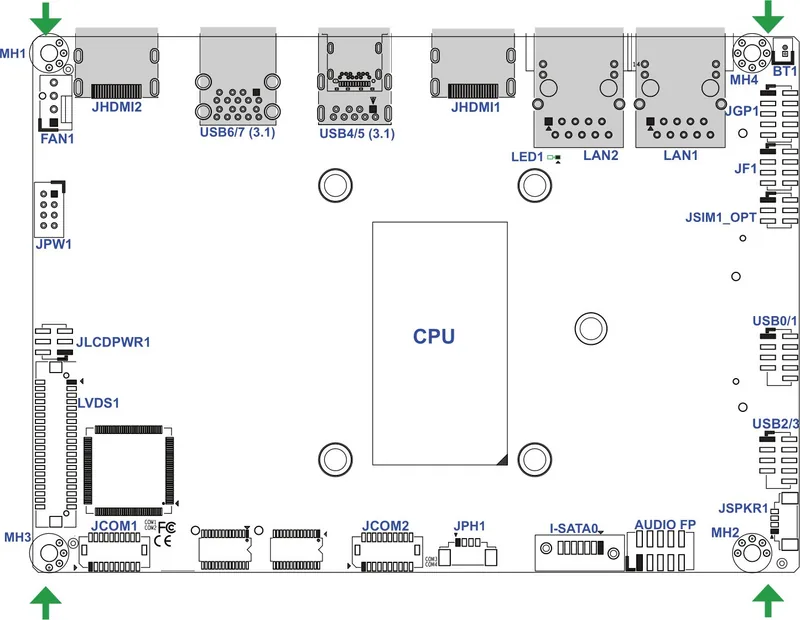
1x M.2/M-Key (PCIe 4.0 x4/SATA, 2280/2242), 1x M.2/B-Key (PCIe 3.0 x1/SATA, 2280/2242), 1x M.2/E-Key (Intel CNVi, 2230), 2x Mini SAS HD SFF-8643 (PCIe 3.0 x4)
External Ports
1x HDMI 2.0b (iGPU), 1x HDMI 1.4b (iGPU), 1x USB-C 3.1 (10Gb/s), 3x USB-A 3.1 (10Gb/s), 2x 2.5GBase-T (Intel I225-IT)
Internal Ports
2x USB 2.0 Header (480Mb/s, 4x USB 2.0), 1x SATA 6Gb/s, 1x Card reader (Nano-SIM), 2x serial, 1x TPM-Header, 1x GPIO-Header, 1x SMBus-Header
Cooling Header
1x Fan 4-Pin
Lighting Header
N/A
Buttons/Switches
N/A
Audio
7.1 (Realtek ALC888S)
Graphics
Intel Iris Xe Graphics (iGPU), 96EU/768SP, 1.35GHz, Architecture "Gen 12.1" (Tiger Lake GT2)
Wireless
N/A
RAID Level
N/A
Multi-GPU
N/A
Power Connectors
1x proprietary (8-Pin, 12-24V)
Lighting
N/A
Special Features
All solid capacitors, passively cooled
USB Notation
Link
Product Description
Supermicro X12STN-H Manual — Compact, Rugged, High‑Efficiency SBC
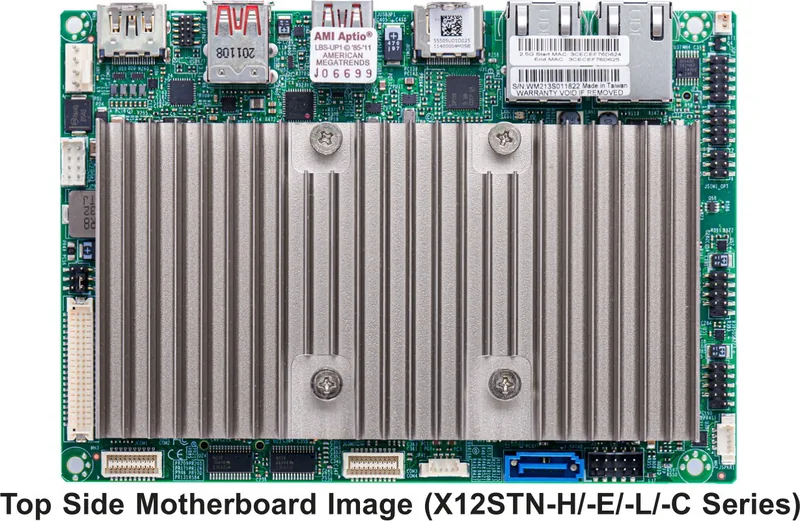
The Supermicro X12STN-H is a compact 3.5" single board computer built around 11th‑Gen Intel U‑series processors to deliver efficient, feature‑rich performance for embedded, industrial and edge applications. With support for Core i7/i5/i3 and Celeron variants, the board balances low TDP (15–28W) operation with capable integrated graphics (Intel Iris Xe or UHD) and multiple display outputs for flexible multimedia and signage use.
Designed for demanding embedded deployments, the X12STN‑H supports up to 64GB DDR4 SO‑DIMM memory at 3200MHz, dual Intel 2.5GbE ports, and three M.2 sockets (B/E/M keys) to accommodate NVMe storage, wireless modules and cellular SIMs. I/O is abundant: HDMI 2.0b, HDMI 1.4b, USB3.1 Gen2 Type‑C (DP Alt Mode), Type‑A ports, four front‑accessible USB2 headers, four COM ports (including RS232/422/485 options), SATA 6Gb/s, LVDS for legacy panels, audio headers and an onboard 3W speaker amplifier.
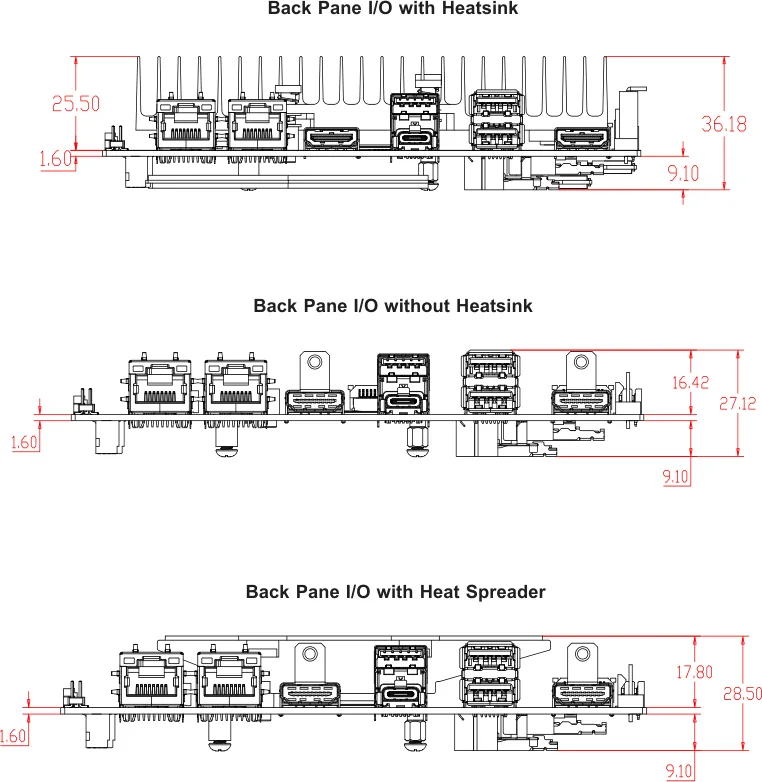
Thermal and power flexibility are core strengths: the board supports a wide 12–24V DC range, an optimized passive (fanless) heatsink option for silent operation, and industrial temperature models (down to −40°C or extended up to 85°C for WOHS SKUs). Firmware features include UEFI AMI BIOS with robust ACPI support, configurable power recovery, BIOS rescue/recovery and detailed CPU/power/performance controls. Management features target professional deployments with TPM 2.0, Intel vPro support on select SKUs, SuperDoctor® monitoring, SMBus/GPIO headers and onboard health sensors for voltages, temperatures and fan control.
Whether you need a compact system for networking, digital signage, industrial automation or storage gateways, the X12STN‑H combines modern CPU/GPU capabilities with flexible expandability, wide environmental tolerance and enterprise management features in a small‑footprint SBC.
Notes
- Industrial variants extend operating temperature ranges and remove heatsinks (WOHS) for specialized cooling or conformal coating workflows.
- Ensure correct LVDS panel VCC jumper selection (3.3V/5V/12V) before enabling LVDS output.
- M.2 slots carry different key types and interfaces—confirm B/E/M slot roles (SATA/PCIe/CNVi/USB) when selecting modules.
Search for 67,706 Manuals online


Type-in Brand or Model