
Supermicro LAN Adapter Manual
PDF manual · 27 Pages
English


Quick check
Incorrect answer, please try again.
Chat with your Supermicro LAN Adapter manual using AI
Get instant AI answers from your Supermicro LAN Adapter manual
Ask anything about the Supermicro LAN Adapter. Answers come from this manual, with the pages they are based on.
Ask a Question
Do you recommend LAN Adapter?
Yes NoFrequently Asked Questions
It is designed for server and data center networking where 10GbE speed, stable performance, and efficient CPU use are important. It fits virtualization, storage, and general high-throughput workloads well.
Is this answer helpful?
The i1S has one SFP+ port, while the i2S has two. The dual-port version is better for redundancy, separate traffic paths, or more flexible network design.
Is this answer helpful?
The family uses Intel 82599 controllers: 82599EN for the i1S and 82599ES for the i2S. These controllers are known for mature 10GbE performance and server-focused features.
Is this answer helpful?
It supports SFP+ direct-attached twin-ax cables and LC fiber-optic links when used with compatible transceiver modules. NC-SI cabling is also supported on matching Supermicro platforms.
Is this answer helpful?
Yes. Features like VMDq, SR-IOV, checksum offloading, and Receive Side Scaling are intended to improve VM performance and lower the networking burden on the host CPU.
Is this answer helpful?
It supports a broad set of server operating systems, including Windows Server versions, Windows desktop editions, Linux distributions such as Red Hat and SUSE, VMware, and FreeBSD.
Is this answer helpful?
Advantages and Disadvantages
Advantages

- Dual SFP+ connectivity gives flexible 10GbE deployment options for storage, virtualization, or uplinks.
- PCIe 2.0 x8 and low-profile design make it suitable for many server chassis.
- Strong offload and virtualization features help reduce CPU load under heavy network traffic.
- Broad OS support and NC-SI compatibility improve enterprise usability and remote management.
Disadvantages

- NC-SI is only available on compatible Supermicro motherboards, limiting universal use.
- SFP+ DAC or fiber accessories may be required, which can add setup cost.
- Best value is in server environments; it is more card than most basic office networks need.
- Physical fit should be checked carefully because chassis space can still be restrictive.
Product Specification
Type
LAN Adapter
Form Factor
1x PCIe card (interchangeable bracket: full height and low profile bracket included)
Interface
1x PCIe 2.0 x8
Ports
2x SFP+
Transmission
2x SFP+ (1G/10Gb/s)
Power Supply
Power supply only via interface
Chipset
Intel 82599 (LAN Adapter, SFP+)
Dimensions
4.02x2.72 in (WxH, without bracket)
Compatibility
universal
Special Features
VLAN, VXLAN, FCoE, iSCSI, PXE-Bootrom, NC-SI Header, SNMP-Management, Intel VT-c, SR-IOV
Product Description
Supermicro LAN Adapter, 2x SFP+, PCIe 2.0 x8: A Practical 10GbE Upgrade
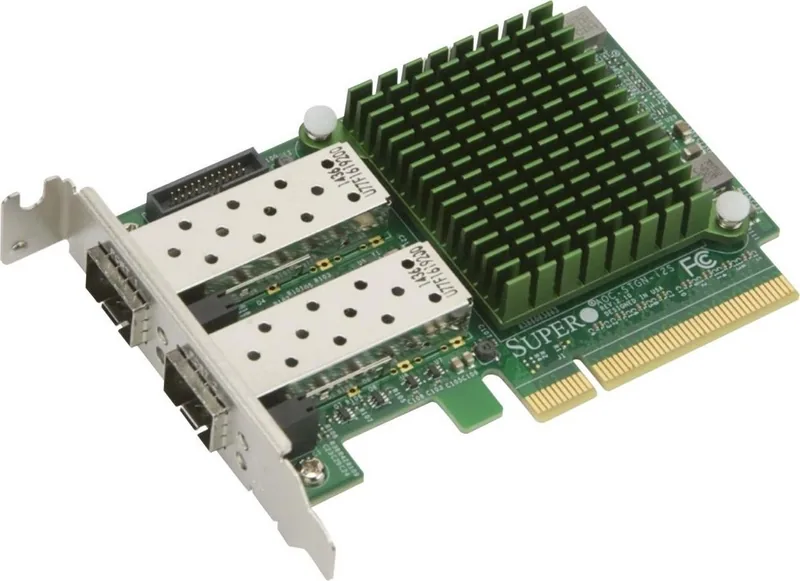
The Supermicro AOC-STGN-i1S and AOC-STGN-i2S are compact 10GbE LAN adapters designed for servers that need fast, reliable, and scalable connectivity. Built around Intel’s 82599 controller family, these cards target data center workloads where network throughput, low CPU overhead, and flexible deployment matter. The design keeps things simple: a standard low-profile form factor, PCIe 2.0 x8 interface, and SFP+ connectivity for high-speed links.
What makes this adapter especially useful is its balance between performance and versatility. The single-port i1S model is a clean fit for straightforward upgrades, while the dual-port i2S version is better suited to environments that need redundancy, segmentation, or separate traffic paths for storage and LAN. Both options support 10Gbps and 1Gbps links, and they work with direct-attached twin-ax cables or fiber solutions when paired with the right transceivers.
Beyond raw speed, the card is built with virtualization and server management in mind. Features such as VMDq, SR-IOV, checksum offloading, Receive Side Scaling, and Intel QuickData help reduce bottlenecks and improve efficiency under heavy workloads. That makes the adapter a strong match for virtualized hosts, storage networking, and systems that carry mixed traffic across multiple cores and applications.
Installation is straightforward for experienced technicians, though the usual ESD precautions apply. The adapter supports Windows, Linux, FreeBSD, VMware, and several server-class operating environments. Its NC-SI support also adds remote-management value on compatible Supermicro motherboards, making it easier to maintain visibility even when the main operating system is unavailable.
From a practical point of view, this adapter is best understood as a focused enterprise networking tool rather than a general-purpose consumer accessory. It is built for compatibility with Supermicro platforms, uses standard server networking conventions, and emphasizes reliability over novelty. If your goal is to modernize a server with stable 10GbE connectivity, this card delivers a disciplined and proven approach.
Notes
- Choose DAC or fiber media that matches your switch and transceiver requirements.
- NC-SI functionality depends on compatible Supermicro motherboards.
- Low-profile hardware fit can vary by chassis design, so verify clearance before installation.
Search for 67,706 Manuals online


Type-in Brand or Model