
Supermicro H8QG6-F Manual
PDF manual · 82 Pages
English



Quick check
Incorrect answer, please try again.
Chat with your Supermicro H8QG6-F manual using AI
Get instant AI answers from your Supermicro H8QG6-F manual
Ask anything about the Supermicro H8QG6-F. Answers come from this manual, with the pages they are based on.
Ask a Question
Do you recommend H8QG6-F?
Yes NoFrequently Asked Questions
The board supports AMD Opteron 6000-series CPUs using Socket G34 in up to a four-socket configuration. At least two processors are recommended for full functionality; verify supported CPU models and BIOS compatibility on Supermicro’s support pages before installation.
Is this answer helpful?
The motherboard supports 32 DDR3 DIMM slots: up to 256 GB with unbuffered DDR3 UDIMM or up to 1 TB using ECC RDIMMs. For best performance, populate DIMMs in groups associated with each installed CPU and follow the manual’s channel/bank interleaving tables (install in groups of four per CPU channel when applicable).
Is this answer helpful?
Yes — the H8QG6-F variant includes an LSI 2008 SAS2 controller providing eight SAS ports with RAID 0/1/10 supported and optional RAID-5. On-chip SATA provides six SATA ports with RAID 0/1/10. RAID codebase selection (Adaptec or DotHill) is configurable in BIOS; OS installations using RAID may require loading drivers during setup.
Is this answer helpful?
The board provides hardware health monitoring (voltages, temperatures, fan RPM), watchdog timer, chassis intrusion, and support for Supermicro’s SuperDoctor III. Optional BMC/IPMI 1.5/2.0 enables remote management, event logging, sensor monitoring, and remote console redirection.
Is this answer helpful?
A 24-pin ATX main power connector plus three 8-pin +12V CPU power connectors (JPW2/JPW3/JPW4) are required to support multi-CPU configurations. Using the correct connectors and a stable, compatible power supply is essential for reliable operation and to avoid voiding warranties.
Is this answer helpful?
Enable RAID in BIOS under IDE/SATA configuration (set OnChip SATA Type to RAID), choose the RAID codebase (Adaptec or DotHill), save and reboot, then use the RAID utility during POST (Ctrl+R or Ctrl+A). For Windows installs, prepare driver media (floppy or USB) from Supermicro’s FTP site and press F6 during Windows setup to load the RAID driver.
Is this answer helpful?
Power down and unplug the system, remove the onboard battery if instructed, then short the CMOS contact pads (JBT1) per the manual’s instructions to clear CMOS. Reconnect power and reboot; be aware clearing CMOS also removes BIOS passwords and saved settings.
Is this answer helpful?
Advantages and Disadvantages
Advantages

- Quad-socket support (Socket G34) for high compute density and scalability.
- Up to 32 DIMM slots: supports up to 1 TB ECC RDIMM or 256 GB UDIMM for large-memory workloads.
- Extensive storage: 6 SATA ports plus 8 SAS2 ports (H8QG6-F) with RAID support and SGPIO headers.
- Strong remote management: BMC/IPMI support, SuperDoctor III, hardware sensors and event logging.
- Flexible expansion: multiple PCIe Gen2 x16/x8 slots and UIO riser support for custom I/O.
Disadvantages

- Requires proprietary chassis/power supply and three 8-pin CPU power connectors for full operation.
- Complex memory population rules; optimal performance requires careful DIMM grouping per CPU.
- Older platform: DDR3 and Socket G34 limit modern upgrade paths compared to newer architectures.
- Onboard RAID codebases (Adaptec/DotHill) require driver steps during OS install (manual F6 process).
- Optional IPMI/RAID features and some firmware functionality may require additional configuration or jumpers.
Product Specification
Form Factor
SWTX
Socket
4x AMD G34, spread layout
Chipset
AMD SR5690/SR5670/SP5100
RAM
32x DDR3 DIMM, quad PC3L-12800R/DDR3L-1600, max. 256GB (UDIMM), 1TB (RDIMM)
Expansion Slots
2x PCIe 2.0 x16, 2x PCIe 2.0 x8
External Connectors
1x VGA (G200eW), 2x USB-A 2.0 (480Mb/s), 2x Gb LAN (Intel 82576), 1x PS/2 Keyboard, 1x PS/2 Mouse, 1x serial, 1x Management Port (RJ-45)
Internal Connectors
2x USB 2.0 Header (480Mb/s, 4x USB 2.0), 1x USB-A 2.0 Port (480Mb/s), 6x SATA 3Gb/s (AMD SP5100), 8x SAS 3Gb/s (LSI SAS 2008), 1x serial
Cooling Header
9x Fan 4-Pin
Lighting Header
N/A
Audio
N/A
Graphics
Matrox G200 - Onboard
Wireless
N/A
RAID Level
0/1/10 (SP5100), 0/1/5/10 (LSI SAS 2008)
Multi-GPU
N/A
Power Connectors
1x 24-Pin ATX, 3x 8-Pin EPS12V
Lighting
N/A
Features
All solid capacitors, IPMI 2.0
USB Notation
Link
Product Description
Supermicro H8QG6-F — Supermicro H8QG6-F Manual
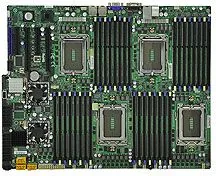
The Supermicro H8QG6-F is a high-density server motherboard built for multi-socket AMD Opteron platforms, designed for enterprise and data-center use. Supporting up to four Socket G34 processors and extensive DDR3 memory configurations, this board targets system integrators and technicians who need robust I/O, storage, and management features. With support for up to 256 GB of unbuffered DDR3 or up to 1 TB of registered ECC DDR3 across 32 DIMM slots, the H8QG6-F delivers large-memory capacity for database, virtualization, and compute-heavy workloads.
This board uses the AMD SR5690/SR5670/SP5100 chipset family and exposes a rich set of expansion and connectivity options: multiple PCIe Gen2 slots (x16 and x8), onboard dual Intel 82576 gigabit LAN ports plus a dedicated IPMI LAN, and a Matrox G200 VGA controller. Storage flexibility is strong — six on-chip SATA ports (RAID 0/1/10) plus eight SAS2 ports served by an LSI 2008 controller on the H8QG6-F variant (SAS/RAID optional RAID-5). SATA and SAS management headers (SGPIO/T-SGPIO) allow backplane enclosure monitoring. The board supports UIO riser flexibility for adding LAN, InfiniBand, or extra SAS lanes.
Reliability and manageability are emphasized: hardware health monitoring, multiple fan headers with BIOS-driven fan control modes (Full Speed, Performance, Balanced, Energy Saving), voltage and temperature sensors, watchdog timer, chassis intrusion detection, and Supermicro SuperDoctor III remote/local management software. IPMI 1.5/2.0 support (optional) and onboard BMC functionality let administrators monitor events, power states, and sensor logs. BIOS features include comprehensive chipset, memory timing, and power configuration options, RAID codebase selection (Adaptec or DotHill), ACPI/WOL support, and remote console redirection options.
Installation notes and best practices are covered: proper handling of static-sensitive devices, CPU and heatsink installation, correct population of DIMM channels for optimal interleaving and performance, and power connector requirements (24-pin ATX plus three 8-pin 12V CPU connectors for full operation). The manual details jumper/clear-CMOS procedures, onboard front-panel pinouts, SATA/SAS connector pinouts, and driver/RAID driver installation steps for OS deployment (including F6 driver install for Windows). BIOS update and troubleshooting guidance—beep codes, POST checkpoint codes, and common failure checks—are also provided.
For rack or chassis integration, the board’s form factor (418 x 330 mm) and recommended proprietary power supplies are noted, plus safety and disposal warnings regarding the onboard CR2032 battery and lead solder handling. Overall, the H8QG6-F is positioned as a versatile, serviceable serverboard for demanding multi-socket deployments requiring large memory footprints, multiple I/O and storage options, and strong remote management capabilities.
Notes
- Supports quad-socket AMD Opteron G34 CPUs; at least two CPUs required for full features.
- H8QG6-F includes integrated LSI 2008 SAS2 (8 ports); H8QGi-F lacks onboard SAS.
- Populate DIMMs in groups per CPU for best interleaving and performance.
- Use recommended CR2032 battery orientation and dispose of batteries per local regulations.
Search for 67,706 Manuals online


Type-in Brand or Model