
Supermicro Goldmont Series Manual
PDF manual · 111 Pages
English



Quick check
Incorrect answer, please try again.
Chat with your Supermicro Goldmont Series manual using AI
Get instant AI answers from your Supermicro Goldmont Series manual
Ask anything about the Supermicro Goldmont Series. Answers come from this manual, with the pages they are based on.
Ask a Question
Do you recommend Goldmont Series?
Yes NoFrequently Asked Questions
It utilizes an integrated Intel Atom C3000 Series System-on-Chip (SoC) with up to 16 cores and a 32W TDP.
Is this answer helpful?
The board supports up to 256GB of RDIMM or 64GB of Non-ECC/ECC UDIMM DDR4 memory running at speeds up to 2400MHz.
Is this answer helpful?
Yes, it features an ASpeed AST2400 BMC chip that supports full IPMI 2.0 functionality for remote monitoring and control.
Is this answer helpful?
No, the board has two PCI-E 3.0 x8 slots but allows only one to be active at a time, selected via the JSEL1 jumper.
Is this answer helpful?
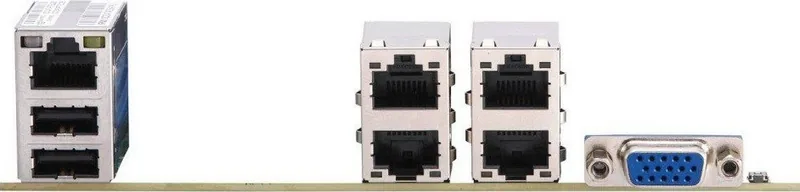
There are five LAN ports total: one Gigabit Ethernet port and four 10Gigabit Ethernet ports for high-speed data transfer.
Is this answer helpful?
Yes, a BIOS Recovery jumper (JBR1) allows users to restore the firmware if the system becomes unbootable due to corruption.
Is this answer helpful?
It uses a compact FlexATX form factor measuring 9 inches by 7.25 inches, designed for embedded and small chassis applications.
Is this answer helpful?
Advantages and Disadvantages
Advantages

- High core count up to 16 cores with ultra-low 32W TDP
- Four 10G LAN ports provide exceptional network throughput
- Integrated BMC supports advanced IPMI 2.0 remote management
- Dual M.2 slots offer flexible storage and expansion options
- Robust system health monitoring prevents overheating and failures
Disadvantages

- Only one PCI-E slot can be active at a time due to jumper selection
- Maximum memory capacity is limited compared to standard server boards
- Requires professional installation and maintenance by technicians
- No native ECC support for non-RDIMM UDIMMs
- Complex jumper settings may confuse inexperienced users
Product Specification
Chipset
System-on-Chip (SoC)
Header Lighting
N/A
Audio
N/A
Graphics
ASPEED AST2400 - Onboard
Wireless
N/A
RAID Level
N/A
Multi-GPU
N/A
Power Connectors
1x 24-Pin ATX, 1x 4-Pin ATX12V, 1x 4-Pin Molex
Lighting
N/A
USB Formatting
Link
Product Description
Supermicro Goldmont: The Powerhouse for Embedded Solutions
The Supermicro Goldmont motherboard series, specifically the A2SDV-8C/-12C+/-16C-TLN5F models, represents a pinnacle of efficiency and performance in the embedded computing sector. Designed with an integrated Intel Atom SoC from the C3000 series, these boards deliver up to 16 cores while maintaining a remarkably low thermal design power of just 32 watts. This unique combination makes them ideal for demanding workloads such as networking appliances, cloud storage servers, and edge computing devices where space and energy consumption are critical factors.
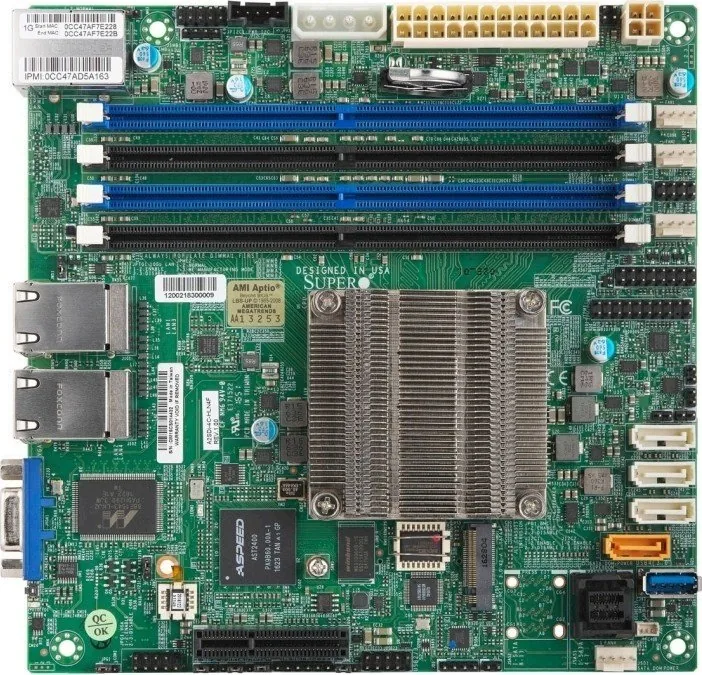
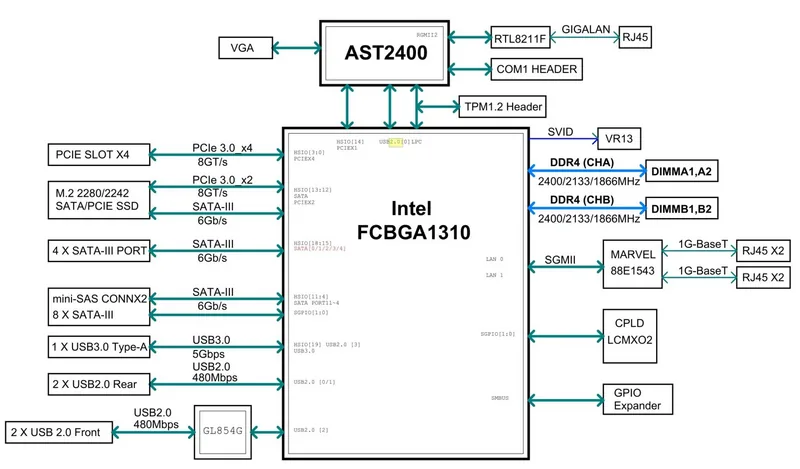
Engineered for flexibility, the motherboard features a compact FlexATX form factor that fits seamlessly into small form factor chassis without sacrificing expandability. Users benefit from two M.2 connectors supporting both PCIe and SATA interfaces, allowing for rapid boot drives or high-speed NVMe storage expansion. Connectivity is robust, offering four dedicated 10G LAN ports alongside a Gigabit Ethernet port, ensuring seamless integration into high-bandwidth networks. The system also includes dual PCI-E 3.0 x8 slots, though only one can be active at a time, selectable via jumper settings to suit specific hardware requirements.
Reliability is at the core of the Supermicro design philosophy. The board incorporates comprehensive system health monitoring through an onboard Baseboard Management Controller (BMC) based on the ASpeed AST2400 chip. This enables remote management capabilities via IPMI 2.0, allowing administrators to monitor voltage levels, fan speeds, and temperatures in real-time. Features like automatic recovery from AC power loss and watchdog timers ensure that systems remain operational even in unstable environments. Whether you are deploying a network gateway or a lightweight database server, this platform provides the stability and control necessary for professional applications.
Notes:
- Always populate DIMMA1 first for optimal memory channel configuration.
- Ensure adequate airflow when installing heatsinks to manage the CPU TDP effectively.
- Use only certified DDR4 memory modules to guarantee compatibility and stability.
Search for 67,706 Manuals online


Type-in Brand or Model