
Supermicro AOC-STG-i4T Manual
PDF manual · 29 Pages
English



Quick check
Incorrect answer, please try again.
Chat with your Supermicro AOC-STG-i4T manual using AI
Get instant AI answers from your Supermicro AOC-STG-i4T manual
Ask anything about the Supermicro AOC-STG-i4T. Answers come from this manual, with the pages they are based on.
Ask a Question
Do you recommend AOC-STG-i4T?
Yes NoFrequently Asked Questions
It combines four 10GbE RJ-45 ports, PCIe 3.0 x8 bandwidth, and hardware offloads that help servers move large amounts of traffic efficiently. It is a good fit for virtualization, storage, and network-heavy workloads.
Is this answer helpful?
RJ-45 lets you use familiar copper Ethernet cables, which are often cheaper and easier to deploy. It can be a practical choice when you want 10GbE without adding fiber transceivers or specialized cabling.
Is this answer helpful?
Yes. The adapter includes technologies such as SR-IOV, VMDq, VxLAN, and NVGRE support. These features help improve traffic handling, VM isolation, and performance in virtualized server environments.
Is this answer helpful?
The card supports several major platforms, including Windows Server, Linux distributions, FreeBSD, UEFI environments, and VMware ESXi. That broad support makes it easier to use across mixed infrastructure.
Is this answer helpful?
Yes. NC-SI support helps connect the network controller with the motherboard management controller, which can be valuable for out-of-band administration and monitoring in enterprise systems.
Is this answer helpful?
It is best for system integrators, IT administrators, and advanced users who need dependable 10GbE networking in a server or data-center setting, especially where copper cabling and Supermicro integration are priorities.
Is this answer helpful?
Advantages and Disadvantages
Advantages

- Four 10GbE RJ-45 ports support flexible multi-connection server setups.
- PCIe 3.0 x8 design helps sustain high throughput across all ports.
- Virtualization offloads improve efficiency in VM-heavy environments.
- NC-SI and thermal monitoring add useful management and safety features.
Disadvantages

- Copper 10GBASE-T can use more power than some fiber alternatives.
- Best results come from Supermicro-compatible hardware ecosystems.
- Four-port design may be unnecessary for small or low-traffic systems.
- Higher power draw than simpler dual-port network adapters.
Product Specification
Type
LAN Adapter
Form Factor
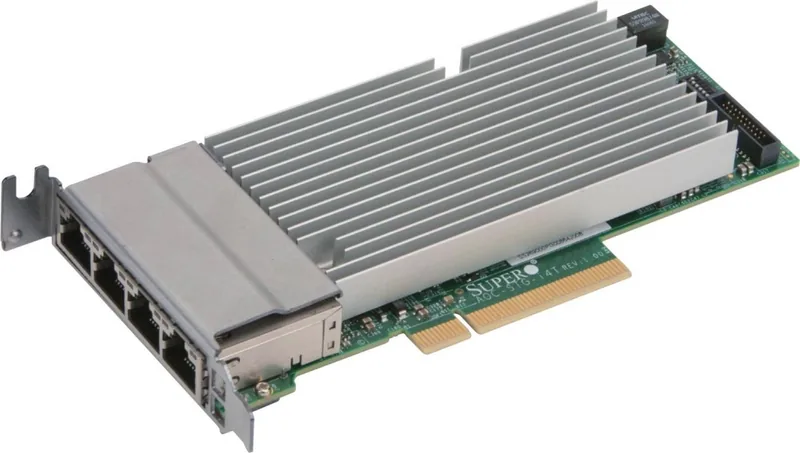
1x PCIe card (interchangeable bracket: full height and low profile bracket included)
Connection
1x PCIe 3.0 x8
Ports
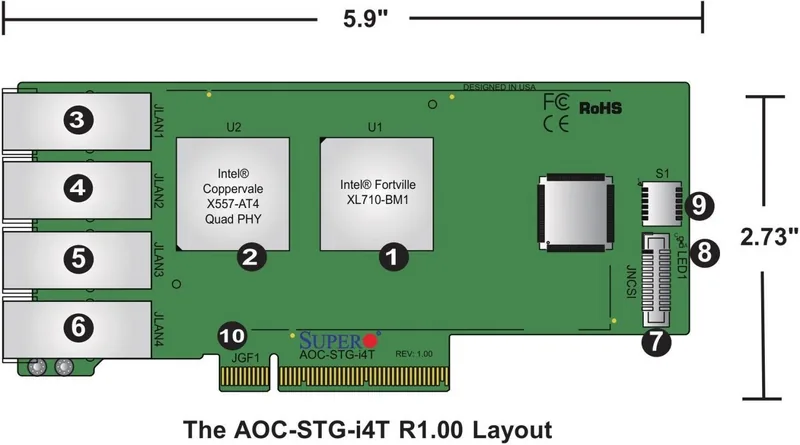
4x RJ-45
Transfer Rate
4x RJ-45 (100/1000/10GBase-T)
Power Supply
Power supply only via connection
Chipset
Intel XL710 (LAN Adapter, RJ-45), Intel X557 (LAN Adapter, RJ-45)
Dimensions
5.91x2.72 in (WxH, without bracket)
Compatibility
universal
Special Features
NVGRE, VLAN, VXLAN, LACP, PXE Bootrom, iSCSI, SNMP Management, Intel VT-c, SR-IOV
Product Description
Supermicro 10G LAN Adapter: Practical 4-Port Performance for Modern Servers
The Supermicro 10G LAN Adapter, 4x RJ-45, PCIe 3.0 x8 Manual points to a networking card built for real-world server workloads where speed, stability, and easy deployment matter. Designed around Intel networking silicon, this adapter brings four 10GBase-T ports into a compact low-profile form factor, making it a strong fit for data centers, virtualization hosts, storage nodes, and business servers that need reliable copper-based connectivity.
What stands out first is the balance between performance and convenience. With four RJ-45 ports, the card can connect through standard Ethernet cabling, which simplifies installation and often reduces infrastructure costs compared with fiber-based alternatives. The PCIe 3.0 x8 interface provides enough bandwidth for multi-port traffic, while the hardware offloads and queue management features help reduce CPU load under heavy network activity.
This adapter is also tuned for advanced environments. Support for VxLAN, NVGRE, SR-IOV, VMDq, VLAN tagging, and flow control makes it suitable for virtualization and segmented networks. In practice, that means better traffic isolation, more efficient packet handling, and smoother operation when multiple virtual machines or services share the same physical server.
Supermicro also clearly aimed this product at managed server deployments. NC-SI support can help with out-of-band management, while the onboard thermal sensor and overheat LED add a layer of hardware visibility. The card is intended to integrate cleanly with Supermicro systems and motherboards, and it supports major operating systems including Windows Server, Linux, FreeBSD, UEFI, and VMware ESXi.
From a usage perspective, the adapter is best for teams that want a dependable 10GbE copper solution without unnecessary complexity. It is especially appealing where short installation time, broad compatibility, and straightforward cabling matter more than chasing the latest headline speed. Power draw is moderate for a four-port design, and the low-profile bracket options help it fit a wide range of chassis.
Notes
- Best suited for server and data-center networking
- Uses standard RJ-45 cabling for simple deployment
- Strong fit for virtualization and remote management setups
- Designed primarily for Supermicro platform integration
Search for 67,706 Manuals online


Type-in Brand or Model