
Supermicro AOC-STG-i2T Manual
PDF manual · 27 Pages
English



Quick check
Incorrect answer, please try again.
Chat with your Supermicro AOC-STG-i2T manual using AI
Get instant AI answers from your Supermicro AOC-STG-i2T manual
Ask anything about the Supermicro AOC-STG-i2T. Answers come from this manual, with the pages they are based on.
Ask a Question
Do you recommend AOC-STG-i2T?
Yes NoFrequently Asked Questions
It combines dual 10G RJ-45 ports, PCIe 2.1 x8 connectivity, and server-focused features like jumbo frames, virtualization support, and load balancing. That makes it well suited for heavy network traffic and data center workloads.
Is this answer helpful?
Yes. The adapter supports auto-negotiation between 1GbE and 10GbE, so it can operate in older networks while allowing a smooth transition to faster speeds later.
Is this answer helpful?
Cat6 cable can work up to shorter distances, while Cat6A is recommended for the full 10GbE reach. Using the right cable is important to maintain stable performance and speed.
Is this answer helpful?
It is designed for standard PCIe x8 server slots and low-profile or full-height brackets, so installation is straightforward for qualified users. Proper ESD precautions and system shutdown are still essential.
Is this answer helpful?
It includes jumbo frame support, TCP/UDP offload, MSI-X, Direct Cache Access, and virtualization features such as VMDq and SR-IOV. These help reduce CPU load and improve throughput.
Is this answer helpful?
No. Some features vary by revision. For example, asset management and thermal alert functions are available only on newer revisions, while older versions may include different jumper and power options.
Is this answer helpful?
Advantages and Disadvantages
Advantages

- Dual RJ-45 ports simplify 10G copper networking and help reuse existing cabling.
- Backward compatibility with 1GbE supports gradual upgrades in mixed network environments.
- PCIe 2.1 x8 and low-profile design fit many server builds without major space issues.
- Advanced features like jumbo frames, virtualization support, and load balancing improve efficiency.
Disadvantages

- 10G performance depends on proper Cat6/Cat6A cabling and compatible network equipment.
- Power draw and heat are higher than basic Gigabit adapters, so cooling matters.
- Some manageability and thermal features are revision-specific or limited to certain Supermicro systems.
- Not all operating systems or platform setups are equally supported, especially older environments.
Product Specification
Type
LAN adapter
Form factor
1x PCIe card (interchangeable bracket: full height and low profile bracket included)
Interface
1x PCIe 2.1 x8
Ports
2x RJ-45
Transmission
2x RJ-45 (100/1000/10GBase-T)
Power supply
Power supply only via interface
Chipset
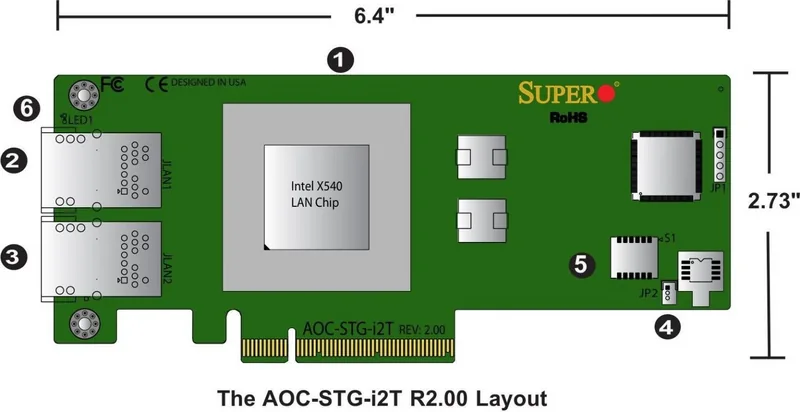
Intel X540 (LAN adapter, RJ-45)
Dimensions
5.91x2.72 in (WxH, without bracket)
Compatibility
universal
Features
VLAN, VXLAN, Wake on LAN, 15.5KB Jumboframes, FCoE, iSCSI, Intel VT-c, PXE-Bootrom 2.0, LACP, SR-IOV
Product Description
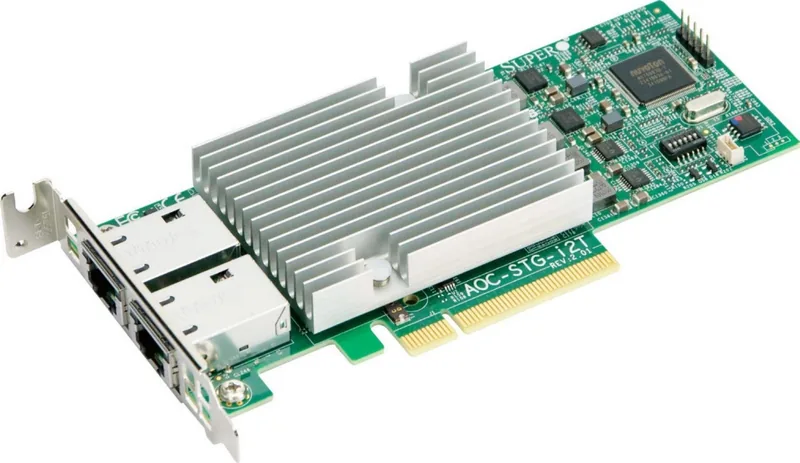
Supermicro 10G LAN Adapter, 2x RJ-45, PCIe 2.1 x8 Manual: A Practical Look
The Supermicro 10G LAN Adapter, 2x RJ-45, PCIe 2.1 x8 Manual highlights a network card built for fast, reliable server connectivity. At its core, this adapter is designed to bridge the gap between classic Gigabit Ethernet and modern 10GbE networking, making it a smart upgrade path for data centers and business servers that need more bandwidth without replacing every part of the infrastructure.
One of its biggest strengths is flexibility. The dual RJ-45 ports support both 10GbE and 1GbE auto-negotiation, which means it can work smoothly in mixed environments. That backward compatibility helps teams upgrade gradually, while still gaining the speed and responsiveness needed for backup jobs, virtualization, large file transfers, and storage-heavy workloads. Because it uses copper Ethernet, it also benefits from familiar cabling and longer reach compared with many fiber-based alternatives.
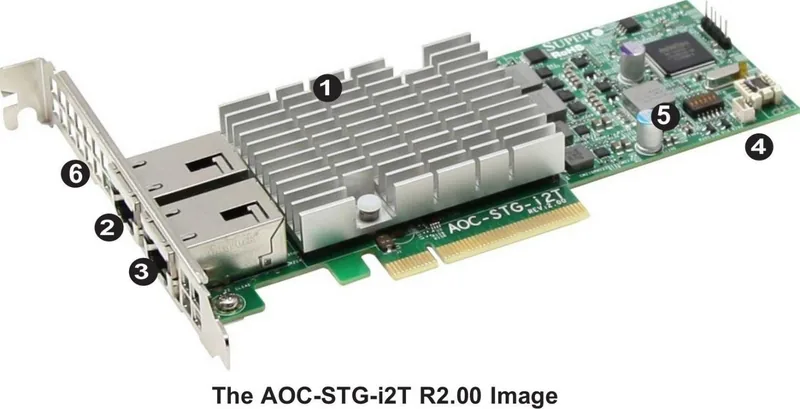
The adapter follows a PCIe 2.1 x8 design and comes in a compact, low-profile form factor, making it a good fit for dense server builds. The hardware is also tuned for performance efficiency, with features such as jumbo frame support, load balancing across CPUs, interrupt reduction, and support for virtualization technologies like VMDq and SR-IOV. In practical use, that means less pressure on the host processor and a more stable network experience under demanding traffic.
Beyond raw speed, the card reflects Supermicro’s server-focused approach. It includes manageability features on supported revisions, thermal alert support on newer versions, and compatibility with common operating systems used in enterprise environments. That makes it appealing for IT teams that value monitoring, serviceability, and predictable deployment.
Why it stands out
This adapter is not just about faster networking; it is about balanced performance, easier migration, and dependable integration inside Supermicro systems. For organizations modernizing infrastructure, it offers a cost-conscious way to step into 10G networking while keeping installation and maintenance straightforward.
Notes
- Best suited for server and data center environments.
- Requires proper cooling and compatible PCIe x8 hardware.
- Cat6 or Cat6A cabling is recommended for 10G operation.
- Some functions vary by revision and platform support.
Search for 67,706 Manuals online


Type-in Brand or Model