
Sungrow SH15/20/25T Manual
PDF manual · 152 Pages
English



Quick check
Incorrect answer, please try again.
Chat with your Sungrow SH15/20/25T manual using AI
Get instant AI answers from your Sungrow SH15/20/25T manual
Ask anything about the Sungrow SH15/20/25T. Answers come from this manual, with the pages they are based on.
SH15/20/25T Maintenance Schedule
Check the fastener, appearance, voltage, and resistance of the button cell quarterly when relevant fault alarms occur.
Conduct periodic inspections at least once every six months. Replace packaging materials if insect or rodent bites are found.
Check temperature and dust of the inverter. Clean the enclosure if necessary depending on air dust content.
Check whether all cables are firmly connected and inspect for damage, especially where cables contact metal.
Visually check for damage or deformation, listen for abnormal noise, verify operation parameters, and ensure nothing covers the heat sink.
If installed in dusty environments, clean fans and heat sink regularly to ensure good heat dissipation performance.
Free maintenance reminders
Timed to your purchase date. Always free, unsubscribe anytime.
Ask a Question
Do you recommend SH15/20/25T?
Yes NoFrequently Asked Questions
The SH15/20/25T are three-phase hybrid inverters designed to convert PV DC power to AC, manage battery charge/discharge, optimize self-consumption with an integrated EMS, and provide backup power for protected loads.
Is this answer helpful?
Yes. When household loads are wired to the inverter LOAD terminal and within the inverter's backup capacity, the system can supply all household loads from PV and battery during grid outages; a manual changeover and proper wiring are required.
Is this answer helpful?
SUNGROW Li-ion batteries listed in the compatibility table are supported (e.g., SBR and SBH series). Using third-party batteries requires validation for charge/discharge compatibility; unsupported batteries may limit features or performance.
Is this answer helpful?
A Smart Energy Meter is recommended to enable feed-in limitation, proper export control, and optimized energy management. Without it, the inverter can still operate but battery discharge and certain control features may be restricted.
Is this answer helpful?
The inverter includes anti-islanding, earth-fault alarm with DO relay, residual current monitoring, DC over/under-voltage and over-current protection, short-circuit protection, and grounding detection, plus multiple operational safeguards for installation and maintenance.
Is this answer helpful?
Yes—up to two identical SH-series hybrid inverters can be paralleled for grid-connected PV ESS; parallel configuration, master/slave roles, and unified management are supported via RS485 and iSolarCloud.
Is this answer helpful?
Verify proper grounding, AC/DC wiring and polarity, sealed unused terminals, correct AC circuit breakers and protection devices, communication links, and that DC switches and breakers are OFF prior to first startup.
Is this answer helpful?
Advantages and Disadvantages
Advantages

- Integrated PV MPPT and bidirectional battery management for efficient self-consumption and backup.
- Robust safety suite: anti-islanding, earth-fault alarm, residual current monitoring, and multiple protections.
- Supports whole-home backup and parallel operation (up to two inverters) for scalable installations.
- Remote monitoring and configuration via WiNet-S2 and iSolarCloud with firmware updates and logs.
- Versatile retrofit options to upgrade existing PV systems into PV‑ESS with improved energy management.
Disadvantages

- Backup operation not guaranteed for life-sustaining medical devices; limited to supported load profiles.
- Battery compatibility limited to approved models; third-party batteries may require validation.
- Requires qualified technicians for installation; improper wiring or grounding voids warranty.
- PV strings and battery voltages must stay within strict limits (max DC 1000 V), restricting some designs.
- Some advanced functions depend on Smart Energy Meter presence; absent meter limits discharge control.
Product Specification
Note
Prices partly include 0% VAT rates for AT and DE
Input Voltage
150-1000V DC Voltage (DC)
Max. Input Current
16A
MPP Voltage Range
150-950V DC Voltage (DC)
Number of MPP Trackers
3
Output Phases
3-phase
Input
MC4
Interfaces
Wi-Fi (WLAN), 1x RJ-45, 1x RS-485
Protection Class
IP65
Ambient Temperature
-13°F to +140°F
Dimensions
24.41x18.90x9.65in (WxHxD)
Product Description
Sungrow SH15/20/25T Manual — Overview and Product Description
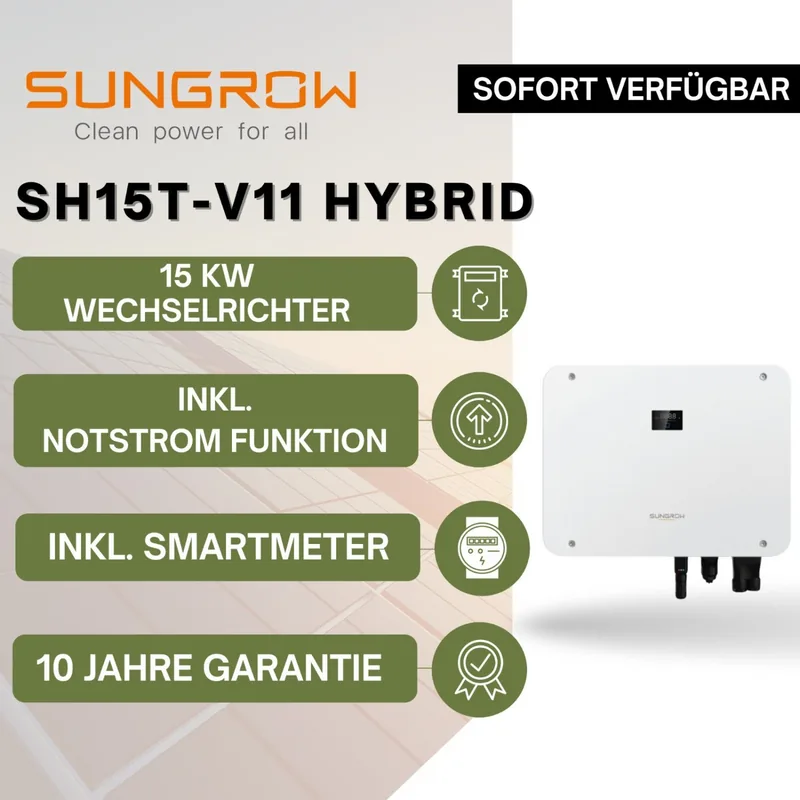
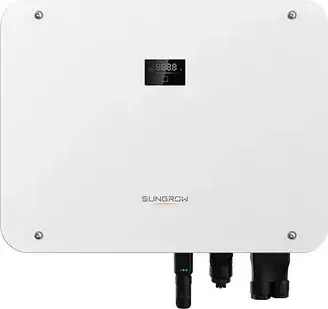
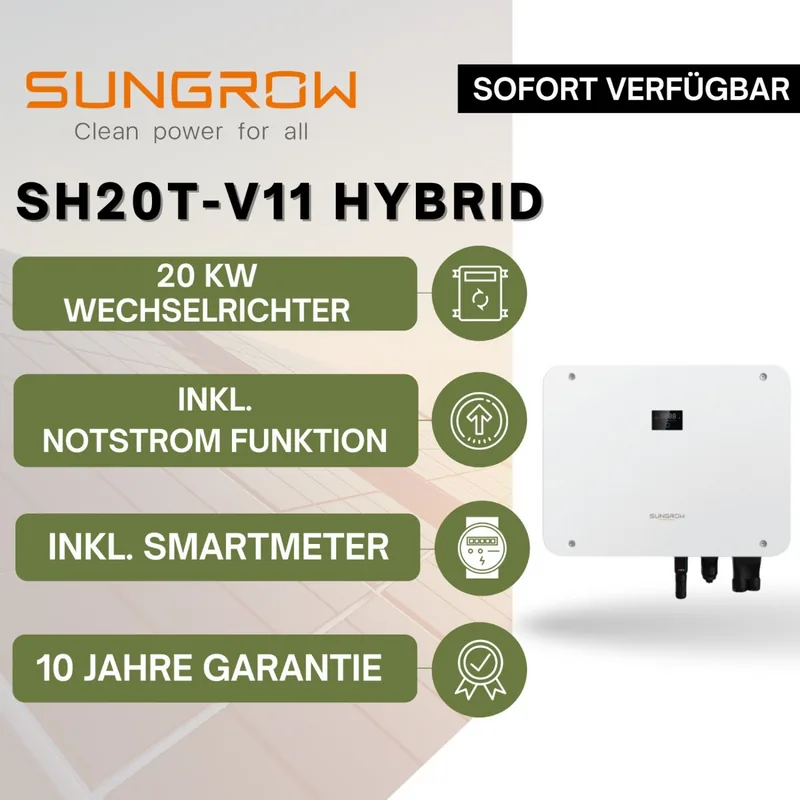
The Sungrow SH15/20/25T series are three-phase hybrid inverters designed for residential and small commercial photovoltaic (PV) energy systems with integrated energy storage. Combining PV MPPT conversion, bidirectional battery management, and advanced energy management, these inverters support on-grid generation, off-grid backup, and whole-home backup scenarios. With IP65 protection, multiple MPPT inputs, and compatibility with SUNGROW Li-ion batteries, the SH15/20/25T models offer flexible deployment for modern PV-plus-storage installations.
Key Features and Capabilities
The SH15/20/25T family provides multi-MPPT inputs to optimize energy harvest from arrays with different orientations or tilts. Built-in bidirectional converters handle both battery charge and discharge while protecting battery life through SOC-based algorithms and emergency charge logic. The inverters include integrated safety protections (anti-islanding, ground-fault alarm, over/under voltage and frequency protections), a DO relay for external alarms or load control, and support for reactive power regulation.
Energy management prioritizes self-consumption: during daytime PV powers backup loads first, then normal loads, and charges the battery; at night the battery supplies loads while the grid fills shortfalls as needed. When equipped with a Smart Energy Meter, the inverter supports feed-in limitation and advanced export control. Parallel connection of up to two identical hybrid inverters is possible for increased capacity and unified energy management. The units also support retrofit modes to upgrade existing PV systems to PV-ESS configurations.
Install and Use Notes
Installation must be performed by qualified technicians and comply with local regulations. The inverter requires proper grounding, correctly sized AC/DC cabling, and attention to ventilation and mounting clearances. PV inputs must remain ungrounded and meet voltage/current limits. The inverter provides WiFi/Ethernet monitoring through the WiNet-S2 module and full remote access via iSolarCloud for configuration, logging, firmware updates, and diagnostics. Backup operation is supported but not guaranteed for life-support devices; start-up time and capacity depend on battery state and system conditions.
Product Benefits at a Glance
- Flexible multi-MPPT PV inputs for mixed arrays
- Integrated battery management and emergency charge protection
- Backup modes and whole-home backup wiring options
- Remote monitoring and configuration via iSolarCloud
- Safety features including earth-fault alarm and residual current monitoring
Notes:
- Only compatible battery models are supported for full functionality; consult manufacturer compatibility lists.
- Ensure PV string voltages and battery voltages remain within inverter limits (max DC input 1000 V).
- Follow local grid requirements (e.g., grounding types and protection devices) when wiring and commissioning.
Search for 67,706 Manuals online


Type-in Brand or Model