
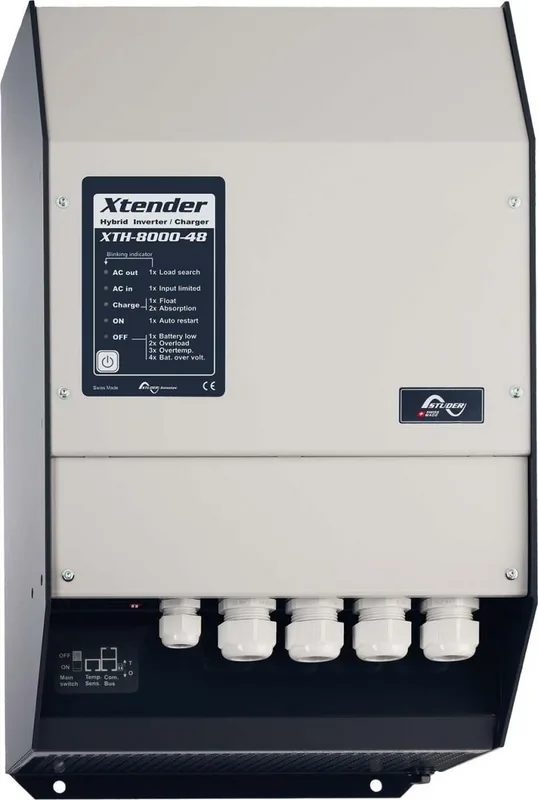
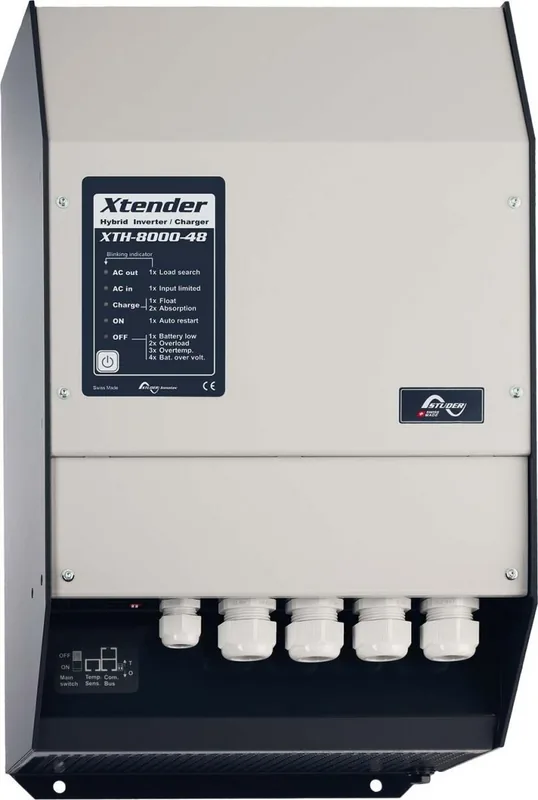
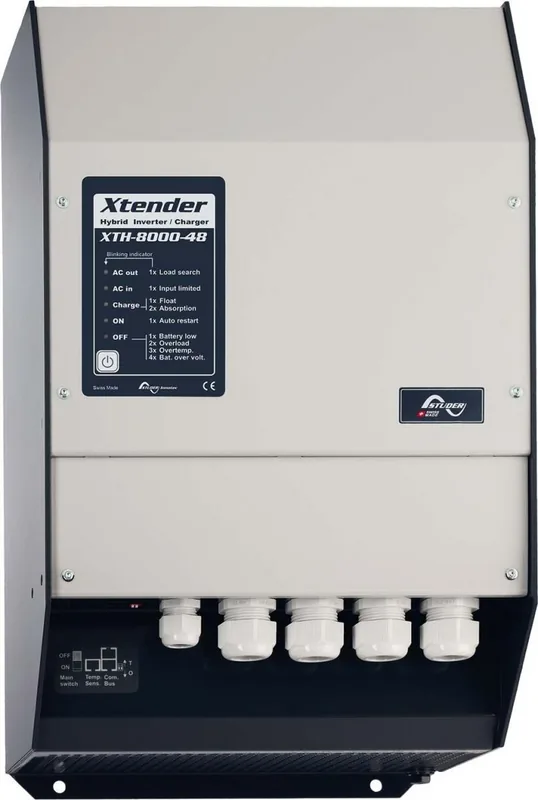
Studer Xtender XTH Manual
PDF manual · 1 Pages
English


Quick check
Incorrect answer, please try again.
Chat with your Studer Xtender XTH manual using AI
Get instant AI answers from your Studer Xtender XTH manual
Ask anything about the Studer Xtender XTH. Answers come from this manual, with the pages they are based on.
Ask a Question
Do you recommend Xtender XTH?
Yes NoFrequently Asked Questions
The XTH series is available for nominal battery voltages of 12 V, 24 V and 48 V, with continuous power ratings ranging from 2.5 kVA up to 8 kVA depending on the model. Choose the correct model to match your battery bank and load requirements.
Is this answer helpful?
Yes. The XTH produces a pure sine-wave output (230 Vac or 120 Vac where specified) with output regulation around ±2% (230 V) and adjustable output frequency. Harmonic distortion is below 2%, suitable for sensitive electronics.
Is this answer helpful?
The integrated charger uses a six-step charge algorithm (bulk, absorption, floating, equalization, reduced floating, periodic absorption). Number of steps, thresholds, end current and times are fully adjustable with RCC-02 or RCC-03 remote controls, enabling tailored battery management.
Is this answer helpful?
Available accessories include Xcom-232i, Xcom-LAN, Xcom-GSM, Xcom-SMS communication modules, a Battery Status Processor (BSP), RCC remote controls and other modules to enable LAN, GSM, SMS and serial monitoring and remote management.
Is this answer helpful?
The XTH features automatic overload and short-circuit disconnection with restart attempts, thermal protection with warning and auto-restart, forced ventilation above 55°C, IP20 protection rating, and an operating temperature range from -20°C to 55°C. Ensure proper enclosure and ventilation for harsh environments.
Is this answer helpful?
Some references end with -01 to indicate 120 V/60 Hz variants; not all models offer 120 V. Certain features—like adjustable functions, cooling-dependent performance, and temperature compensation—require optional accessories (RCC-02/03, ECF-01, BTS-01).
Is this answer helpful?
Studer backs the XTH series with a five-year warranty. The units comply with EU Low Voltage and EMC directives and reference standards such as EN 50178, EN 62040-2 and EN 61000 series; manufacturing follows relevant ISO certifications.
Is this answer helpful?
Advantages and Disadvantages
Advantages

- Pure sine-wave output with low harmonic distortion for sensitive electronics.
- High continuous power up to 8000 VA and strong short-term surge capability.
- Configurable six-step battery charger with high maximum charging currents.
- Comprehensive communication and remote control options for system integration.
- Rugged industrial design, wide operating temperature range and five-year warranty.
Disadvantages

- Some advanced features require optional accessories, adding cost and complexity.
- IP20 protection means enclosure is required for outdoor or dusty installations.
- Cooling module required for some adjustable features and higher-temperature operation.
- Weight and size may be substantial for certain mobile applications.
- 120 V variants and specific features are model-dependent and must be specified.
Product Specification
Note
Prices partially include 0%-VAT tax rates for AT and DE
Type
Battery inverter, with fan
Noise level
<45dB
Protection class
IP20
Ambient temperature
-4F to +131F
Dimensions
11.81x19.69x9.06in (WxHxD)
Product Description
Studer XTH — High‑Performance Inverter-Charger
The Studer XTH is a family of robust inverter-chargers designed for demanding off-grid, mobile and backup power installations. Available in 12 V, 24 V and 48 V nominal battery versions and rated from 2.5 kVA up to 8 kVA continuous (model dependent), the XTH line blends pure sine-wave inverter output, flexible charging algorithms and industrial-grade protection and communications.
Key product highlights
The XTH delivers pure sine 230 V (or 120 V variants) power with low total harmonic distortion and adjustable frequency. Efficiency reaches the mid-90s on larger models, keeping conversion losses low. Inverter output withstands heavy asymmetric and short-circuit loads, with automatic overload and short-circuit protection and thermal shutdown with automatic restart. Transfer times are under 15 ms for reliable continuity between sources.
Integrated chargers use a six-step charge profile (bulk, absorption, floating, equalization, reduced floating, periodic absorption) with fully configurable thresholds, currents and timers via remote control units (RCC-02 / RCC-03) and allow high charging currents (up to 160 A depending on model). Temperature compensation is supported with accessory sensors to optimize battery life.
For system integration the XTH includes multifunction relay contacts, optional communication modules (Xcom-232i, Xcom-LAN, Xcom-GSM, Xcom-SMS), a Battery Status Processor (BSP), and modules for remote control and monitoring. A cooling module (ECF-01) is available to enhance performance at elevated temperatures and certain features depend on fitted accessories.
Constructed for harsh environments, XTH units operate from -20 to 55°C with forced ventilation above 55°C, IP20 protection, and quiet acoustic levels under ventilation thresholds. They meet relevant EU Low Voltage and EMC directives and come with a five-year warranty and ISO certification background.
Typical use cases
- Off-grid solar or hybrid energy systems where reliable pure-sine output and high surge capacity are needed.
- Mobile power applications requiring compact, rugged inverter/chargers with remote management.
- Backup power installations where fast transfer times and configurable charging keep batteries healthy and loads protected.
Notes:
- Multiple nominal voltages and power ratings are available—select the model that matches battery voltage and continuous power requirements.
- Some features require optional accessories (RCC controls, ECF-01 cooling, BTS-01 temperature sensor).
- Output can be factory-configured for 230 V or 120 V versions where indicated.
Search for 67,706 Manuals online


Type-in Brand or Model