


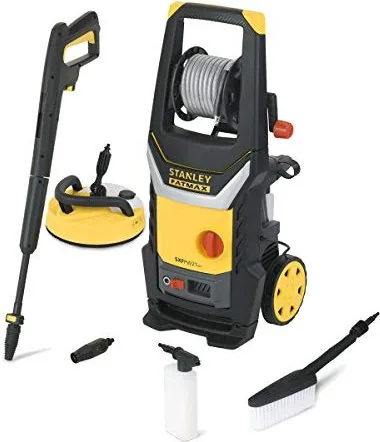
Stanley SXPW14E/16E Manual
PDF manual · 280 Pages
English



Quick check
Incorrect answer, please try again.
Chat with your Stanley SXPW14E/16E manual using AI
Get instant AI answers from your Stanley SXPW14E/16E manual
Ask anything about the Stanley SXPW14E/16E. Answers come from this manual, with the pages they are based on.
SXPW14E/16E Maintenance Schedule
Verify that all screws are fully tightened and check for broken or worn parts before every use.
Inspect the inlet filter (L) and detergent filter if fitted. Clean them according to instructions if necessary.
Disconnect the lance and remove dirt deposits from the nozzle hole using the provided cleaning tool (C1).
Run the appliance with non-corrosive, non-toxic antifreeze fluid before storing it in a dry place protected from frost.
Ask a Question
Do you recommend SXPW14E/16E?
Yes NoFrequently Asked Questions
The product information covers Stanley SXPW25DTS and SXPW27DTS high-pressure washer models. They offer 2.5 kW and 2.7 kW rated power respectively, with different maximum pressure and flow ratings.
Is this answer helpful?
It is intended for individual cleaning of vehicles, machines, boats, masonry, garden equipment, and similar durable surfaces. Use clean water and biodegradable detergents. Engine cleaning is only appropriate where contaminated water can be disposed of according to local rules.
Is this answer helpful?
Regular mode is intended for standard washing tasks. Heavy-duty mode raises cleaning force by 50% for more demanding grime. On large areas, a compatible Twin Nozzle adapter can use two nozzles simultaneously to reduce working time.
Is this answer helpful?
Yes. Use highly biodegradable detergent supplied or recommended for the washer. Select the detergent nozzle setting or fit the detergent accessory where provided. Avoid using overly thick detergent, and dilute it with water if needed.
Is this answer helpful?
Direct connection is permitted only when the supply hose has a compliant backflow preventer with drain facility. Follow local water authority requirements. Water that has passed through a backflow preventer is considered non-potable.
Is this answer helpful?
Use the lowest suitable pressure near wheels and tyres, keep the jet at least 30 cm away, and never aim directly at tyres. Do not use the turbo lance on vehicle parts. Avoid fine jet settings and rotating nozzles on delicate or painted surfaces.
Is this answer helpful?
Turn off the water, discharge residual pressure, switch off, unplug, empty and rinse the detergent tank, and engage the gun safety catch. Store the unit in a dry location protected from frost. Use non-toxic, non-corrosive antifreeze before winter storage if necessary.
Is this answer helpful?
Advantages and Disadvantages
Advantages

- Strong output: up to 16 MPa maximum pressure and 14.16 L/min maximum flow, depending on model.
- Two cleaning modes provide regular operation and heavy-duty cleaning with up to 50% more cleaning force.
- TSS models automatically stop the motor when the trigger is released, supporting efficient use.
- Adjustable nozzle, detergent control, and optional accessories improve versatility across cleaning tasks.
- Designed for vehicles, masonry, boats, machines, and outdoor surfaces using clean water and biodegradable detergent.
Disadvantages

- High pressure can damage tyres, painted finishes, delicate materials, and pressurized components if used incorrectly.
- Requires careful electrical and water-supply setup, including suitable outdoor extension leads and protection.
- Detergent suction may weaken or stop when using longer high-pressure hoses or hose extensions.
- The rotating nozzle may reduce pressure by about 25% compared with an adjustable nozzle.
- Noise levels can reach 95 to 97 dB(A), so hearing protection is recommended.
Product Specification
Operating mode
Cold water
Inlet temperature
max. 122°F
Mobility
Trolley
Product Description
Stanley High-Pressure Washer - Read, Download & Print Free
The Stanley High-Pressure Washer is built for demanding outdoor cleaning tasks, offering a practical way to refresh vehicles, patios, garden equipment, masonry, boats, and other durable surfaces. This range includes the SXPW25DTS and SXPW27DTS models, designed to combine strong water flow with adjustable cleaning control for regular maintenance and heavier dirt removal.
Powerful Cleaning for Home Projects
With rated power options of 2.5 kW and 2.7 kW, these washers provide operating pressure up to 10.7 MPa and maximum pressure up to 16 MPa, depending on the model. A 9.5 L/min rated flow helps lift stubborn grime efficiently, while maximum flow reaches 13.5 to 14.16 L/min. The result is reliable cleaning performance for driveways, exterior walls, garden furniture, machinery, and vehicles.
The two-mode control supports regular cleaning and heavy-duty cleaning. Heavy-duty mode increases cleaning force by 50%, making it useful for larger or dirtier areas. Compatible accessories may include a rotating nozzle, brush, detergent kit, hose reel, surface-cleaning brush, pipe-cleaning kit, and Twin Nozzle adapter. The Twin Nozzle setup can use two nozzles at once to reduce work time on broad surfaces.
Adjustable Operation and Care
An adjustable nozzle lets users tailor the water pattern to the task. Detergent delivery can be controlled through the appropriate setting or accessory, while selected models include a pressure regulator and gauge. For best results, apply biodegradable detergent to dry surfaces, allow it to work briefly, then rinse from the bottom upward at a safe distance.
The washer is intended for use with clean or filtered water at temperatures up to 50 C. Its TSS automatic flow cut-off system stops the motor when the trigger is released and restarts it when spraying resumes. This supports efficient operation while helping protect the pump.
Safety Notes
- Wear suitable eye, hearing, hand, foot, and protective clothing.
- Keep people and animals at least 15 m away during operation.
- Never aim the jet at people, animals, electrical equipment, tyres, or delicate painted surfaces.
- Use approved outdoor extension leads and a residual current device.
- Release pressure and disconnect power before cleaning, maintenance, transport, or storage.
Regular nozzle and filter cleaning helps maintain consistent pressure. Store the washer in a dry, frost-protected place, and use suitable non-toxic antifreeze before winter storage when needed.
Search for 67,732 Manuals online


Type-in Brand or Model