
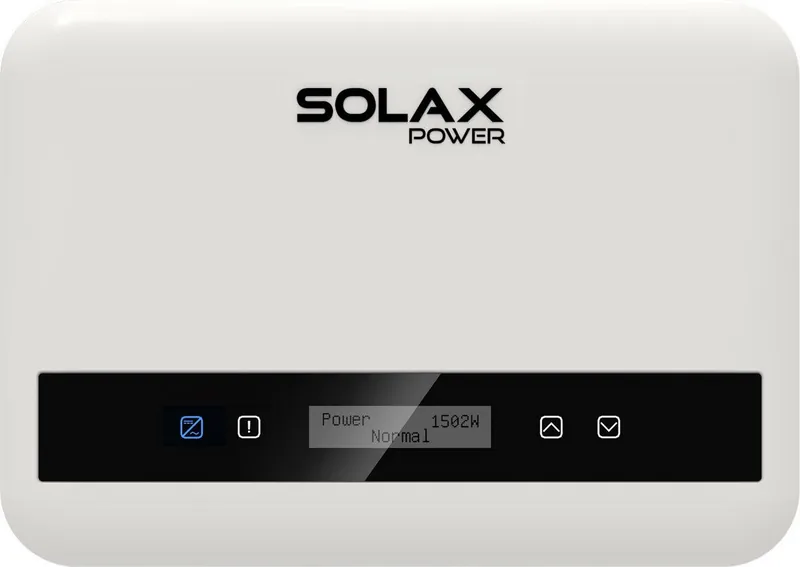
SolaX Power X1-MINI-G4 Manual
PDF manual · 49 Pages
English



Quick check
Incorrect answer, please try again.
Chat with your SolaX Power X1-MINI-G4 manual using AI
Get instant AI answers from your SolaX Power X1-MINI-G4 manual
Ask anything about the SolaX Power X1-MINI-G4. Answers come from this manual, with the pages they are based on.
X1-MINI-G4 Maintenance Schedule
Verify that the inverter's indicators, keys, and LCD display are functioning normally.
Check if the input and output wires are damaged or aged.
Get the inverter panels cleaned and ensure their mounting security is intact.
Conduct safety checks every 12 months using qualified personnel. Record data in an equipment log.
Check if cooling fins on the rear are covered by dirt. Clean with a soft dry cloth or brush and absorb dust when necessary.
Free maintenance reminders
Timed to your purchase date. Always free, unsubscribe anytime.
Ask a Question
Do you recommend X1-MINI-G4?
Yes NoFrequently Asked Questions
Available models range from 0.6 kW to 3.3 kW including the X1-MINI-0.6K-G4 up to X1-MINI-3.3K-G4.
Is this answer helpful?
Maximum efficiency reaches up to 98% with European efficiency achieving around 96.5%.
Is this answer helpful?
Wi-Fi support is available via an optional dongle purchased separately from the supplier.
Is this answer helpful?
Wait five minutes after disconnecting power to let capacitors discharge fully before accessing parts.
Is this answer helpful?
Only qualified electricians should perform installation tasks involving high voltage connections.
Is this answer helpful?
Yes, supports parallel connection for multiple inverters using Modbus or Datahub methods.
Is this answer helpful?
The unit offers IP66 protection suitable for harsh outdoor weather conditions.
Is this answer helpful?
Advantages and Disadvantages
Advantages

- High efficiency up to 98% for better energy yield.
- Compact design saves valuable roof space.
- Multiple communication options including WiFi.
- Built-in RCD provides enhanced safety.
- Natural cooling keeps noise levels low.
Disadvantages

- Requires a five minute discharge wait for service.
- Must be installed by qualified personnel only.
- Single phase limit restricts large commercial setups.
- Optional dongles needed for wireless features.
- Specific cable lengths recommended for loss minimization.
Product Specification
Note
Prices include partial 0% VAT rates for AT and DE
Type
Solar Inverter, Without Transformer, Passive
Max Input Current
16A
MPP Tracker Count
1
Output Phases
Single-phase
Input
MC4
Output
BC01
Interfaces
1x RJ-45, 1x USB, 1x RS-485
Noise Level
25dB
Protection Rating
IP66
Ambient Temperature
-22°F to +158°F
Dimensions
11.42 x 8.11 x 4.72 in (WxHxD)
Product Description
Unveiling the Efficiency of Solar Innovation
Welcome to our detailed look at modern photovoltaic solutions designed specifically for residential grid-tied needs. The device in focus delivers exceptional performance with advanced digital signal processing technology integrated directly into a compact form factor suitable for outdoor environments. When users explore technical guidelines such as the SolaX Power X1-MINI-G4 Manual resources, they find critical data regarding setup and operation essential for peak output. This equipment stands out due to its single-phase capability and robust protection mechanisms tailored for public electricity networks across different regions.
Advanced Technical Specifications
Efficiency remains the top priority for this model with maximum ratings reaching up to ninety-eight percent globally. The system utilizes optimal Maximum Power Point Tracking technology ensuring energy harvest even under partially shaded conditions or changing irradiance levels. Input voltage ranges are wide to accommodate diverse solar array configurations without compromising system stability or warranty coverage. Cooling relies entirely on natural convection currents which reduces audible noise emissions significantly during daily power generation cycles compared to forced air systems.
Safety and Protection Features
Safety protocols are fundamentally embedded within the hardware architecture to prevent severe hazards during maintenance or operation. Mandatory grounding procedures exist to mitigate risks associated with high voltages present in the direct current lines connecting panels. Installations must strictly adhere to local national regulations regarding lightning surge protection and electrical isolation distances. Qualified professionals should always handle all primary connections to ensure full compliance with international safety standards. The unit includes certified residual current devices internally to protect against potential electrocution risks automatically without external reliance.
Communication and Control Interfaces
Modern smart grid monitoring requires seamless connectivity which this series actively supports through several standard physical ports. Optional external modules allow wireless transmission to cloud platforms for remote tracking of daily generation statistics and historical trends. Direct connection to mobile phones enables real-time adjustments to export limits or password protection settings via dedicated human machine interfaces. Users can manage parallel system setups easily using the onboard liquid crystal display menu structure without specialized software tools.
Important Installation Notes for Owners
Proper vertical spacing ensures adequate airflow around the metal enclosure body prevents thermal throttling. Dust accumulation on passive cooling fins may lead to overheating issues over time so periodic gentle cleaning is recommended annually. Always disconnect both mains and photovoltaic power supplies completely and wait five minutes before touching terminals to allow internal capacitors to discharge hazardous voltage safely. Adhering to these rigorous safety practices guarantees longevity and uninterrupted reliable service for many operational years.
Warranty registration should occur immediately after commissioning to secure legal protections against manufacturing defects. Various power ratings are available starting from small six hundred watts units scaling up to three thousand three hundred watts for larger residential loads. This flexibility allows homeowners to match their system investment precisely with their rooftop space availability. Integration with heat pumps or electric vehicle chargers adds intelligence to the overall energy management strategy for sustainable living.
Environmental Tolerance and Maintenance
Operating ranges extend to negative thirty degrees Celsius ensuring functionality in cold climates up to forty degrees altitude limits. Storage temperatures differ slightly allowing safe transit logistics during extreme weather events. Troubleshooting steps involve checking status LEDs first to identify fault codes recorded in internal logs. Routine inspections verify wire integrity and indicator light functionality semiannually to maintain warranty validity. If errors persist contact authorized service partners who possess the necessary diagnostic equipment to resolve complex electronic failures efficiently.
Search for 67,706 Manuals online


Type-in Brand or Model