
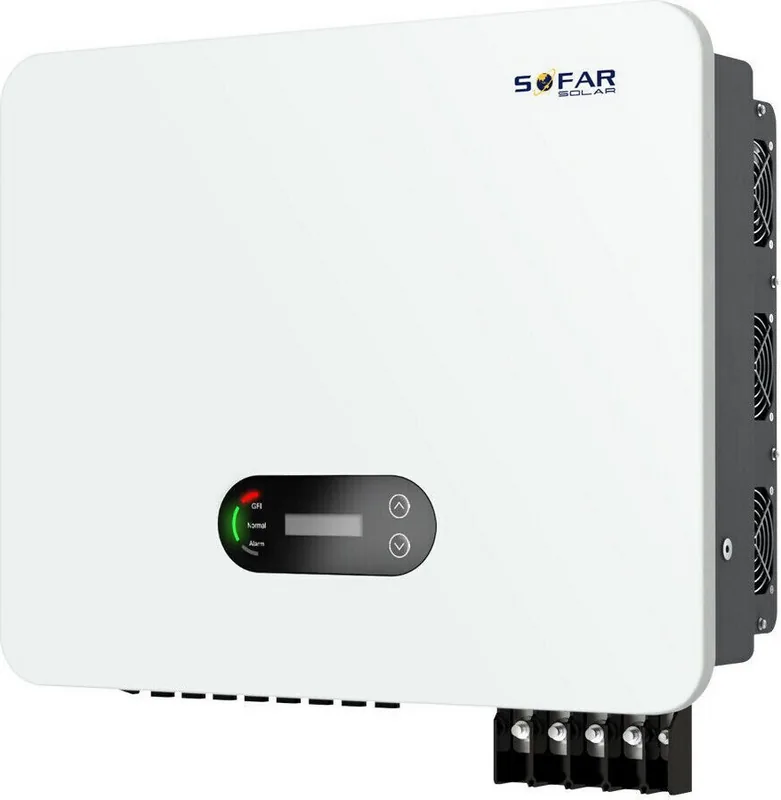
SofarSolar 25-50KTLX-G3 Manual
PDF manual · 81 Pages
English



Quick check
Incorrect answer, please try again.
Chat with your SofarSolar 25-50KTLX-G3 manual using AI
Get instant AI answers from your SofarSolar 25-50KTLX-G3 manual
Ask anything about the SofarSolar 25-50KTLX-G3. Answers come from this manual, with the pages they are based on.
25-50KTLX-G3 Maintenance Schedule
Ensure heat sink is not blocked by dust or dirt. Clean using an air blower, dry soft cloth, or soft bristle brush.
Listen for abnormal sounds during operation. Check fans for cracks and replace if necessary.
Close inverter, disconnect power, remove screws, unplug terminal, clean with soft brush, and reinstall.
Free maintenance reminders
Timed to your purchase date. Always free, unsubscribe anytime.
Ask a Question
Do you recommend 25-50KTLX-G3?
Yes NoFrequently Asked Questions
The series covers rated outputs from 25 kW to 50 kW with model-dependent MPPT channels: lower-power models support 6 MPPT inputs, mid-range up to 8 strings, and larger/HV variants offer 3–4 MPPT trackers with 6–8 DC inputs depending on the model.
Is this answer helpful?
The inverters are compatible with major grid codes (AS/NZS 4777, VDE-AR-N 4105, EN50549, CEI 0-21, G98/G99, etc.) and include configurable volt-watt and volt-var responses, under/over voltage and frequency protections, anti-islanding, and logic interfaces (DRM/RRCR) for demand-response.
Is this answer helpful?
Export limiting (anti-reflux) supports soft and hard limits via external meter+CT or PCC meter configuration. Configure PCC Select and Reflux Mode in the inverter menu, set limits under Set AntiReflux, and ensure reliable meter communication to avoid faults.
Is this answer helpful?
Standard RS485 and USB (for acquisition sticks) are included; optional Wi‑Fi, Ethernet, GPRS or 4G acquisition sticks enable remote monitoring and firmware updates via SolarMAN web and mobile apps. RS485 supports up to 31 inverters in a daisy chain.
Is this answer helpful?
Turn off the AC circuit breaker and the DC switch, then wait at least 5 minutes for capacitors to discharge. Maintenance must be done by qualified personnel; avoid water or corrosive cleaners and ensure fans and heatsinks are free of dust.
Is this answer helpful?
Updates are done via USB flash drive inserted into the inverter’s USB port. Follow the menu path Software Update, enter the password, and the inverter updates DSPs and ARM in sequence. If an update fails, power-cycle and retry per manual instructions.
Is this answer helpful?
Standard warranty is typically 5–10 years depending on purchase options; standard stated period examples include 5 years with optional extensions to 7, 10, or 15 years available within specified purchase windows. Extended warranty excludes some accessories like PV modules and acquisition sticks.
Is this answer helpful?
Advantages and Disadvantages
Advantages

- High peak efficiencies up to ~98.9% with strong European weighted efficiency for maximum yield.
- Flexible multi-MPPT design (6–8 PV strings) supports varied array layouts and HV variants for higher DC voltages.
- Comprehensive grid support: reactive power, volt-var/volt-watt, export limiting and DRM/RRCR interfaces for standards compliance.
- Robust protection suite including anti-islanding, GFCI/ground-fault monitoring, surge and thermal derating.
- Multiple communications (RS485/USB, optional Wi‑Fi/GPRS/4G) and SolarMAN monitoring for remote diagnostics and control.
Disadvantages

- Requires qualified electricians for installation and commissioning; complex settings are locked for end users.
- External meter/CT or acquisition stick needed for advanced export-limit features and full monitoring.
- Potential for nuisance RCD tripping if external RCD choice or inverter internal leakage settings are not coordinated.
- Software updates and country-code/grid-parameter selection require careful handling and possibly manufacturer support.
- Heavier and larger than small inverters; requires sturdy mounting surface and sufficient clearance for cooling.
Product Specification
Note
Prices partly include 0%-VAT tax rates for AT and DE
Type
Solar inverter, without transformer, with fan
Input voltage
180-1100V direct current (DC)
Max. input current
40A
MPP voltage range
180-1000V direct current (DC)
Output phases
3-phase
Input
MC4
Output
Terminals
Interfaces
Wi-Fi (WLAN), Bluetooth, 1x RJ-45, 1x RS-485
Noise level
<60dB
Protection class
IP65
Ambient temperature
-22°F to +140°F
Dimensions
23.03x18.90x8.66in (WxHxD)
Product Description
SofarSolar 25K–50KTLX-G3 Manual
SofarSolar's 25K–50KTLX-G3 series are transformer-less, three-phase grid-tied PV inverters designed for commercial and large residential solar systems. Built for high efficiency and flexible deployment, these inverters convert DC from PV arrays into grid-compliant AC, support multi-MPPT inputs (6–8 strings depending on model), and deliver rated outputs from 25 kW up to 50 kW. Rated for IP65 protection, wide ambient temperature operation (-30°C to +60°C) and high altitude use (up to 4000 m), the models include robust cooling, comprehensive protection features and multiple communication options for monitoring and control.
Key product highlights
SofarSolar 25K–50KTLX-G3 inverters emphasize efficiency and grid compatibility. Peak efficiencies reach up to ~98.9% with high weighted efficiencies, while MPPT ranges and input voltages support modern high-voltage PV strings (maximum DC input 1100 V). The product family includes HV variants for higher nominal DC voltage, and supports configurable MPPT topologies (independent or parallel) to fit diverse string layouts.
Functionality covers advanced grid interaction: reactive power control, configurable volt-var and volt-watt responses, active power curtailment, anti-reflux/export limiting (soft and hard limits), and demand-response logic interfaces (DRM/RRCR) to meet various regional grid codes (AS/NZS, VDE, EN50549, CEI, etc.). Built-in meter/CT integration and optional acquisition sticks (Wi‑Fi/Ethernet/GPRS/4G) enable remote monitoring through SolarMAN web and mobile apps.
Installation and operation overview
Installations must be performed by qualified electricians following local regulations. The manual details mechanical mounting (rear-panel bracket), clearance requirements, DC/AC wiring, grounding (PE), PV connector crimping and polarity checks, AC cable sizing and RCD recommendations, and RS485/USB communications. Commissioning includes country-code selection, software updates via USB, auto-tests for grid protection thresholds, and configuring export-limiting modes. Routine maintenance focuses on cleaning heatsinks and fans, verifying ventilation, and replacing faulty fans or connectors.
Safety and protections
Comprehensive protections include anti-islanding, leakage/GFCI monitoring, ground-fault detection, bus and PV hardware over/under protections, temperature derating, surge protection, string-fuse alarms, and multiple diagnostic fault codes with troubleshooting guidance. The inverters comply with major EMC and safety standards and are supplied with a standard 5–10 year warranty (with options to extend).
Notes
- Models: 25K, 30K (including A variant), 33K, 36K, 40K, 45K, 50K and HV versions. Dimensions (L×W×H): 585×480×220 mm. Typical weight ~36–37 kg.
- Use appropriate AC/PE cable sizing and recommended RCD type (A/B) to avoid nuisance tripping.
- Always turn off AC breaker and DC switch and wait at least 5 minutes before service.
Search for 67,706 Manuals online


Type-in Brand or Model