Manual.ly Logo

sera Aqua-Test Box Manual

0.0 · 0 Ratings

PDF manual · 92 Pages

English

M: QW-35-FL
page

/ 92

Loading...
4834d201da100325a08c01624342858718ec page 7
7
US Information for use
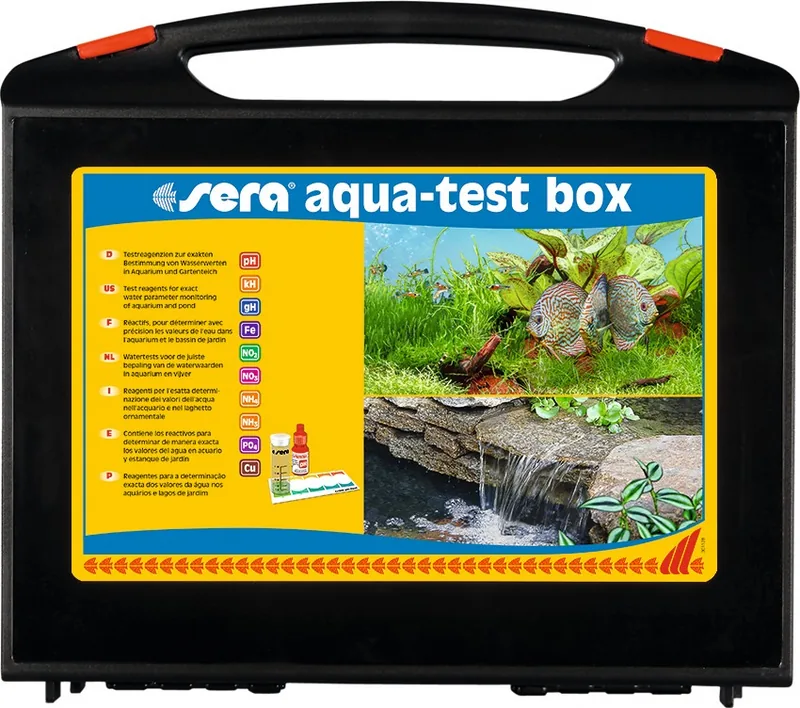
sera aqua-test box and sera aqua-test box marin
The practical sera aqua-test box – available in fresh and marine
water configurations with the appropriate water tests for each sup-
plied in a handy storage case – is the ideal professional set for aquar-
ists and pond keepers. It contains everything you need for the quick
and reliable monitoring of:
sera aqua-test box
freshwater
sera Koi aqua-test box
pond
• pH value (pH)
• total hardness (GH)
• carbonate hardness (KH)
• ammonium/ammonia
(NH
4
/NH
3
)
• nitrite (NO
2
)
• nitrate (NO
3
)
• phosphate (PO
4
)
• iron (Fe)
• copper (Cu) or chlorine (Cl)
sera aqua-test box marin
marine water
• pH value (pH)
• carbonate hardness (KH)
• ammonium/ammonia
(NH
4
/NH
3
)
• nitrite (NO
2
)
• nitrate (NO
3
)
• phosphate (PO
4
)
• copper (Cu)
• calcium (Ca)
The sera aqua-test box guarantees reliable monitoring of all important
water parameters. A 250 ml (8.45 fl.oz.) bottle of sera aqua-dest has
been enclosed with the set for cleaning the measurement vials and for
the dilution of samples (phosphate- and copper-Test), when necessary.
Use only high-quality distilled water for refilling empty sera aqua-dest
bottles.
Please follow directions for use closely! Attention! Formation of a
curved surface (meniscus) can often be observed with watery liquids
in volume measuring devices, as the edge of the liquid surface is
slightly pulled up. Read off the volume at the lowest point of the liquid
surface in such cases. The lowest point of the meniscus must align
with the upper edge of the scale line (please see picture on page 90,
lowest point at, for instance, 5 ml). Use test reagents for the intended
purpose only! Do not allow tested water to contact aquarium or
pond water! Close reagent bottles immediately after use and do not
exchange caps. Keep locked up and out of the reach of children!
Store at room temperature and away from light. For testing ornamen-
tal fish aquariums and pond water only.
Manufacturer: sera GmbH • P.O. Box 1466 • D 52518 Heinsberg
phone +49 2452 9126-0 • Made in Germany
pH
n pH-Test (fresh and marine water)
Make sure the carbonate hardness is at least 5°dKH as
to achieve a stable pH value. Otherwise, there is dan-
ger of varying (suddenly sinking!) pH value. Therefore,
always check the carbonate hardness by means of the sera kH-Test
before adjusting the pH value. Use the sera water conditioners sera
KH/pH-plus for aquariums and sera pond bio balance for ponds for
increasing the carbonate hardness to at least 5°dKH.
Then adjust the pH value by either using sera KH/pH-plus for rais-
ing it or sera pH/KH-minus for lowering it. sera super peat (for
freshwater aquariums) can also lower and stabilize the pH value.
Your specialized retailer will be pleased to inform you about the
correctpHvalueforyourshandplantsinyouraquariumorpond.
Directions for use: Shake reagent bottle well before using!
1. Rinse the measurement vial several times with the water to be
tested, then fill to the 5 ml mark (please see page 90, fig. “volume
reading in sera test vials”). Dry the vial on the outside.
2. Add 4 drops of the reagent and shake until the liquid is evenly
distributed.
3. Compare the colors immediately. Place the vial on the chart and
compare from a position above under natural daylight. Avoid
direct sunlight.
4. Match the resulting color on the color chart and read off the pH
value.
5. Cleaning: Clean the vial thoroughly with tap water before and after
each test.
gH
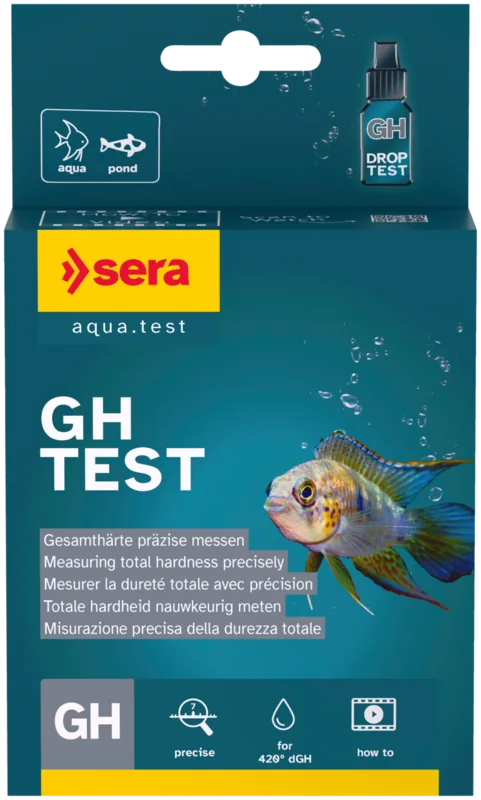
n gH-Test (freshwater)
Most ornamental fish originate from countries where the
soil is poor in minerals. However, it is exactly the oppo-
site in many other areas around the world. Rain water
dissolves calcium and magnesium from the soil and consequently
creates hard water. With the sera gH-Test, you can quickly determine
the exact total hardness. Looking at the natural conditions helps
selecting the optimal fish stock for a community aquarium, and is a
precondition for successful breeding. High total hardness levels can
be lowered by mixing in R/O water. A combination of sera aquatan
and sera blackwater aquatan or filtering through sera super peat
will create soft water, as required for most South American fishes
(e.g. from the Amazon basin).
Directions for use: Shake reagent bottle well before using!
1. Rinse the measurement vial several times with the water to be
tested, then fill to the 5 ml mark (please see page 90, fig. “volume
reading in sera test vials”). Dry the vial on the outside.
2. Add reagent drop by drop. Shake vial gently after every drop, until
the color changes from red via brown to an intense green.
3. The number of drops used from the reagent represents the exist-
ing total hardness (in °dGH). E.g., 5 drops = 5°dGH.
4. Cleaning: Clean the vial thoroughly with tap water before and
after each test.
kH
n kH-Test (fresh and marine water)
Carbonate hardness (KH) stabilizes the pH value. It
buffers variations as caused by biological breakdown
processes in aquariums and ponds, and by plants tak-
ing up carbon dioxide. A low carbonate hardness (below 5°dKH)
causes a strongly varying (suddenly sinking!) pH value. In community
aquariums, KH values between 5 and 10°dKH ensure a stable pH and
vigorous plant growth. Cichlids from Lake Malawi and Tanganyika
prefer higher KH values. Ideal KH for marine water aquariums is
between 8 and 12°dKH. By using sera KH/pH-plus (for freshwater),
sera marin COMPONENT 2 Ca pH-Buffer (for marine water) or sera
pond bio balance (for ponds), you can easily achieve the desired KH
level. If you want to lower the pH value of the water, you can lower
high carbonate hardness (e.g. more than 21°dKH in a community
aquarium) with sera super peat (for fresh water aquariums) if nec-
essary.
Directions for use: Shake reagent bottle well before using!
1. Rinse the measurement vial several times with the water to be
tested, then fill to the 5 ml mark (please see page 90, fig. “volume
reading in sera test vials”). Dry the vial on the outside.
2. Add reagent drop by drop. Shake vial gently after every drop, until
the color changes from blue via green to clear yellow.
3. The number of drops used from the reagent corresponds to the
existing carbonate hardness (in °dKH). E.g., 5 drops = 5°dKH.
4.
Cleaning: Clean the vial thoroughly with tap water before and after
each test.
NH
4
NH
3
n ammonium/ammonia-Test (fresh and marine water)
Reagent 3: Danger! Contains sodium hy-
pochlorite, solution 1.6% Cl active, sodium
hydroxide. Causes severe skin burns and
eye damage. Warning! Do not use together
with other products. May release dangerous
gases (chlorine). If medical advice is needed,
have product container or label at hand.
Keep out of reach of children. Do not breathe vapours. Wear
protective gloves, eye protection. IF SWALLOWED: Rinse mouth.
Do NOT induce vomiting. IF ON SKIN (or hair): Take off immedi-
ately all contaminated clothing. Rinse skin with water. IF IN-
HALED: Remove person to fresh air and keep comfortable for
breathing. IF IN EYES: Rinse cautiously with water for several
minutes. Remove contact lenses, if present and easy to do.
Continue rinsing. Immediately call a doctor. Dispose of container
to household waste.
High ammonium levels indicate a disturbed or not fully developed
bacterial activity in the filter. Ammonia (NH
3
) formed from ammonium
(NH
4
) in case of pH values above 7 is especially dangerous. Even
ammonia values of 0.02 mg/l lead to gill damages in the long term.
Therefore you should always check the pH value in addition to the
NH
4
level. Evaluation and judgment of the meas ured values is effect-
ed using the chart below.
sera toxivec immediately lowers the ammonia value in acute cases.
Additionally, the biological filter activity should be improved by using
sera bio nitrivec (freshwater), sera pond bio nitrivec (ponds) or
sera marin bio reefclear (marine water), respectively. Regular par-
tial water changes prevent too high water pollution.
Directions for use: Shake reagent bottles well before using!
1. Rinse the measurement vial several times with the water to be
tested, then fill to the 10 ml mark (freshwater) or the 5 ml mark
(marine water) (please see page 90, fig. “volume reading in sera
test vials”). Dry the vial on the outside.
2. Add 6 drops of reagent 1 and shake until the liquid is evenly
distributed.
3. Add 6 drops of reagent 2 and shake the same manner.
4. Add 6 drops of reagent 3 and shake the same manner.
GBI aqua-testbox set 2015.indd 7 07.07.2015 14:49:46

Chat with your sera Aqua-Test Box manual using AI

Get instant AI answers from your sera Aqua-Test Box manual

Ask anything about the sera Aqua-Test Box. Answers come from this manual, with the pages they are based on.

Aqua-Test Box Maintenance Schedule

Before and after each test
Clean the test cuvette with tap water

Thoroughly clean the measurement vial with tap water before and after every test to ensure accurate results.

When color fades
Refill CO2 long-term indicator

If colors in the CO2 test device fade, refill it with aquarium water and indicator solution. Clean the device during this process.

If cap is stuck
Grease O-ring of CO2 test device

If the cap is difficult to remove, the silicone grease on the O-ring has dried up. Reapply silicone grease to the O-ring.

As needed
Replace brittle O-ring

Check the O-ring if the water level changes rapidly or the cap does not seal tightly; replace it if it has become brittle.

M: qwen/qwen3.8-flash

Ask a Question

0/1000

Do you recommend Aqua-Test Box?

Yes No

Frequently Asked Questions

A

The kit measures pH, total hardness (GH), carbonate hardness (KH), ammonium/ammonia, nitrite, nitrate, phosphate, iron, copper, and chlorine. Marine versions also include calcium and magnesium tests.

Is this answer helpful?

A

If the color turns dark blue, the sample contains over 1 mg/l of copper. You should repeat the test with a diluted sample to get an exact reading. Levels above 0.3 mg/l can be harmful to snails and invertebrates.

Is this answer helpful?

A

Yes, you should clean the vials thoroughly with tap water before and after every test to remove any residue. However, always rinse with the sample water first and dry the outside before starting a new measurement.

Is this answer helpful?

A

Carbonate hardness stabilizes the pH value. If it is too low, below 5 dKH, the pH can fluctuate wildly or crash, which is dangerous for fish. Maintaining proper KH ensures a stable environment for your aquatic life.

Is this answer helpful?

A

High ammonia indicates a disturbed biological filter. You should immediately perform a partial water change and dose sera toxivec to lower ammonia levels quickly. Also, add bacteria starter products to boost filter activity.

Is this answer helpful?

A

Yes, the kit includes specific instructions and reagents for garden ponds. It helps monitor parameters that affect koi and other pond fish, such as ammonia, nitrite, and nitrate levels.

Is this answer helpful?

M: QW-35-FL

Advantages and Disadvantages

Advantages

  • Comprehensive testing for all major water parameters in one portable case
  • Simple drop-count method makes results easy to read without advanced math
  • Includes specific tests for copper which is often overlooked but critical for invertebrates
  • Provides clear safety warnings and handling instructions for chemical reagents
  • Suitable for both freshwater and marine aquarium setups
VS

Disadvantages

  • Some reagents contain hazardous chemicals requiring careful storage away from children
  • Certain tests require multiple steps and waiting periods for accurate color development
  • High phosphate or copper levels may require repeat testing with diluted samples
  • Vials must be cleaned meticulously after every use to prevent contamination
  • Not all tests are included in the base set and may need separate purchase
M: QW-35-FL

Product Specification

Range

Water values

Type

Water test (pH, total hardness, carbonate hardness, ammonium/ammonia, nitrite, nitrate, phosphate, iron, copper), test kit

M: QW-35-FL

Product Description

Mastering Aquarium Water Quality with the sera Aqua-Test Box mit Cu

Maintaining a thriving aquarium or pond requires more than just good intentions; it demands precise knowledge of your water parameters. The sera Aqua-Test Box mit Cu Manual serves as an essential guide for aquarists who want to ensure the health and longevity of their aquatic life. This comprehensive testing kit is designed to provide reliable monitoring of critical water values, ensuring that your fish, plants, and invertebrates live in optimal conditions.

The box includes specialized reagents for testing freshwater, marine water, and ponds. It covers a wide range of parameters including pH, total hardness (GH), carbonate hardness (KH), ammonium/ammonia, nitrite, nitrate, phosphate, iron, copper, and chlorine. For marine enthusiasts, additional tests for calcium and magnesium are available. Each test uses a simple color-change method where the number of drops added corresponds directly to the concentration level, making complex chemistry accessible to everyone.

Proper water management prevents common issues like algae blooms, fish stress, and sudden parameter crashes. For instance, knowing your copper levels is vital because even trace amounts from pipes or medications can be fatal to snails and shrimp. Similarly, monitoring ammonia and nitrite ensures your biological filter is functioning correctly. The included manual provides detailed safety instructions and step-by-step procedures for each test, emphasizing the importance of cleaning vials thoroughly between uses to avoid cross-contamination.

By regularly using the sera Aqua-Test Box, you create a stable environment that mimics natural habitats. Whether you are keeping sensitive South American fish requiring soft water or Malawi cichlids needing high hardness, this kit helps you adjust your water chemistry with confidence. The inclusion of distilled water for cleaning and dilution further enhances accuracy, allowing you to detect subtle changes before they become dangerous problems.

M: QW-35-FL

© Copyright 2026 Manual.ly