
Schneider Electric Acti9 iID B-SI Manual
PDF manual · 84 Pages
English



Quick check
Incorrect answer, please try again.
Chat with your Schneider Electric Acti9 iID B-SI manual using AI
Get instant AI answers from your Schneider Electric Acti9 iID B-SI manual
Ask anything about the Schneider Electric Acti9 iID B-SI. Answers come from this manual, with the pages they are based on.
Acti9 iID B-SI Maintenance Schedule
After installation and at regular intervals, press the Test button to run a self-diagnostic test of the device.
Disconnect all input and output wires before running an insulation resistance test to prevent equipment damage.
Ask a Question
Do you recommend Acti9 iID B-SI?
Yes NoFrequently Asked Questions
It protects against residual currents by disconnecting the circuit when leakage is detected. Its Type B-SI behavior is designed for broader current shapes, including mixed-frequency and DC-related disturbances on AC installations.
Is this answer helpful?
Modern systems often include drives, inverters, EV chargers, and UPS equipment that can generate leakage currents other devices may not detect well. Type B-SI is built to handle those more complex conditions.
Is this answer helpful?
No. It is intended for the AC part of an installation only. It should not be used as a DC-network protection solution.
Is this answer helpful?
Yes. The LED only indicates voltage presence. It does not replace a proper voltage test with a suitably rated tester before any work is performed.
Is this answer helpful?
Use the built-in Test button and confirm that the device trips correctly. This should be done after installation and repeated at regular intervals.
Is this answer helpful?
All input and output wires must be disconnected first. Leaving conductors attached can damage the device during insulation resistance testing.
Is this answer helpful?
When a dedicated 2P version is available, it is usually the cleaner choice. A 4P unit may be adapted in certain cases, but the exact wiring and voltage conditions must be checked carefully.
Is this answer helpful?
Advantages and Disadvantages
Advantages

- All-current sensitive design supports complex leakage currents and modern electronic loads.
- Suitable for drives, PV, EV, UPS, and other demanding AC-side applications.
- Compact 2P format makes panel integration practical and space-efficient.
- Test button and voltage LED help with routine checks and maintenance.
Disadvantages

- Must be installed only by a qualified electrician.
- Not suitable for DC network installation.
- Dielectric testing requires full disconnection of all conductors.
- Regular testing is necessary to maintain safe operation.
Product Specification
Type
RCCB
Number of poles
1 + N
Rated voltage
400V
Rated current
25A
Rated residual current
300mA
Residual current type
B-SI
Degree of protection
IP20
Width
2.83 in
Modular units
4
Special features
Neutral conductor on left
Product Description
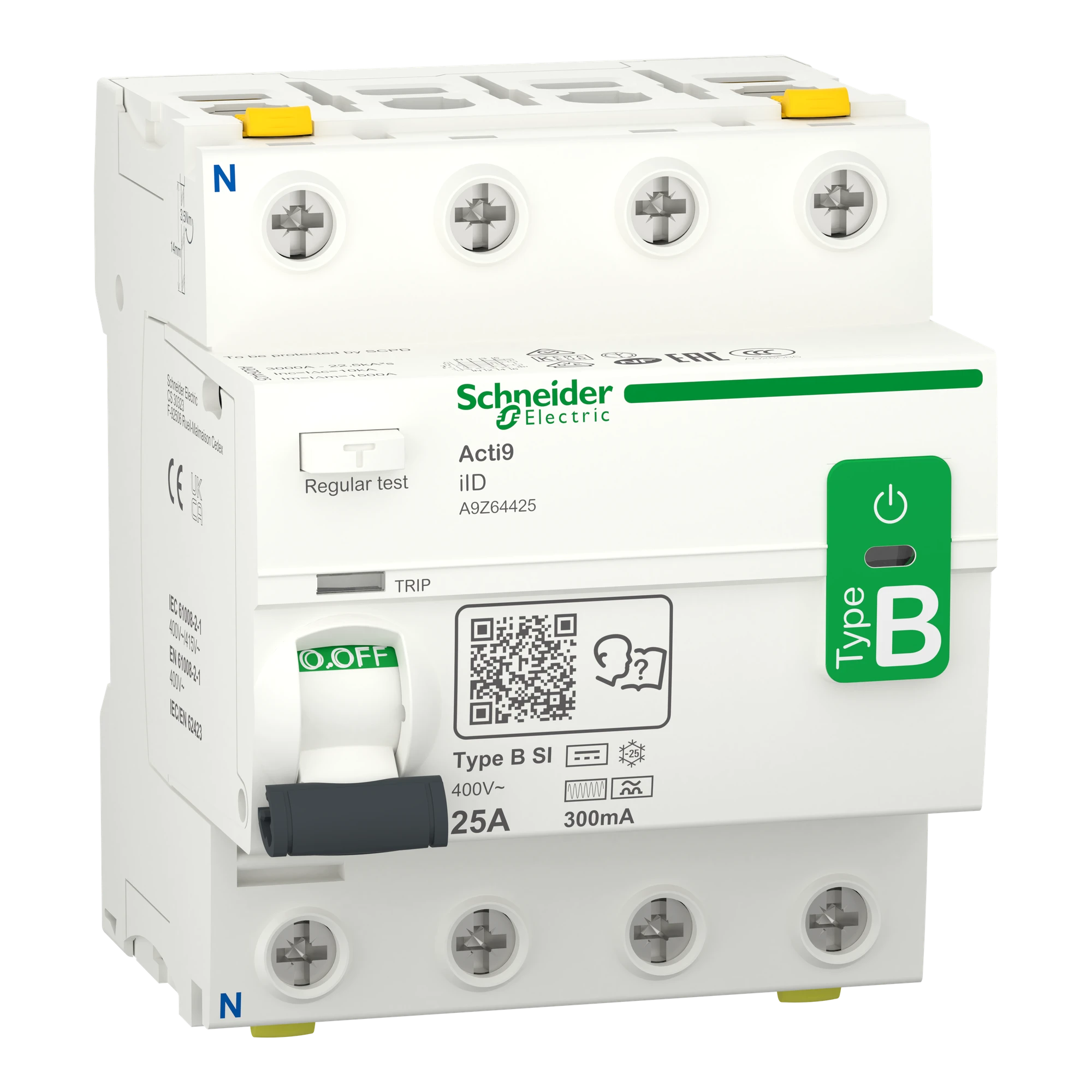
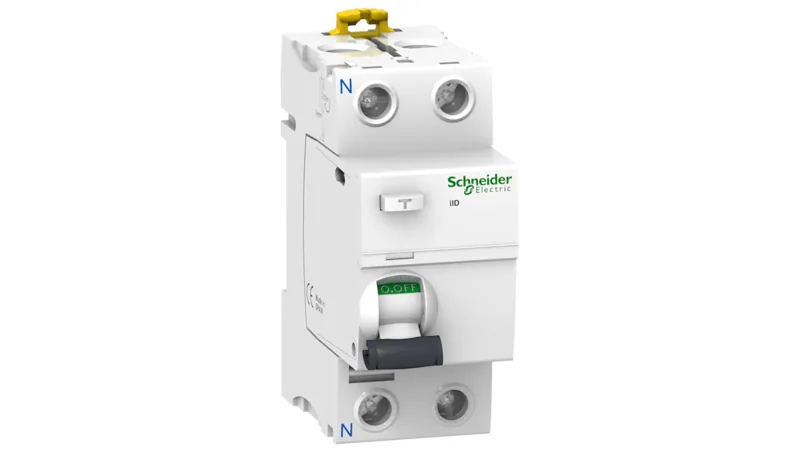
Schneider Electric iID 2P 25A Type B-SI 300mA: Reliable Residual Current Protection
The Schneider Electric all-current sensitive residual current circuit breaker iID 2P 25A Type B-SI 300mA is designed for installations where protection has to stay dependable even under complex electrical conditions. Built for AC-side use, it combines compact two-pole design with sensitive detection of residual currents, making it a strong fit for modern homes, commercial systems, and technical installations with demanding loads.
What makes this device stand out is its all-current-sensitive behavior. Unlike simpler residual current devices, a Type B-SI unit is intended to respond to a broader range of leakage patterns, including smooth DC components and mixed-frequency disturbances. That makes it especially useful for equipment such as drives, photovoltaic inverters, EV-related systems, UPS units, and medical or automation applications. For readers looking for practical guidance, the Schneider Electric all-current sensitive residual current circuit breaker iID 2P 25A Type B-SI 300mA Manual is a helpful reference for setup, testing, and safe operation.
The 25A rating and 300mA sensitivity position this model toward circuit protection where fire safety and installation reliability matter. It is not just about tripping when a fault appears; it is also about helping maintain a stable electrical environment when sensitive electronics may generate leakage currents that standard devices can miss. The built-in test function and voltage presence indication further support routine checks and maintenance discipline.
Installation guidance is strict for a reason. The device must be handled by a qualified electrician, power must be isolated before work begins, and the voltage LED should never replace proper verification with a tester. The manual also emphasizes post-installation testing and dielectric test precautions, showing that safe use depends on both correct wiring and regular validation.
In everyday terms, this residual current circuit breaker is a smart choice when protection needs to match the realities of modern power systems. It offers a balance of compact design, advanced detection, and easy maintenance checks, while staying aligned with professional electrical standards.
Notes
- Use only on the AC side of an installation.
- Disconnect conductors before dielectric testing.
- Test the device after installation and at regular intervals.
Pros and Cons
Pros
- Detects a wide range of residual currents, including complex DC-related leakage.
- Suitable for modern loads such as drives, PV systems, EV equipment, and UPS units.
- Compact 2P format supports straightforward integration in many panels.
- Built-in test button helps verify operation over time.
- Clear voltage indication supports safer routine inspection.
Cons
- Must be installed and maintained by a qualified electrician.
- Not intended for DC network installation.
- Dielectric testing requires full disconnection of input and output wiring.
- Regular testing is necessary to keep protection reliable.
FAQ
What is the main purpose of this circuit breaker?
It protects electrical systems by detecting residual currents and disconnecting power when dangerous leakage is found. Its all-current-sensitive design makes it suitable for installations with mixed or complex current patterns.
Which applications benefit most from Type B-SI protection?
It is ideal for equipment that may create DC disturbances or higher-frequency leakage, such as variable-speed drives, photovoltaic converters, EV systems, UPS units, and medical devices.
Can it be used in a DC network?
No. This device is meant for the AC portion of an installation. It should not be used as a solution for DC network protection.
Is the voltage LED enough to confirm safety?
No. The LED is only an indicator. A proper voltage test with a correctly rated tester is still required before touching the circuit.
How often should the test button be used?
It should be used after installation and then at regular intervals. This helps confirm that the self-diagnostic function is still working properly.
Why must wires be disconnected before a dielectric test?
The insulation resistance test can damage the device if input and output conductors remain connected. Disconnecting all wiring prevents avoidable equipment damage.
Can a 4P Type B-SI be used for 2P applications?
Yes, in some cases it can be adapted, especially at 400 V, by connecting the correct terminals. However, the dedicated 2P version is the better match when available.
Search for 67,706 Manuals online


Type-in Brand or Model