
Schneider Electric Acti9 iID B-EV Manual
PDF manual · 4 Pages
English



Quick check
Incorrect answer, please try again.
Chat with your Schneider Electric Acti9 iID B-EV manual using AI
Get instant AI answers from your Schneider Electric Acti9 iID B-EV manual
Ask anything about the Schneider Electric Acti9 iID B-EV. Answers come from this manual, with the pages they are based on.
Ask a Question
Do you recommend Acti9 iID B-EV?
Yes NoFrequently Asked Questions
Type B-EV detects AC residual currents, pulsating DC and smooth DC residual currents, providing protection for EV chargers that can generate complex fault currents not detected by AC-only devices.
Is this answer helpful?
No. The manual states installation, maintenance and replacement must be done by a qualified electrician to ensure correct wiring, safe commissioning and compliance with local regulations.
Is this answer helpful?
Run the built-in self-diagnostic test after installation and at regular intervals thereafter by pressing the Test (T) button. The manual does not set a single nationwide interval; follow local rules and site maintenance schedules.
Is this answer helpful?
Shut down all power sources and verify absence of voltage with a suitably rated tester. Do not work on or install the device if it is damaged on unpacking.
Is this answer helpful?
No. Before performing insulation resistance (dielectric) tests, disconnect all input and output wires from the device to avoid damaging the unit.
Is this answer helpful?
The manual lists a wide range of conductor cross-sections and torque recommendations for terminals; always follow the specific terminal markings and torque values provided in the product documentation during installation.
Is this answer helpful?
The Acti9 iID Type B-EV references IEC/EN standards relevant to residual current devices, including IEC/EN 61008-2-1 and IEC/EN 62423, ensuring compliance with international safety and performance requirements.
Is this answer helpful?
Advantages and Disadvantages
Advantages

- Type B-EV sensitivity detects AC, pulsating DC and smooth DC residual currents—suitable for modern EV chargers.
- 4-pole 63A rating supports three-phase plus neutral installations and higher-power charging equipment.
- Installer-friendly features: VISI-TRIP window, VISI-SAFE rocker, isolated IP20 terminals, and large circuit ID area.
- Compatibility with comb busbars and double-terminal MCBs simplifies panel integration where supported.
- Clear safety and testing guidance including mandatory self-test and dielectric test procedures.
Disadvantages

- Must be installed, maintained and replaced only by qualified electricians—no DIY option.
- Device cannot be repaired; replacement required if faulty, which may increase lifecycle cost.
- Dielectric testing requires full disconnection of all input/output wires to avoid damage.
- Availability of some terminal/busbar features (double-terminal compatibility) is country-dependent.
- Periodic manual testing is required (press Test button) to ensure continued protection.
Product Specification
Type
RCCB
Number of poles
3 + N
Rated voltage
400V
Rated current
63A
Rated residual current
30mA
Residual current type
B-EV
Degree of protection
IP20
Width
2.83 in
Modular units
4
Product Description
Schneider Electric Residual Current Circuit Breaker EV Charging Station iID 4P 63A Type B-EV 30mA Manual
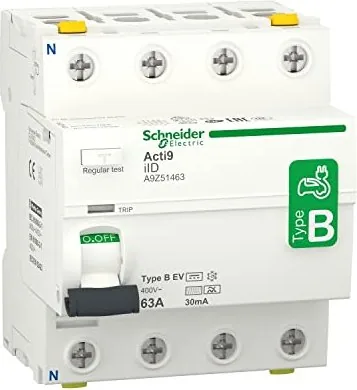
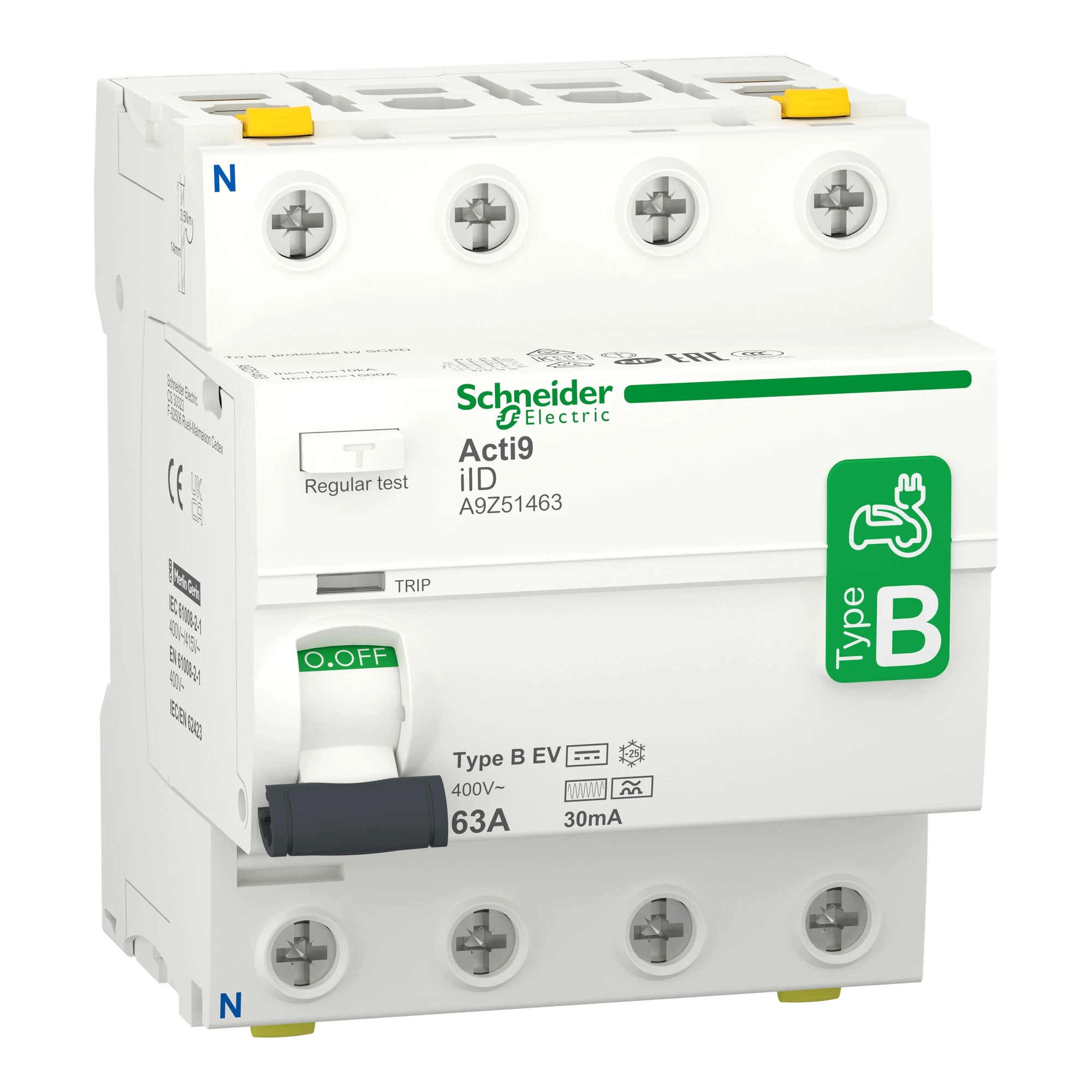
The Schneider Electric Acti9 iID residual current circuit breaker (RCCB) Type B-EV 4-pole, 63A, 30mA is designed for safe, reliable protection of electric vehicle (EV) charging installations. Engineered for modern EV loads, this device detects AC, pulsating DC and smooth DC residual currents, meeting IEC/EN standards for Type B sensitivity. Its 4P configuration supports three-phase systems with neutral, and the 63A rating accommodates higher-power chargers common in residential and commercial charging points.
Compact and installation-friendly, the Acti9 iID features an oversized circuit identification area, isolated IP20 terminals, VISI-TRIP indication window and a VISI-SAFE rocker for clear status and safer operation. Dual locking on the DIN rail and compatibility with comb busbars simplify panel assembly, even when mixing with double-terminal miniature circuit breakers (MCBs) where offered. Clearly labeled terminals accept a broad range of conductor sizes and torque settings, while a dedicated comb terminal supports combined busbar installations.
Safety and maintenance are emphasised: only qualified electricians should install, test, or replace the device; repairs are prohibited. The manual stresses pre-installation inspections to avoid installing damaged equipment and strict adherence to local regulations. Before work, power must be shut off and voltage verified with a suitable tester to prevent electric shock, arc flash or explosion hazards.
Testing routines are built into normal operation: the device includes a test button for periodic self-diagnostic checks, and the manual mandates running the self-test after installation and at regular intervals. Dielectric (insulation-resistance) testing requires disconnecting all input and output wiring to prevent equipment damage. Clear multilingual warnings and step-by-step wiring guidance (L1, L2, L3, N) support international installations.
In summary, the Schneider Electric Acti9 iID Type B-EV 4P 63A 30mA is a robust, standards-compliant RCCB tailored for EV charging safety. It combines high sensitivity to DC/AC residual currents, installer-friendly features, visible trip indication, and strict safety guidance to protect users and equipment.
Notes
- Always disconnect power and verify zero voltage before working on the device.
- Perform the built-in self-test after installation and periodically thereafter.
- Disconnect all wiring before dielectric testing to avoid damage.
- Installation and maintenance must be performed by qualified electricians only.
Search for 67,706 Manuals online


Type-in Brand or Model