
Schneider Electric Acti9 iCV40N VigiARC Manual
PDF manual · 8 Pages
English



Quick check
Incorrect answer, please try again.
Chat with your Schneider Electric Acti9 iCV40N VigiARC manual using AI
Get instant AI answers from your Schneider Electric Acti9 iCV40N VigiARC manual
Ask anything about the Schneider Electric Acti9 iCV40N VigiARC. Answers come from this manual, with the pages they are based on.
Ask a Question
Do you recommend Acti9 iCV40N VigiARC?
Yes NoFrequently Asked Questions
It combines arc-fault detection (AFDD), residual current protection (FI) with 30 mA Type A-SI sensitivity, and short-circuit/overload (LS) protection with a B-characteristic 13A trip setting and 6000 A breaking capacity.
Is this answer helpful?
No. Installation, maintenance, and replacement must be performed by a qualified electrician and comply with local, regional, and national regulations to ensure safety and correct operation.
Is this answer helpful?
Use the multifunction Test (T) button to run a self-diagnostic after installation and at regular intervals. Follow manufacturer instructions for periodic checks and use a suitable voltage tester to ensure circuits are de-energized before maintenance.
Is this answer helpful?
VISI-TRIP provides visual fault diagnosis for earth leakage, arc faults, and overvoltage events. Combined LEDs show specific fault types (parallel arc, series arc, earth leakage, overload/short-circuit, overvoltage, internal fault).
Is this answer helpful?
No. The device is not intended to be repaired. If it shows internal faults or is damaged, it should be replaced to maintain safety and compliance.
Is this answer helpful?
Yes. Disconnect all input and output conductors from the device before performing insulation resistance (dielectric) tests to avoid equipment damage.
Is this answer helpful?
Ideal for residential and light-commercial circuits—kitchens, living areas, bedrooms, and fixed-appliance feeds—where arc-fault detection and residual current protection significantly reduce fire and shock risks.
Is this answer helpful?
Advantages and Disadvantages
Advantages

- Integrated AFDD, residual current and overcurrent protection in a single compact 1P+N unit.
- 30 mA Type A-SI improves detection of pulsating/DC leakage, enhancing shock and fire protection.
- VISI-TRIP LED diagnostics and Test/Reset button simplify fault identification and routine checks.
- 6000 A breaking capacity suitable for standard residential and light-commercial circuits.
- DIN-rail mounting and top/bottom feed flexibility ease installation and retrofitting.
Disadvantages

- Must be installed and serviced only by qualified electricians, limiting DIY use.
- Device is non-repairable — faults require replacement, increasing lifecycle cost.
- Single-pole-plus-neutral may not suit three-phase or high-current industrial circuits.
- Dielectric testing requires full disconnection of input/output cables, adding test prep time.
- B-characteristic 13A rating may not match all circuit protection needs without coordination.
Product Specification
Type
RCBO
Number of poles
1 + N
Rated voltage
230V
Rated current
13A
Rated residual current
30mA
Short-circuit breaking capacity
6kA
Residual current type
A-SI
Tripping characteristic
B
Degree of protection
IP20
Width
1.42 in
Module units
2
Special features
Arc fault detection device, neutral conductor on left
Product Description
Schneider Electric Acti9 iCV40N VigiARC — Advanced AFDD + FI/LS Protection
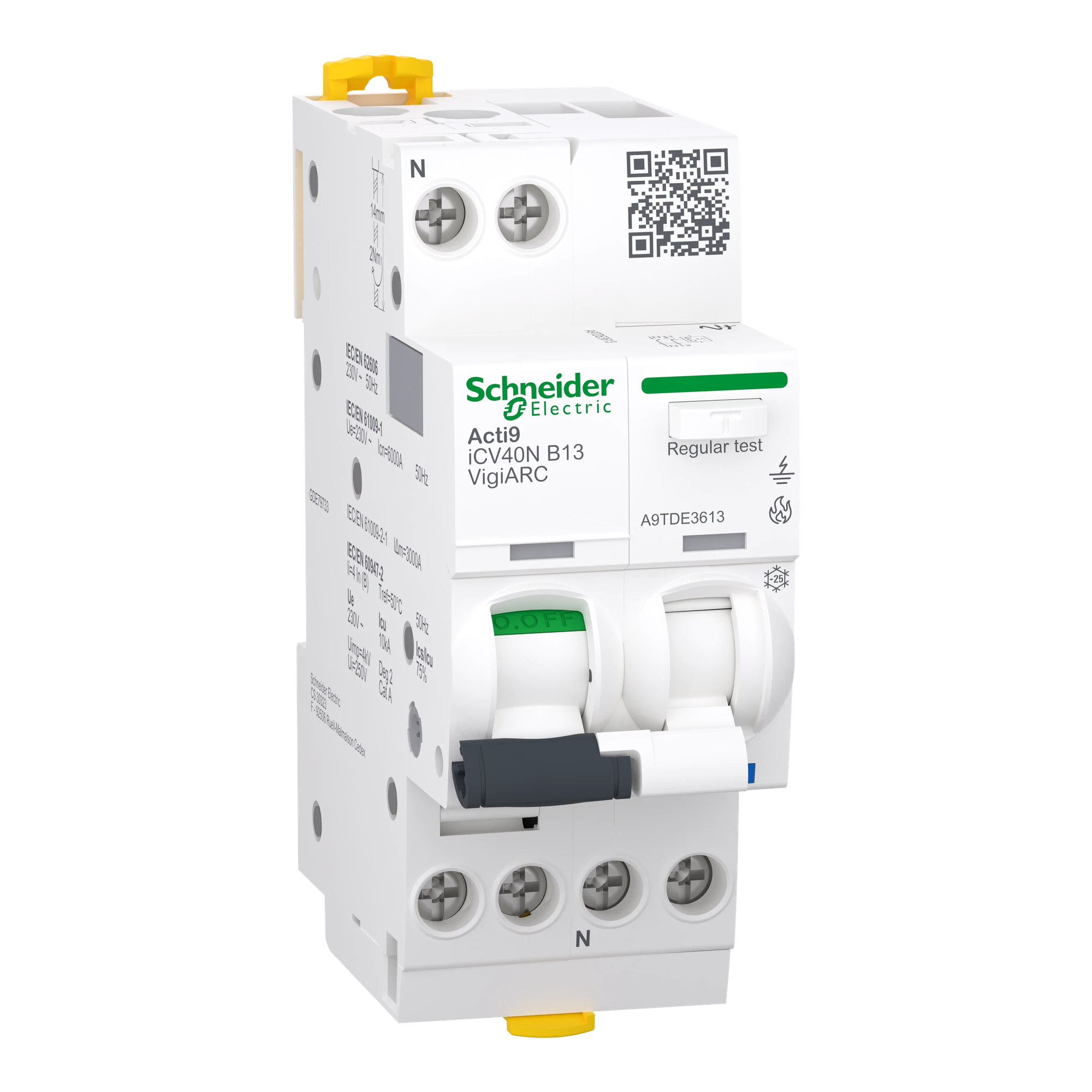
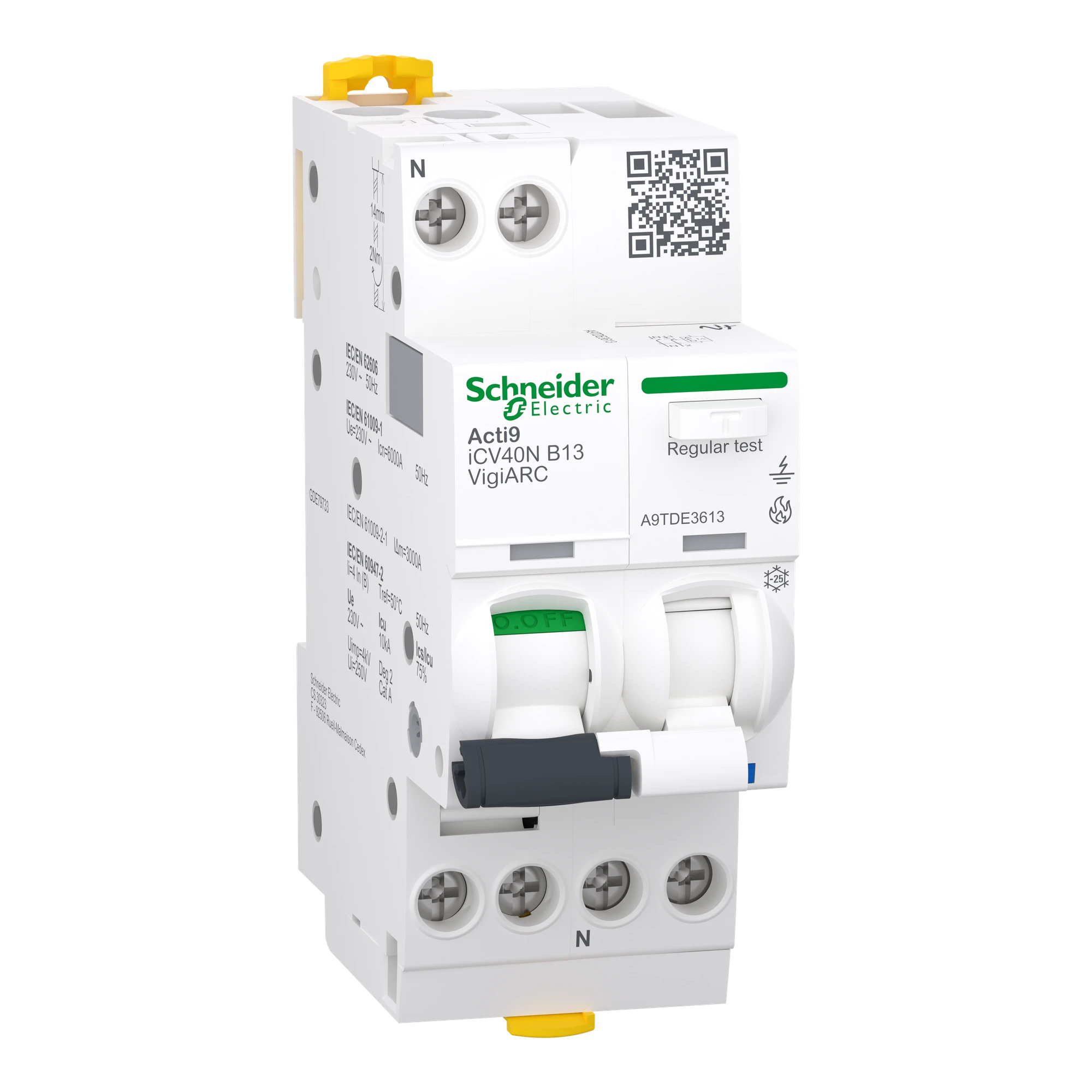
The Schneider Electric Acti9 iCV40N VigiARC is a compact, single-pole-plus-neutral (1P+N) protective device that combines arc-fault detection (AFDD) with residual current and overcurrent protection (FI/LS). Rated 13A with a B-characteristic tripping curve, 30 mA residual sensitivity (Type A-SI) and 6000 A fault breaking capacity, this device is designed for modern residential and light-commercial electrical installations where fire risk reduction and personnel safety are priorities.
Key product highlights
This Acti9 unit integrates multiple protection functions in one DIN-rail mountable module: parallel and series arc detection, earth leakage detection, short-circuit and overload protection, and clear diagnostic indication. A multifunction Test/Reset button enables periodic self-checks and on-demand diagnostics, while a VISI-TRIP indicator and LEDs provide immediate, readable fault cause information. The device supports top or bottom feeding and includes clear installation cues for qualified electricians.
Why it matters
Arc faults are a common cause of electrical fires; combining AFDD with residual current protection and overcurrent tripping reduces both ignition sources and electric shock risk. The 30 mA Type A-SI sensitivity improves detection of pulsed and smooth DC components in leakage currents, while the 6000 A breaking capacity suits typical distribution circuits. The compact 1P+N format conserves panel space and simplifies retrofits.
Typical applications
- Family homes and apartments where wiring aging or damaged cords pose fire risk
- Small commercial units and tenant-fit outs requiring enhanced protection without large switchgear changes
- Circuits feeding fixed appliances, kitchens, bedrooms, and living areas where arc detection adds safety
Practical use and maintenance
Installation and wiring must be performed by qualified electricians following local regulations. After installation, run the device’s self-diagnostic test using the T button and repeat periodically. Follow the device’s dielectric test guidance and always isolate inputs/outputs before high-voltage testing. If packaging is damaged or internal faults appear (product out of order), replace rather than repair.
Notes
- Device must not be repaired; follow service instructions for lifetime compliance.
- Disconnect all conductors before dielectric tests to avoid equipment damage.
- Always de-energize circuits and verify with an appropriate voltage tester before maintenance.
Search for 67,706 Manuals online


Type-in Brand or Model