
Sanitas SBG 21 Manual
PDF manual · 36 Pages
English



Quick check
Incorrect answer, please try again.
Chat with your Sanitas SBG 21 manual using AI
Get instant AI answers from your Sanitas SBG 21 manual
Ask anything about the Sanitas SBG 21. Answers come from this manual, with the pages they are based on.
SBG 21 Maintenance Schedule
Clean occasionally with a damp cloth. Do not use abrasive detergents and never immerse the scale in water.
Replace when 'L0' appears on display or if scale fails to operate. Use two 3V Lithium CR 2032 batteries.
Ask a Question
Do you recommend SBG 21?
Yes NoFrequently Asked Questions
It uses Bioelectrical Impedance Analysis (BIA): a harmless, imperceptible electric current passes through the feet via electrodes to measure impedance, which the scale combines with personal data (age, height, sex, activity) to estimate body fat, water, muscle and bone metrics.
Is this answer helpful?
People with medical implants such as pacemakers and pregnant women should not use the scale. If you have medical conditions or are on cardiovascular or vasoactive medications, consult a physician before using BIA-based devices.
Is this answer helpful?
Weigh at the same time each day, preferably morning, after toilet, fasting and unclothed. Stand barefoot with slightly moist soles, still and evenly weighted. Avoid measuring immediately after intense exercise and wait about 15 minutes after rising to let body fluids stabilize.
Is this answer helpful?
Errors occur if you step on before the display shows 0.0, exceed 180 kg, have very dry or callused soles, or if body fat/water are outside measurable ranges. Remedy: wait for 0.0, retry barefoot, slightly moisten soles, remove calluses, and replace weak batteries.
Is this answer helpful?
Readings are approximations for personal monitoring and can show technical tolerances. They do not replace medical diagnostics; only clinical methods (e.g., CT scans) performed by medical professionals can provide exact body composition analysis.
Is this answer helpful?
The scale uses two 3 V CR2032 lithium batteries. When batteries are too weak the display shows 'L0' and the scale will turn off; replace both batteries to restore function.
Is this answer helpful?
Clean the scale with a damp cloth, avoid immersion and harsh cleaners, and protect it from shocks and extreme temperatures. Dispose of used batteries and the device according to local regulations and the WEEE directive at designated collection points.
Is this answer helpful?
Advantages and Disadvantages
Advantages

- Provides multiple body composition metrics (body fat, water, muscle, bone mass, BMR, AMR).
- Stores up to 10 user profiles with height, age and activity level settings.
- Quick BIA measurement with clear digital display and unit switching (kg/lb/st).
- Glass design with tap-on self-test and automatic switch-off for convenience.
- Low-maintenance: only requires occasional cleaning and CR2032 batteries.
Disadvantages

- BIA estimates are approximate and not suitable for medical diagnosis.
- Not safe for people with medical implants or for use during pregnancy.
- Readings affected by hydration, calluses, recent exercise and improper stance.
- Measurement range limits (weight max 180 kg; body fat and water have measurable bounds).
- Repairs require authorized service; device not intended for commercial use.
Product Specification
Operating mode
Battery operated (2x button cell)
Material
Glass
Color
grey
Load capacity
396.83lb
Graduation
0.22lb
Units of measurement
kg, lb, st
Analysis data
Body Mass Index, Calorie requirement, Calorie consumption, Bone mass, Body fat, Body water, Muscle mass
Memory function
10 memory slots
Display
yes
Special features
Automatic switch-on (Tap-on), Automatic switch-off
Standing surface
11.81x12.40in (WxD)
Product Description
Sanitas SBG 21 digital body analysis scale Manual
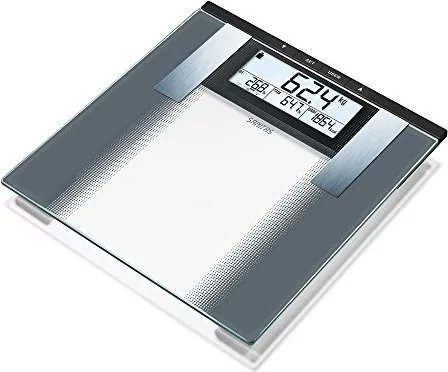
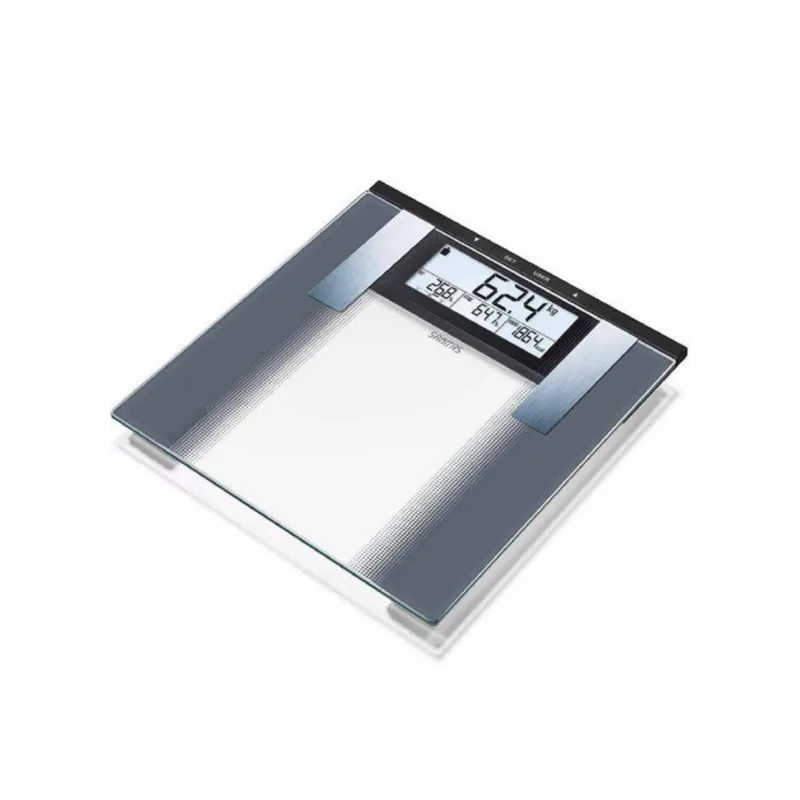
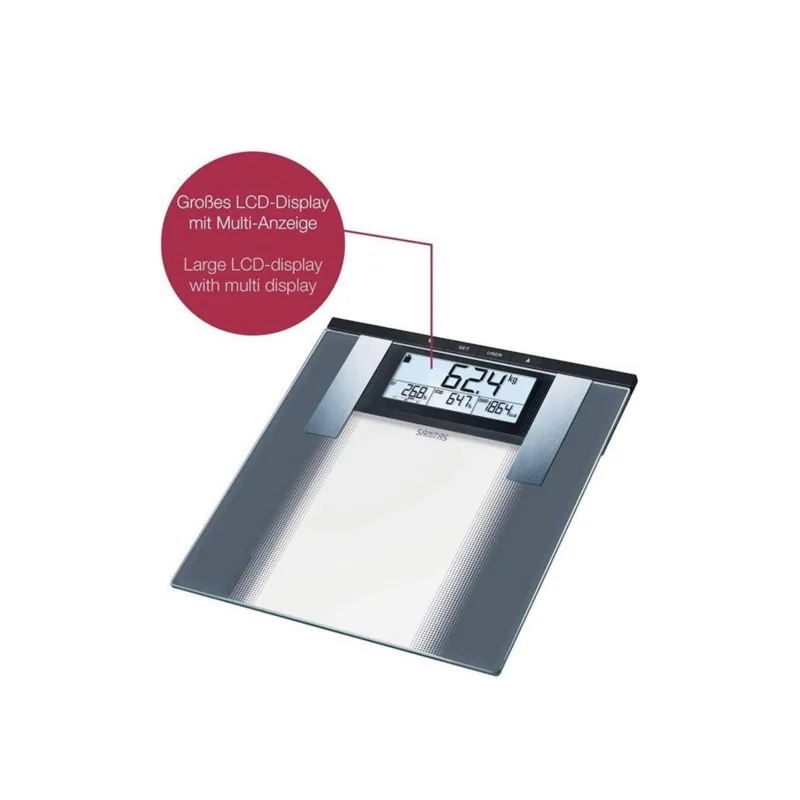
The Sanitas SBG 21 is a glass digital body analysis scale designed for home use to track weight and body composition quickly and conveniently. Using Bioelectrical Impedance Analysis (BIA), the scale estimates body fat, body water, muscle percentage, bone mass, basal metabolic rate (BMR) and active metabolic rate (AMR). It supports up to 10 user profiles with programmable age (10–100 years), height (100–225 cm) and activity levels (1–5), and displays results in precise increments: weight to 100 g, body composition to 0.1% and BMI to 0.1 units.
Key features and how it works
The SBG 21 measures electrical impedance through metal electrodes on the glass platform. Because muscle and water conduct electricity better than fat and bone, the device uses resistance readings plus entered personal data (age, sex, height, activity) to estimate composition values. The scale uses two CR2032 lithium batteries and warns when battery replacement is needed. A firm, level floor and bare, slightly moist feet are recommended for reliable readings. The product offers metric and imperial units and a maximum capacity of 180 kg (397 lb).
Practical use and tips
For consistent tracking, weigh at the same time each day—ideally in the morning after using the toilet and before eating. Stand still with even weight distribution and ensure no contact between legs or thighs during measurement. Slightly dampening the soles improves conductivity; heavy calluses can cause errors. Allow about 15 minutes after waking or after intense activity for body fluids to stabilize before measuring. If the scale displays error messages or implausible values, retry barefoot, moisten the soles, check battery condition, and ensure weight does not exceed the 180 kg limit.
Interpreting results
Results are approximations intended for personal monitoring, not for medical diagnosis. BMI is calculated from height and measured weight and may misclassify very muscular people. Body fat, water and muscle percentage tables in the manual provide age- and sex-specific reference ranges. BMR is estimated using the Harris–Benedict formula; AMR adjusts calorie needs by activity level. Short-term weight changes usually reflect water shifts; medium- to long-term trends better indicate fat or muscle changes.
Safety and maintenance
Do not use if you have medical implants (e.g., pacemaker) or during pregnancy. Keep batteries and packaging away from children. Clean with a damp cloth only; avoid immersion, harsh chemicals, shocks, extreme temperatures and proximity to heat sources. Repairs should be performed by authorized service only. Dispose of batteries and the device in accordance with local regulations and WEEE directives.
Notes
- The device is for personal, non-medical use and can show measurement tolerances.
- Measurement ranges: body fat 3–55% and body water 25–75% (outside these ranges may produce errors).
- Memory: up to 10 user profiles.
- Batteries: 2 × CR2032 (replace when display shows “L0”).
Search for 67,706 Manuals online


Type-in Brand or Model
Gerd Noack
7 months ago
How accurate is the scale, and what should I do if my readings differ between weights like 10 kg and 20 kg?
Manual.ly
7 months ago
Thanks for your question. We recommend using the scale on a flat, stable surface and avoiding placement on carpets or uneven floors. After unboxing, allow it to settle briefly before weighing. Make sure you stay within the specified maximum load. If you notice significant deviations (for example, inconsistent readings between different weights), first verify with a known test weight. If the difference persists, please contact support and we will help you with calibration options or an exchange/refund as appropriate. In many cases, a replacement resolves a reading deviation caused by device tolerance or handling.