

Sage Barista Express SES875 Manual
PDF manual · 40 Pages
English



Quick check
Incorrect answer, please try again.
Chat with your Sage Barista Express SES875 manual using AI
Get instant AI answers from your Sage Barista Express SES875 manual
Ask anything about the Sage Barista Express SES875. Answers come from this manual, with the pages they are based on.
Barista Express SES875 Maintenance Schedule
Soak new filter for 5 minutes, rinse, insert into holder, set date dial 2 months ahead, and lock into water tank.
Insert cleaning disc and tablet in portafilter. Lock into group head and press 1 CUP, 2 CUP, and POWER buttons simultaneously for 10 seconds.
Wipe wand with damp cloth and purge steam briefly over drip tray to clear remaining milk from inside the wand.
Rinse under hot water to remove residual coffee oils. If holes are blocked, soak in cleaning tablet solution for 20 minutes.
Place empty filter basket and portafilter into group head. Press and hold 1 CUP button to run a short flow of water.
Remove grid and separator, dispose of grounds, wash parts in warm soapy water, rinse, and dry thoroughly.
Use Allen key to remove screw, shower screen, and dispersion plate. Remove old seal and install new one before reassembly.
Free maintenance reminders
Timed to your purchase date. Always free, unsubscribe anytime.
Ask a Question
Do you recommend Barista Express SES875?
Yes NoFrequently Asked Questions
It can prepare single or double espresso, ristretto, Americano or long black, cappuccino, latte macchiato, and macchiato. The separate hot-water outlet supports Americanos, while the steam wand makes textured milk for milk-based drinks.
Is this answer helpful?
Start around grind setting 8, then adjust based on the flow. If espresso runs too quickly, choose a finer setting. If it drips slowly or barely flows, choose a coarser setting. Change one variable at a time for clearer results.
Is this answer helpful?
The one-cup button is preset to approximately 30 ml, while the two-cup button is preset to approximately 60 ml. Both volumes can be reprogrammed, and manual extraction allows you to stop the shot at your preferred volume.
Is this answer helpful?
Use single-wall baskets with freshly ground whole beans when you want to control grinding, dosing, and tamping. Use dual-wall baskets with pre-ground coffee because they help regulate pressure and make extraction more forgiving.
Is this answer helpful?
Fast, watery espresso usually means under-extraction. Try a finer grind, increase the coffee dose, and tamp evenly with about 15-20 kg of pressure. Ideally, coffee should begin flowing after 4-7 seconds and run slowly like warm honey.
Is this answer helpful?
Replace the water filter every three months or after approximately 40 litres of water. In areas with lower water hardness, the interval may extend to around 60 litres. Fresh filtered water helps reduce scale and supports better coffee flavour.
Is this answer helpful?
Wipe the steam wand immediately after each use with a damp cloth, then briefly release steam over the drip tray to clear milk residue. If the holes clog, allow the machine to cool and clean them with the supplied cleaning tool.
Is this answer helpful?
Advantages and Disadvantages
Advantages

- Integrated conical burr grinder delivers freshly ground coffee directly into the portafilter.
- PID control, Thermocoil heating, pre-infusion, and pressure gauge support consistent extraction.
- Programmable single and double shots allow convenient repeatable drink volumes.
- 360-degree steam wand, temperature-indicating jug, and hot-water outlet support milk drinks and Americanos.
- Water filter, cleaning alert, removable drip tray, and accessible maintenance tools simplify care.
Disadvantages

- Requires practice with grind size, dose, tamping, and extraction to achieve the best results.
- Single Thermocoil workflow requires a temperature recovery step after steaming milk.
- Regular cleaning, filter replacement, grinder care, and occasional descaling are necessary.
- Manual steam wand technique may be less convenient for users seeking fully automatic milk drinks.
Product Specification
Power
1,850 W
Pump pressure
217.56 psi
Coffee system
Coffee beans, ground coffee
Grinder
Adjustable grinder
Water tank capacity
0.53 gal
Bean hopper capacity
8.82 oz
Features
2-cup function, hot water/steam nozzle, heated cup tray
Dimensions
12.99 x 15.75 x 12.2 in (W x H x D)
Product Description
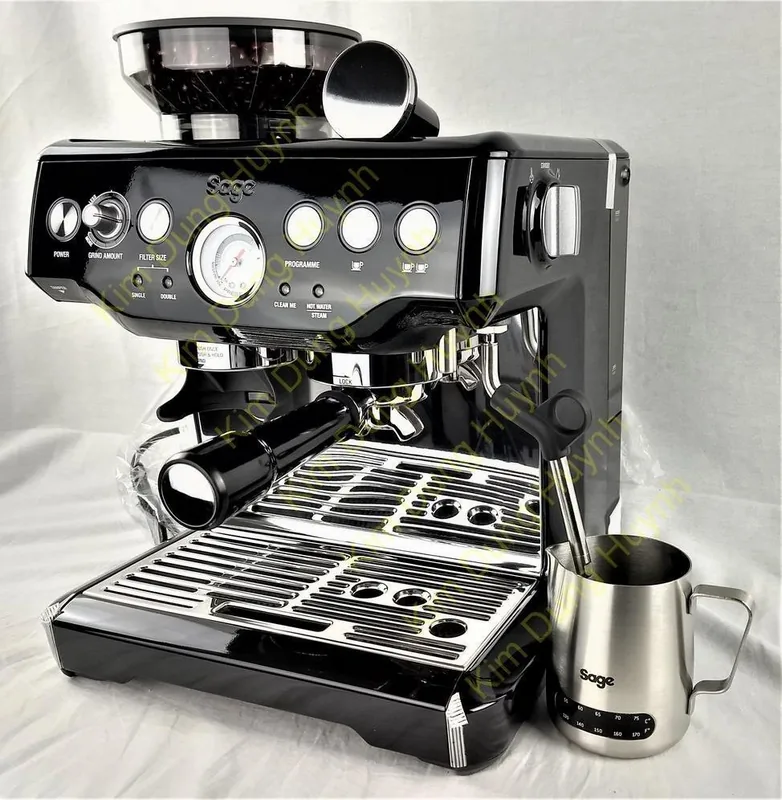
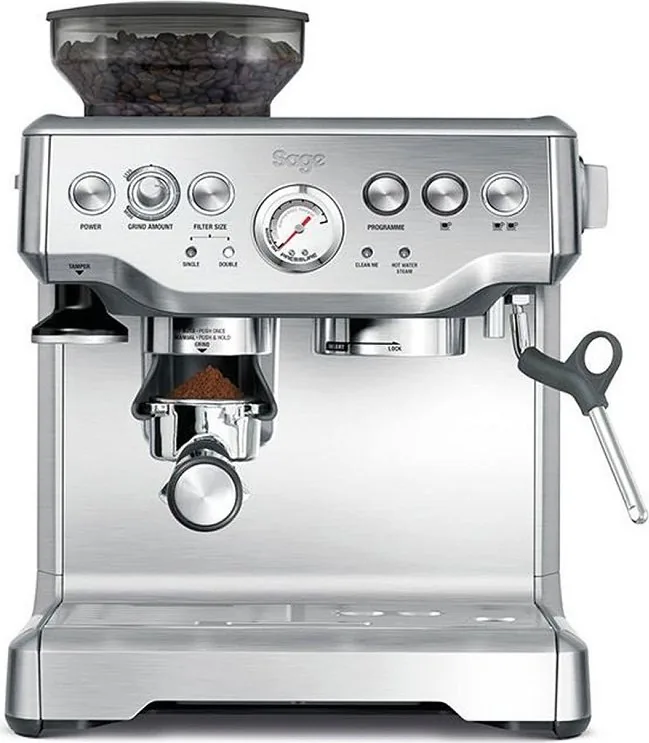
Sage SES875 The Barista Express Manual: Espresso Craft at Home
The Sage SES875 The Barista Express brings the essential stages of cafe-style espresso preparation into one compact home machine. Designed for coffee drinkers who want more control than a capsule system can offer, it combines a built-in conical burr grinder, precise temperature management, manual milk texturing, and programmable shot controls. The Sage SES875 The Barista Express Manual is especially useful for learning how grind size, dose, tamping, and extraction time influence every cup.
Built-in grinding for fresher coffee
Freshly ground beans are central to a balanced espresso, and this machine supports that process with an integrated stainless-steel conical burr grinder. Its grind setting can be adjusted from fine to coarse, while the grind amount dial helps match the dose to the selected grind. Choose single or double filter size, place the portafilter in the grinding cradle, and the grinder can dispense automatically. Manual grinding is also available for greater flexibility.
The 450 g bean hopper has a locking system for easier removal and storage. For consistent puck depth, the included Razor precision dose tool trims excess coffee after tamping. This helps create a cleaner, more repeatable workflow before locking the 54 mm stainless-steel portafilter into the group head.
Control over extraction and temperature
The Barista Express uses PID temperature control and a Thermocoil heating system to promote stable brewing conditions. Low-pressure pre-infusion gently wets the coffee puck before full pressure is applied, supporting a more even extraction. A front pressure gauge gives useful visual feedback, helping users identify whether coffee is flowing too quickly or too slowly.
Preset buttons produce approximately 30 ml for one cup and 60 ml for two cups, while manual and programmable options let you tailor volumes to your taste. Temperature can also be adjusted by up to 2 degrees C above or below the standard setting, which is helpful when experimenting with different roasts and beans.
Milk drinks, hot water, and daily care
A 360-degree swivel steam wand creates textured milk for cappuccinos, lattes, and flat whites. The supplied milk jug includes a temperature indicator, with 60-65 degrees C recommended for smooth, sweet-tasting milk. A separate hot-water outlet is convenient for Americanos and preheating cups.
The 2 L removable water tank accepts a replaceable filter that reduces impurities and scale. Regular maintenance is straightforward: rinse the steam wand after every use, empty the drip tray when its indicator appears, clean the grinder and baskets, and run cleaning or descaling cycles when needed. The automatic purge after steaming helps return the machine to a suitable espresso temperature.
Note: Great espresso requires small adjustments. Start with fresh beans, a fine espresso grind, an even 15-20 kg tamp, and aim for a slow, honey-like flow over roughly 25-35 seconds.
Search for 67,706 Manuals online


Type-in Brand or Model