
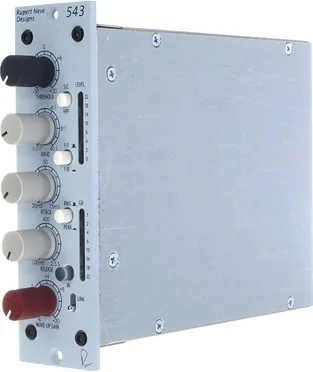
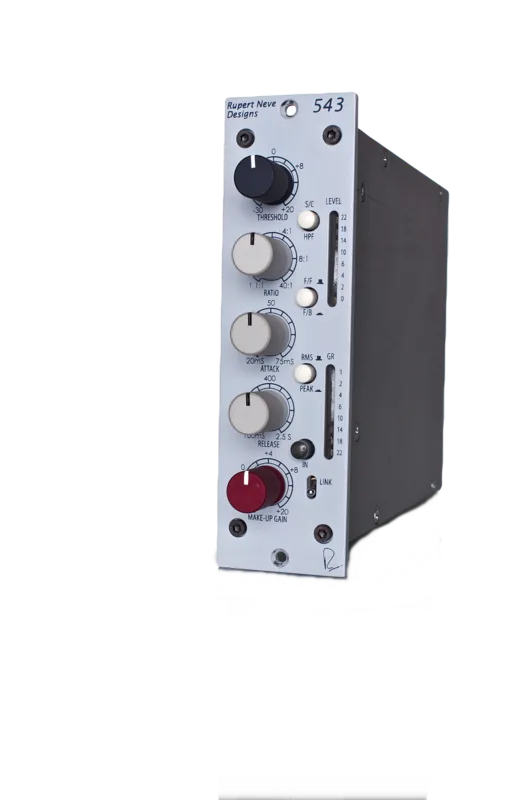
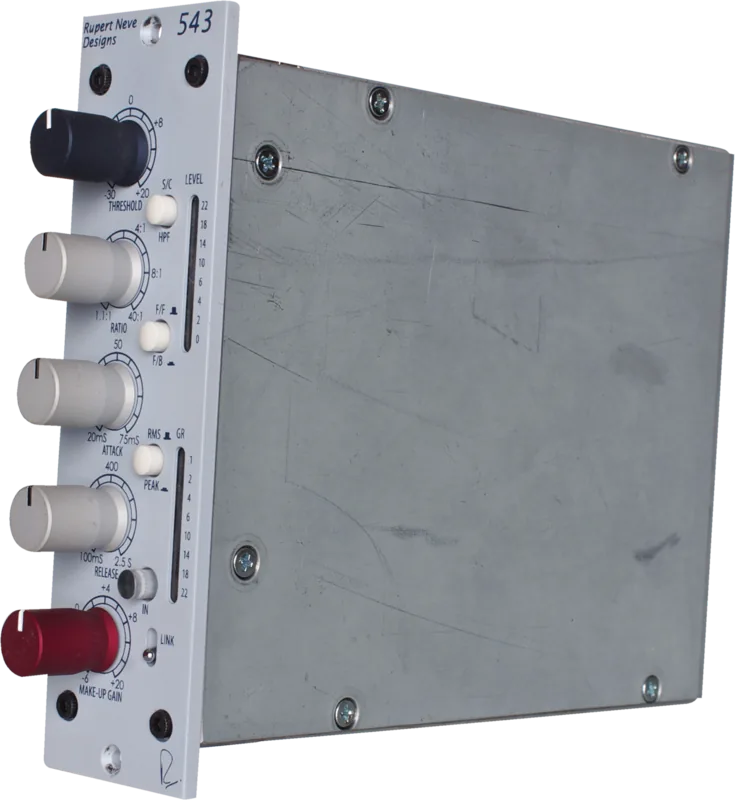
Rupert Neve Designs Portico 543 Manual
PDF manual · 11 Pages
English



Quick check
Incorrect answer, please try again.
Chat with your Rupert Neve Designs Portico 543 manual using AI
Get instant AI answers from your Rupert Neve Designs Portico 543 manual
Ask anything about the Rupert Neve Designs Portico 543. Answers come from this manual, with the pages they are based on.
Ask a Question
Do you recommend Portico 543?
Yes NoVideo Manual
Rupert Neve 543 Compressor DEMO
Frequently Asked Questions
The Portico 543 provides both feed-forward (FF) and feedback (FB) compression modes. FF tends to be punchier and more rhythmically reactive, while FB is smoother and more program-dependent, giving different dynamic behaviors to suit musical goals.
Is this answer helpful?
Yes. The 543’s threshold, ratio, attack and release controls plus Peak/RMS detection let you set anything from unobtrusive leveling to near brick-wall limiting. Use RMS for perceived-loudness control and Peak for strict waveform protection; adjust attack/release to taste.
Is this answer helpful?
Use the side-chain high-pass filter (HPF) to remove low-frequency content from the compressor’s detection path. This prevents the compressor from over-reacting to bass energy and reduces audible pumping on full-range sources.
Is this answer helpful?
Yes. The 543 supports linking via an internal link buss and a rear connector for jumper cables, allowing two or more units to be synchronized for stereo compression when installed in compatible 500-series racks.
Is this answer helpful?
Very fast attack combined with very fast release and high ratios can cause modulation distortion and unnatural pumping. Listen critically and back off one parameter if you notice distortion; sometimes slightly slower times yield more musical results.
Is this answer helpful?
The unit fits standard 500-series racks and uses the rack’s power. For stereo linking or multiple-channel setups, ensure your rack supports link buss wiring and use the recommended jumper cables or wiring method supplied by the rack or manufacturer.
Is this answer helpful?
Typical uses include vocal leveling, drum bus control, individual instrument compression, tracking-stage limiting, and mix bus coloration. Its tonal options make it equally useful for transparent control or creative coloration depending on settings and gain staging.
Is this answer helpful?
Advantages and Disadvantages
Advantages

- Authentic Rupert Neve musical character in 500-series format.
- Feed-forward and feedback modes for punchy or smooth compression.
- Peak/RMS detection gives flexible transient or perceived-loudness control.
- Transformer-coupled I/O and discrete circuitry for rich harmonic tone.
- Side-chain HPF and link buss support practical studio workflows.
Disadvantages

- Compact 500-series form may limit I/O compared with full rack units.
- Complex control interactions require listening skill to avoid artifacts.
- Fast attack + fast release + high ratio can introduce modulation distortion.
- May color signal when driven—undesirable if purely transparent gain control is needed.
- Requires compatible 500-series rack and linking jumpers for stereo setups.
Product Specification
Type
Compressor
Channels
1
Format
System 500
Product Description
Rupert Neve Designs Portico 543 — Compact Musical Compression
The Rupert Neve Designs Portico 543 is a 500-series mono compressor-limiter that brings the celebrated musical character of Rupert Neve circuitry into a compact format. Designed for engineers and producers who demand transparent dynamic control or tasteful coloration, the 543 combines feed-forward and feedback topologies, Peak/RMS detection, transformer-coupled I/O, and mostly discrete circuitry to deliver a versatile tool for tracking, mixing, and mastering.
Small in format but big in features, the Portico 543 offers precise threshold, ratio, attack and release controls along with a useful gain make-up stage. Its dual-mode design (FF/FB) lets you choose between punchy, rhythmically reactive compression and smoother, program-dependent behavior. Peak and RMS detection options let you tailor the compressor’s sensitivity to transients or perceived loudness, while the side-chain high-pass filter helps avoid low-frequency pumping when controlling bass-heavy material.
The unit emphasizes low distortion and high sonic fidelity, using classic Rupert Neve design elements such as input and output transformers and discrete components to preserve harmonic richness while controlling dynamics. Fast attack capability handles sharp transients like snare hits; adjustable release behavior preserves musical sustain or avoids pumping when set carefully. A link buss supports stereo/dual-channel operation across multiple 500-series modules for cohesive stereo compression.
Beyond typical compressor features, the Portico 543 includes metering for gain reduction and output level, a bypassed compressor option for A/B comparison, and user-friendly controls for quick setup in a tracking or mixing environment. Its sound ranges from ultra-transparent leveling to characterful coloration when driven, making it suitable for vocals, drums, buses, and source-level limiting.
Whether you want subtle leveling, aggressive control, or classic Neve warmth in a studio rack, the Portico 543 delivers flexible dynamics processing with professional build quality and a practical control set.
Notes
- Use Feed-Forward for rhythmic, punchy results; use Feedback for smoother program-dependent compression.
- Engage side-chain HPF to reduce low-end triggered pumping on bass-heavy sources.
- Link multiple units for stereo operation; use proper jumper wiring for rack linking.
- Avoid very fast attack + fast release + high ratio to reduce modulation distortion.
Search for 67,706 Manuals online


Type-in Brand or Model