
Rollei Rock Solid Gradient Grey Reverse Manual
PDF manual · 76 Pages
English



Quick check
Incorrect answer, please try again.
Chat with your Rollei Rock Solid Gradient Grey Reverse manual using AI
Get instant AI answers from your Rollei Rock Solid Gradient Grey Reverse manual
Ask anything about the Rollei Rock Solid Gradient Grey Reverse. Answers come from this manual, with the pages they are based on.
Rock Solid Gradient Grey Reverse Maintenance Schedule
Use a microfiber cloth or soft cloth to remove dust from the filter surface.
Use a microfiber cloth or Rollei Filter Cleaner to remove fingerprints. Do not use alcohol or chemical fluids.
Ask a Question
Do you recommend Rock Solid Gradient Grey Reverse?
Yes NoFrequently Asked Questions
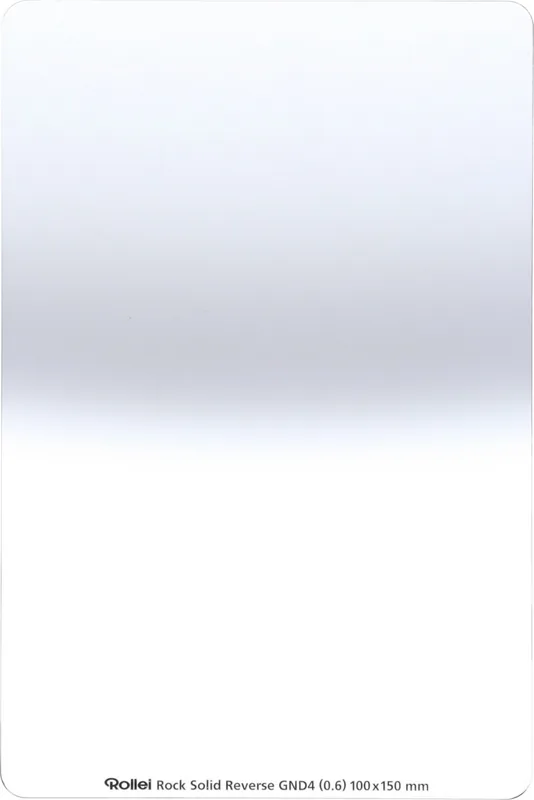
A Reverse Graduated Neutral Density filter places maximum density near the center that tapers toward the top. It’s ideal for sunrise/sunset scenes where the brightest area lies close to the horizon, helping retain highlight detail without darkening the upper sky excessively.
Is this answer helpful?
Rollei uses chemically strengthened Gorilla® glass with precision double-sided nano optical coatings, a water- and oil-repellent layer and anti-reflective treatments to ensure high resolution, low color cast, reduced reflections and improved durability.
Is this answer helpful?
The Reverse GND is a 100 mm rectangular filter designed for insertion into a Rollei-compatible square filter holder. Multiple filters can be stacked in the holder to combine effects, but check for potential vignetting on wide-angle setups.
Is this answer helpful?
Use a clean microfiber cloth or Rollei filter cleaner to remove dust and fingerprints. Avoid alcohol-based or harsh chemical cleaners. Although coatings increase toughness, do not intentionally drop the filter and store it in a protective case when not in use.
Is this answer helpful?
Rollei’s nano-coated optical glass is engineered to provide an even spectral transmission across visible to near-infrared wavelengths, producing ultra-low color cast compared with dyed resin filters; minor shifts are possible but are minimized by precision polishing and coating.
Is this answer helpful?
Yes — Reverse GNDs control highlight exposure near the horizon while neutral density (ND) filters handle overall exposure. For long exposures, combine with appropriate ND filters, use a tripod, calculate base exposure without filters and cover viewfinder to prevent light leaks.
Is this answer helpful?
The Rollei Rock Solid square/rectangular filters referenced in the manual are available in 100 mm format. The Reverse GND models mentioned (e.g., Reverse GND4 and Reverse GND8) are listed for the 100 mm system; check Rollei for adapters or alternative formats.
Is this answer helpful?
Advantages and Disadvantages
Advantages

- High-resolution Gorilla® glass with double-sided nano coatings ensures ultra-low color cast and minimal optical distortion.
- Reverse graduation design controls horizon brightness effectively for sunrise and sunset scenes.
- Durable, scratch- and pressure-resistant coatings increase field reliability and ease of cleaning.
- Double-sided anti-reflective and water/oil-repellent coatings reduce flare and stray reflections.
- Compatible with Rollei Rock Solid 100 mm filter system and can be stacked with other filters.
Disadvantages

- Available only in 100 mm rectangular format, requiring a dedicated holder for use.
- Despite enhanced toughness, coated glass can still break if subjected to repeated or intentional drops.
- Reverse GND’s specialized gradient may be less useful for scenes where the bright area is not near the horizon.
- High-quality glass and coatings typically come at a premium price compared to resin alternatives.
- Requires careful handling and cleaning; alcohol or harsh chemical cleaners must be avoided.
Product Specification
Filter Size
3.94x5.91in
Product Description
Rollei Gradient Filter Grey Rock Solid Reverse Manual
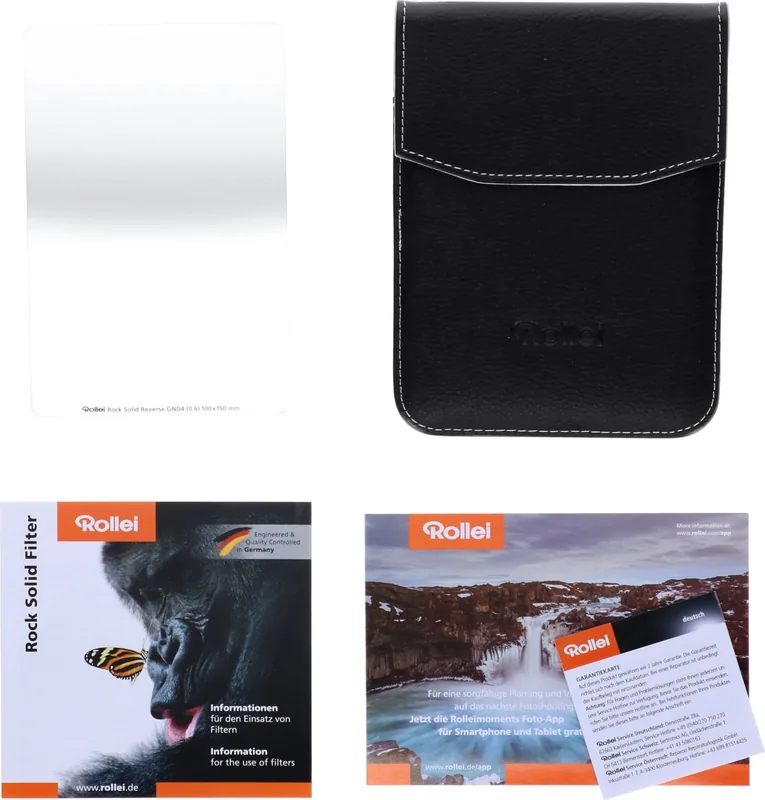
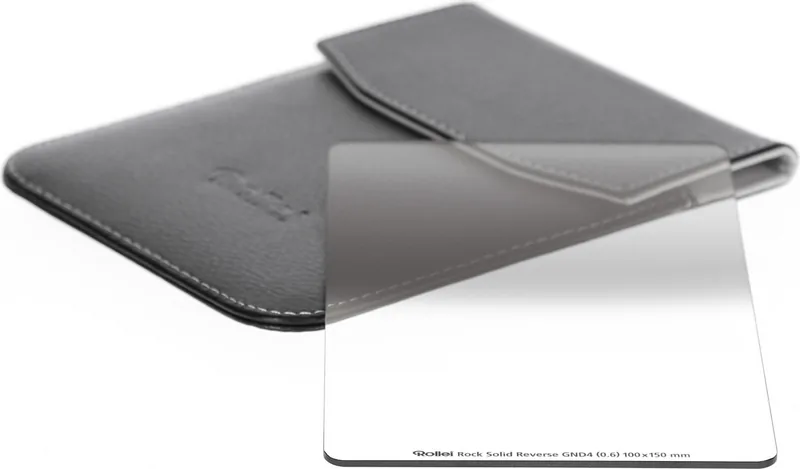
The Rollei Gradient Filter Grey Rock Solid Reverse Manual presents the Reverse GND from the Rock Solid series — a precision-engineered graduated neutral density filter designed for landscape and long-exposure photographers who need fine control over bright horizons. Built from chemically strengthened Gorilla® Glass with Rollei’s nano multi-coating on both faces, the Reverse GND is optimized to preserve high resolution, minimize color cast and reduce reflections while providing durable, scratch- and pressure-resistant protection. Its reverse graduation places the darkest density near the center of the filter, tapering toward the top edge, making it ideal for scenes where the brightest area is close to the horizon at sunrise or sunset.
The manual explains filter types and applications, comparing manufacturing methods (nano-coated optical glass, sandwich/laminated constructions, dyed resin and metal-coated glass) and highlighting the benefits of Rollei’s nano GND approach. Rollei’s nano-coated glass ensures an even spectral transmission from ultraviolet to near-infrared, producing ultra-low color cast and consistent tonal transitions. The double-sided anti-reflective, water- and oil-repellent coatings reduce stray light and glare while simplifying cleaning.
Practical guidance covers insertion into rectangular 100 mm filter holders and combining multiple filters. For Reverse GND use, the manual emphasizes exposure control and composition when the sky is brightest near the horizon. It explains compatibility with Rollei’s Rock Solid filter lineup and how the Reverse GND complements soft, hard and medium grads for varied contrast challenges.
Durability and handling are stressed: Rock Solid filters tolerate multiple accidental drops from about 1.2 m without immediate failure thanks to their coatings, but they remain coated glass and should not be intentionally dropped. Rollei provides ND, GND and CPL options in the 100 mm square format, with ND densities ranging from ND8 to ND1000 and multiple GND variants including Reverse GND4 and Reverse GND8.
Additional notes include cleaning and maintenance recommendations (microfiber cloth or dedicated filter cleaner; avoid alcohol or harsh chemicals), best practices for long exposures (use a tripod, calculate base exposure without the filter, cover viewfinder to prevent light leaks) and the included Rolleimoments app tools (ND calculator, location planner, weather forecasts, saved locations) to plan shoots.
Notes
- Reverse GND is optimized for sunrise/sunset horizons where brightness is concentrated near the center.
- Use with a 100 mm rectangular holder; can be combined with other Rock Solid filters.
- Clean with microfiber; avoid alcohol-based cleaners.
Search for 67,706 Manuals online


Type-in Brand or Model