
Rodcraft RC7705V6 Manual
PDF manual · 64 Pages
English



Quick check
Incorrect answer, please try again.
Chat with your Rodcraft RC7705V6 manual using AI
Get instant AI answers from your Rodcraft RC7705V6 manual
Ask anything about the Rodcraft RC7705V6. Answers come from this manual, with the pages they are based on.
Ask a Question
Do you recommend RC7705V6?
Yes NoFrequently Asked Questions
It is a pneumatic random orbital sander for smoothing surfaces and removing material with sandpaper. It is intended for surface-preparation tasks and should not be used for cutting, grinding, or other unsuitable applications.
Is this answer helpful?
The RC7705V6 uses a 5 mm orbit. This provides more material-removal capability than a smaller finishing orbit while remaining suitable for controlled sanding work.
Is this answer helpful?
The maximum specified operating pressure is 6.3 bar, or 90 psi. Running below this pressure can reduce sanding efficiency and material-removal performance.
Is this answer helpful?
It uses a 150 mm, or 6-inch, Velcro backing plate with a 5/16-24 UNF thread. The plate must be tightened securely onto the drive spindle before use.
Is this answer helpful?
Average air consumption is specified at 450 l/min, with continuous consumption at 550 l/min. Use an air supply, hose, and fittings that can maintain adequate flow during operation.
Is this answer helpful?
Disconnect the air supply, clean the air inlet, add approximately three drops of approved pneumatic air oil, and briefly run the tool. Performing this before and after use can help reduce wear and maintain stable performance.
Is this answer helpful?
Advantages and Disadvantages
Advantages

- 5 mm orbit supports efficient material removal while retaining control for surface preparation.
- 150 mm Velcro backing plate allows quick abrasive changes and broad sanding coverage.
- 10,000 rpm pneumatic performance suits workshop and bodywork applications.
- At about 0.85 kg, the tool is comparatively light for extended hand-held use.
- Progressive lever control lets the operator adjust speed through trigger pressure.
Disadvantages

- Requires a capable compressed-air system delivering up to 6.3 bar and substantial airflow.
- Continuous air consumption of 550 l/min may exceed the capacity of smaller compressors.
- Declared vibration is 5.4 m/s2, so extended use requires exposure management.
- Regular air-oil lubrication and inlet cleaning are necessary to support service life.
- It is intended only for sanding with abrasive paper and is not a multipurpose tool.
Product Specification
Type
Orbital sander
Operating pressure
91.4 psi
Air consumption
19.42 cfm
No-load speed
10,000 rpm
Disc diameter
5.91 in
Orbit diameter
0.2 in
Tool attachment
Hook-and-loop fastening
Features
Soft grip, cold-insulated
Weight
1.87 lb
Product Description
Rodcraft RC7705V6 Pneumatic Eccentric Sander - Read, Download & Print Free
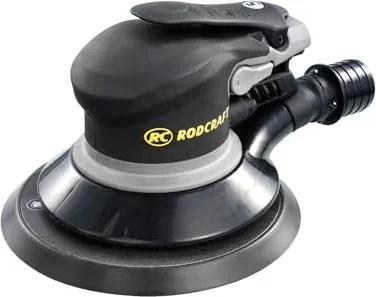
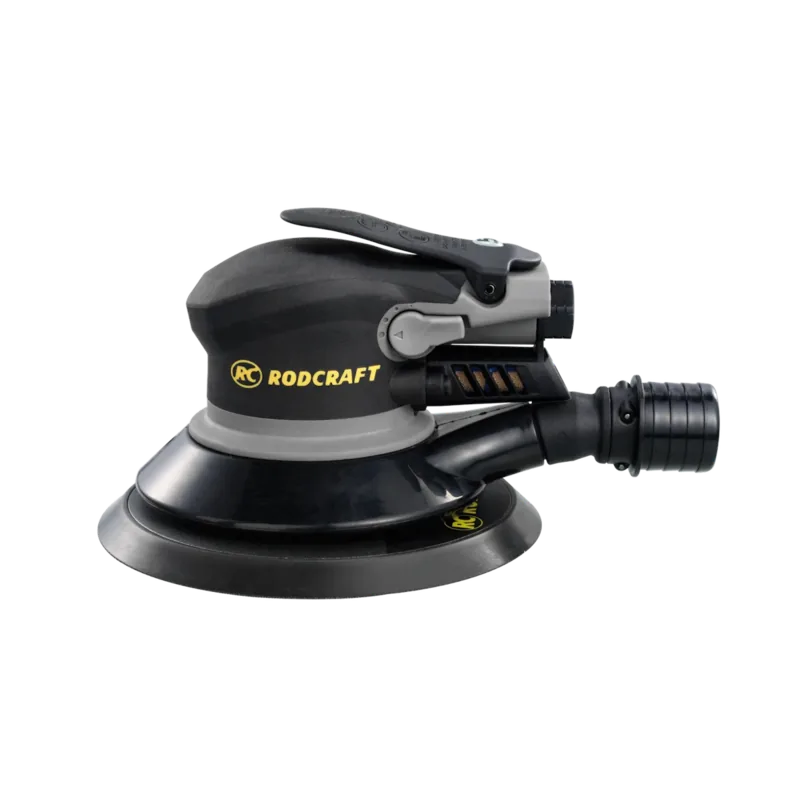
The Rodcraft RC7705V6 Pneumatic Eccentric Sander is a professional air-powered random orbital tool designed for smoothing surfaces and removing material with abrasive paper. Its 5 mm orbit offers a useful balance between efficient stock removal and a controlled finish, making it well suited to preparation work in body shops, workshops, and general fabrication environments.
Built for Practical Surface Preparation
This model uses a 150 mm, or 6-inch, Velcro backing plate with a 5/16-24 UNF thread. The hook-and-loop arrangement makes abrasive changes quick, helping operators move between sanding stages with less interruption. At approximately 0.85 kg, the RC7705V6 remains relatively light for repeated hand-held work while providing the steady pneumatic performance expected in demanding applications.
Powered by compressed air, the sander operates at up to 10,000 rpm and requires a maximum supply pressure of 6.3 bar, or 90 psi. It has a 1/4-inch air inlet and is specified for an 8 mm internal hose diameter. Average air consumption is listed at 450 l/min, rising to 550 l/min during continuous use, so it should be paired with a compressor and air line capable of maintaining consistent flow.
Controlled Operation and Care
A lever trigger starts the tool, with speed increasing as more pressure is applied to the control. The backing plate must be secured firmly to the drive spindle, and the tightening wrench should always be removed before operation. Any speed adjustment should only be made after the spindle has stopped completely, helping prevent unnecessary mechanical damage.
For best sanding performance, maintain the recommended 6.3 bar air pressure. Lower pressure can reduce material-removal efficiency, while the final result will also depend on abrasive selection, surface type, operator technique, and how the tool is guided across the workpiece. The 5 mm eccentric orbit is especially appropriate when a stronger cut is needed than a fine-finish orbit can provide.
Notes
- Use the tool only for sanding surfaces with suitable abrasive paper.
- Disconnect the compressed-air supply before maintenance or inspection.
- Add about three drops of approved pneumatic air oil before and after use to support stable power output and reduce motor wear.
- Keep the air inlet clean, keep the tool away from aggressive chemicals, and have repairs completed by qualified personnel.
- Consider noise and vibration exposure during prolonged work and follow applicable workplace safety practices.
Search for 67,706 Manuals online


Type-in Brand or Model