
RME Digiface AES Manual
PDF manual · 104 Pages
English



Quick check
Incorrect answer, please try again.
Chat with your RME Digiface AES manual using AI
Get instant AI answers from your RME Digiface AES manual
Ask anything about the RME Digiface AES. Answers come from this manual, with the pages they are based on.
Ask a Question
Do you recommend Digiface AES?
Yes NoFrequently Asked Questions
It is a professional USB audio interface for recording, playback, monitoring, routing, and converting analog and digital audio. It can connect AES/EBU, SPDIF, ADAT, microphones, line-level gear, headphones, and MIDI equipment.
Is this answer helpful?
It supports AES/EBU via XLR, coaxial SPDIF, optical SPDIF, and ADAT optical. AES and SPDIF support stereo operation up to 192 kHz, while ADAT supports up to eight channels at standard sample rates.
Is this answer helpful?
Yes. Stored setups and front-panel controls allow stand-alone operation. It can be configured as a converter, monitor mixer, digital format converter, routing matrix, or jitter-reduction device without a connected computer.
Is this answer helpful?
TotalMix FX is RME's hardware-based mixer and routing environment. It lets users create independent output mixes, route any input or playback channel to available outputs, monitor with very low latency, and apply 3-band EQ and low-cut filtering.
Is this answer helpful?
Yes. The two front-panel mic/line inputs offer digitally controlled gain and individually switchable 48 V phantom power. This supports condenser microphones while allowing separate control for each input.
Is this answer helpful?
Digital audio devices must share a stable timing reference. The Digiface AES uses AutoSync, SyncCheck, and SteadyClock FS to help identify and manage clock sources. Incorrect synchronization can produce clicks, noise, or unstable recording and playback.
Is this answer helpful?
Advantages and Disadvantages
Advantages

- Supports AES/EBU, coaxial SPDIF, optical SPDIF, ADAT, analog mic/line inputs, headphones, and MIDI in one compact interface.
- Operates up to 24-bit/192 kHz, with flexible sample rate conversion for AES and SPDIF digital sources.
- TotalMix FX enables low-latency monitoring, independent submixes, comprehensive routing, EQ, low-cut filtering, and loopback.
- SteadyClock FS, AutoSync, and SyncCheck provide reliable clock handling and clear digital sync status feedback.
- Can operate stand-alone as a converter, monitor mixer, routing matrix, format converter, or jitter-reduction tool.
Disadvantages

- ADAT channel count decreases at higher sample rates: four channels at 88.2/96 kHz and two channels at 176.4/192 kHz.
- The sample rate converter can be assigned to only one digital input at a time and does not process eight-channel ADAT signals.
- Proper digital clocking requires care; unsynchronized equipment can cause clicks, noise, or interrupted audio.
- Some advanced routing, driver, and TotalMix functions may require time to learn for new users.
- Multiple Digiface AES units require synchronized clocking, while each unit retains a separate TotalMix mixer.
Product Specification
Interface
USB 2.0
Input Channels
14
Output Channels
16
Mic Preamps
2
Analog Inputs
2x Mic/Line In (XLR/1/4-inch Combo)
Analog Outputs
2x Line Out (XLR), 1x Headphones (1/4-inch Jack)
Digital Inputs
1x ADAT/S/PDIF In (optical), 1x S/PDIF In (coaxial), 1x AES/EBU In (XLR)
Digital Outputs
1x ADAT/S/PDIF Out (optical), 1x S/PDIF Out (coaxial), 1x AES/EBU Out (XLR)
AD/DA Converter
24-bit/192 kHz
Special Features
Bus powered, MIDI In/Out, level meter
Dimensions
8.46 x 1.73 x 5.12 in (W x H x D)
Weight
1.94 lb
Product Description
RME Digiface AES - Read, Download & Print Free
The RME Digiface AES is a compact USB 2.0 digital audio interface designed for demanding studio, broadcast, live sound, and mobile recording workflows. It combines professional analog connectivity with broad digital format support, making it a flexible hub for transferring, monitoring, converting, and routing audio at resolutions up to 24-bit/192 kHz. USB bus power supports portable use, while the included external power supply adds extra security where computer power is limited.
Flexible I/O for Professional Audio
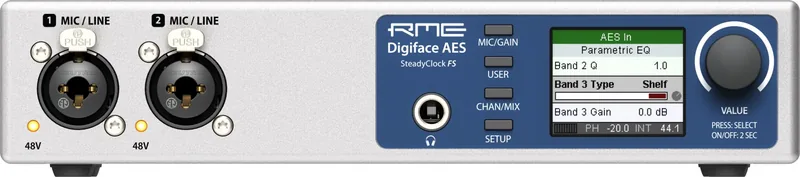
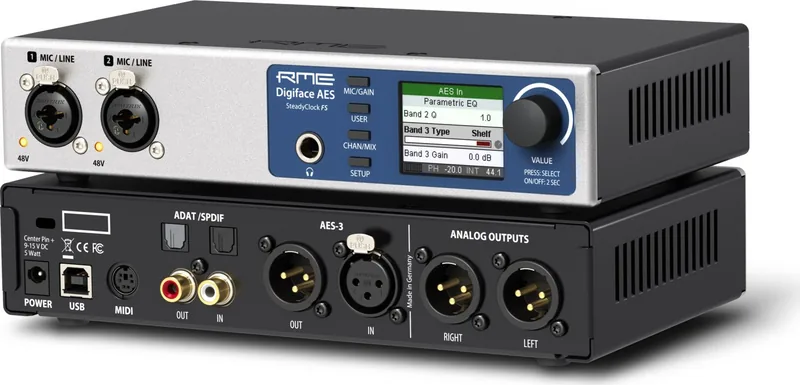
At the front, the interface provides two digitally controlled mic/line inputs with up to 75 dB of gain in precise 1 dB steps. Individually switchable 48 V phantom power supports condenser microphones, while AutoSet gain protection helps preserve headroom during unpredictable recordings. A high-quality headphone output and clear color display make hands-on control practical without reaching for a computer.
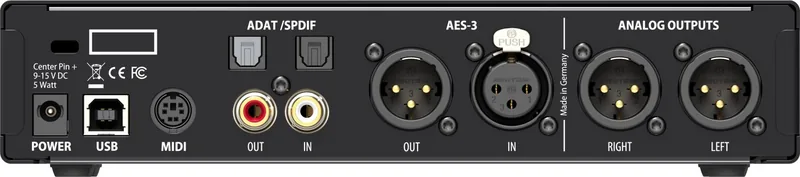
Digital connections include AES/EBU, coaxial SPDIF, optical SPDIF, and ADAT optical. The ADAT port carries up to eight channels at standard sample rates, while AES and SPDIF handle stereo digital recording and playback up to 192 kHz. This range lets the Digiface AES connect converters, recorders, digital mixers, synthesizers, and other studio equipment without relying on separate format-conversion hardware.
TotalMix FX Routing and Monitoring
RME TotalMix FX gives the Digiface AES its exceptional routing flexibility. Inputs and software playback channels can be sent to any hardware output, enabling independent monitor mixes, headphone feeds, signal distribution, loopback capture, and low-latency monitoring. The mixer also includes a 3-band parametric EQ and low-cut filter for practical monitoring adjustments. Six internal setup memories allow frequently used configurations to be stored and recalled quickly.
Clocking is equally important in digital production, and RME addresses it with SteadyClock FS, SyncCheck, and AutoSync. These technologies help maintain stable synchronization, identify invalid or unsynchronized signals, and reduce the impact of incoming jitter. A built-in sample rate converter can be assigned to AES or SPDIF inputs, allowing asynchronous digital sources to be integrated with fewer clocking issues.
Stand-Alone Control and Broad Compatibility
The Digiface AES can work as a stand-alone converter, monitor mixer, routing matrix, format converter, or jitter-reduction device. Its display, encoder, and dedicated buttons provide direct access to gain, volume, routing, clock, and setup functions. It also supports MIDI I/O and Class Compliant operation for compatible devices.
Windows and macOS support, low-latency ASIO operation, Core Audio compatibility, and RME's DIGICheck metering tools make this interface a strong choice for users who need precise control rather than a fixed, limited signal path.
Note: Correct clock configuration is essential when several digital devices are connected. Use SyncCheck status indicators and select a single clock master for reliable operation.
Search for 67,706 Manuals online


Type-in Brand or Model