
RME Babyface Pro FS Manual
PDF manual · 98 Pages
English



Quick check
Incorrect answer, please try again.
Chat with your RME Babyface Pro FS manual using AI
Get instant AI answers from your RME Babyface Pro FS manual
Ask anything about the RME Babyface Pro FS. Answers come from this manual, with the pages they are based on.
Ask a Question
Do you recommend Babyface Pro FS?
Yes NoFrequently Asked Questions
The RME Babyface Pro FS is a portable professional USB audio interface with analog, ADAT, S/PDIF, MIDI, and headphone connectivity. It supports recording and playback up to 24-bit/192 kHz for computer-based, Class Compliant, and selected stand-alone workflows.
Is this answer helpful?
It includes two digitally controlled microphone inputs on XLR connectors. Each can use 48 V phantom power for condenser microphones, and a PAD option helps accommodate louder sources or higher line-level signals.
Is this answer helpful?
Yes. Its optical TOSLINK input and output support ADAT and S/PDIF. An external ADAT converter can add more analog I/O, although the number of available ADAT channels is reduced at 88.2 kHz and above.
Is this answer helpful?
TotalMix FX is the internal mixer and routing system. It allows low-latency monitoring, independent headphone mixes, signal splitting, playback mixing, loopback recording, and routing of inputs or software channels to available hardware outputs.
Is this answer helpful?
Yes. Dedicated RME drivers are available for Windows and macOS, providing access to settings and TotalMix FX. The interface can also be switched to Class Compliant mode for compatible devices and operating environments.
Is this answer helpful?
Digital devices need a shared timing reference to prevent clicks, noise, and data errors. AutoSync can follow a valid optical source automatically, while SyncCheck reports No Lock, Lock, or Sync status to help verify a correct setup.
Is this answer helpful?
Advantages and Disadvantages
Advantages

- 24-bit/192 kHz audio support with analog, ADAT optical, and S/PDIF connectivity.
- Two high-quality mic inputs with individual 48 V phantom power, PAD, and up to 65 dB of gain.
- TotalMix FX provides flexible routing, independent submixes, loopback, EQ, low cut, reverb, and echo.
- SteadyClock FS, AutoSync, and SyncCheck support stable digital synchronization and simple clock monitoring.
Disadvantages

- ADAT channel availability decreases at higher sample rates because S/MUX and S/MUX4 are required.
- Advanced TotalMix FX routing and clock settings may require time to learn for new users.
- USB hubs and extension cables can cause power or data-transfer issues in demanding recording sessions.
- Using multiple interfaces requires proper digital synchronization and does not combine their TotalMix mixers.
Product Specification
Interface
USB 2.0
Input Channels
12
Output Channels
12
Mic Preamps
2
Analog Inputs
2x Mic/Line In (XLR), 2x Line/Instrument In (1/4 in. jack)
Analog Outputs
2x Line Out (XLR), 1x Headphone (1/4 in. jack), 1x Headphone (1/8 in. jack)
Digital Inputs
1x ADAT/S/PDIF In (optical)
Digital Outputs
1x ADAT/S/PDIF Out (optical)
AD/DA Converter
24-bit/192 kHz
Features
Bus-powered, integrated DSP, MIDI In/Out, level meter
Dimensions
4.25 x 1.38 x 7.13 in. (W x H x D)
Weight
1.5 lb
Product Description
RME Babyface Pro FS Manual: Portable Professional Audio Interface
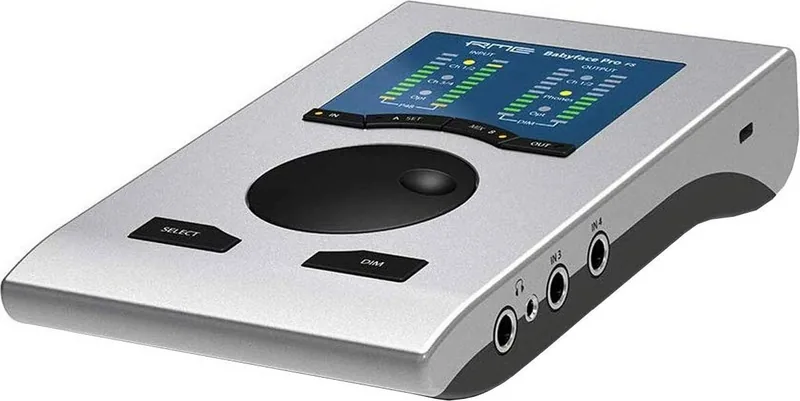
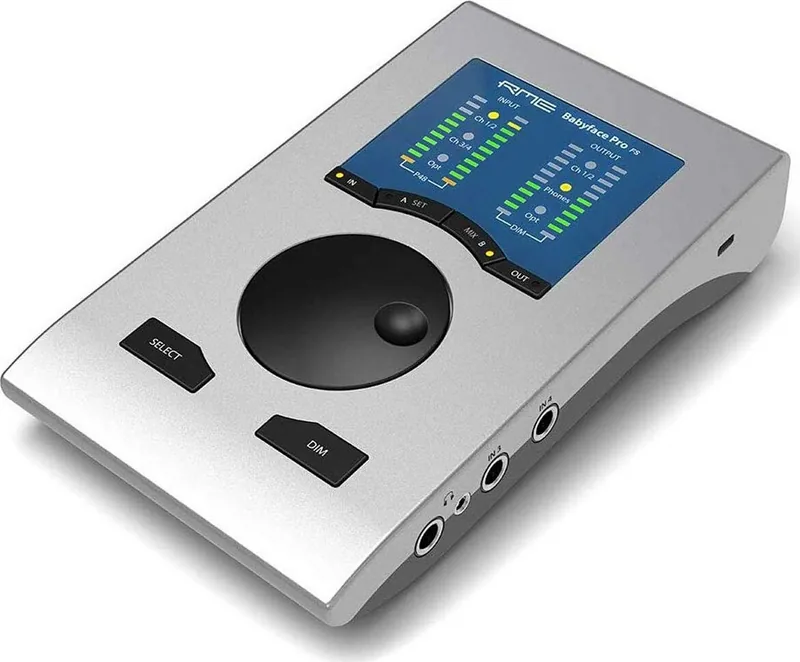
The RME Babyface Pro FS is a compact USB 2.0 audio interface designed for musicians, producers, engineers, and mobile recording setups that demand professional-grade sound. Built from a single block of aluminum, it combines a durable desktop format with a refined control layout, high-resolution conversion, and flexible connectivity for studio or location work.
At its core, the interface supports 24-bit audio at sample rates up to 192 kHz and provides up to 24 channels across analog, ADAT optical, and S/PDIF connections. Two digitally controlled reference-quality microphone inputs include individually switchable 48 V phantom power, making the unit suitable for condenser microphones. The XLR inputs can also handle line-level sources, while the side-mounted instrument and line inputs support guitars, keyboards, and other high-impedance equipment.
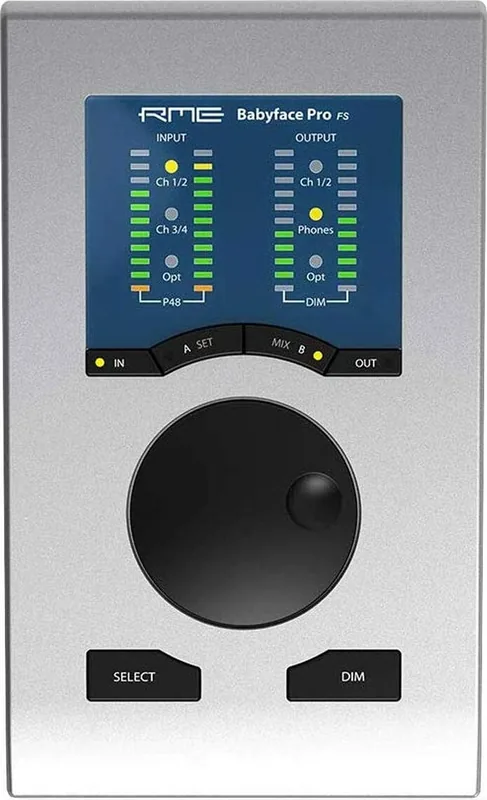
The RME Babyface Pro FS Manual highlights the hardware's direct controls as a major advantage. A precision encoder, dedicated buttons, LED meters, gain adjustment, output level selection, balance control, DIM, Recall, and direct monitoring can all be accessed from the unit itself. This lets users adjust important recording and monitoring settings without constantly switching to software.
For routing and headphone monitoring, TotalMix FX is one of the interface's defining features. Its flexible matrix mixer enables independent submixes, signal distribution, loopback recording, and near-zero-latency monitoring. Integrated effects include a 3-band parametric EQ, low-cut filter, reverb, and echo. These tools support practical tasks such as creating separate artist headphone mixes, routing playback to multiple outputs, or adding monitor effects during recording.
Digital expansion is available through optical I/O, which automatically recognizes incoming ADAT or S/PDIF signals. ADAT support makes it possible to add external converters and increase the number of analog channels. RME's SteadyClock FS technology, AutoSync, and SyncCheck help maintain stable digital synchronization and simplify clock configuration when connecting external equipment.
The Babyface Pro FS works with Windows and macOS through dedicated drivers and can also operate in Class Compliant mode with compatible devices. Stand-alone operation broadens its usefulness when a computer is not required. MIDI input and output, two separately optimized headphone outputs, selectable XLR output reference levels, and optional external power complete a highly adaptable interface package.
Notes
For dependable USB operation, use a direct USB connection and quality cable. When working with digital sources, confirm that the clock status reports Sync to avoid clicks, noise, or recording errors.
Search for 67,706 Manuals online


Type-in Brand or Model