Manual.ly Logo

REV Ritter LCD Battery Tester Manual

0.0 · 0 Ratings

PDF manual · 2 Pages

English

M: QW-35-FL
page

/ 2

Loading...
354b886a78417f9b61da2e6170b9b01aed01 page 1
LCD BATTERIE-TESTER
Bedienungsanleitung
06.19
LCD BATTERIE CHECKER
Instruction Manual
TESTEUR DE PILES LCD
Mode d'emploi
PROBADOR DE BATERÍAS LCD
Manual de instrucciones
GB
FR
ES
DE
Bevor Sie eine Batterie entsorgen, sollten Sie die Batteriekapazit mit diesem Tester überprüfen, ob diese
auch wirklich leer ist. Das ist ökologisch und schont die Umwelt.
ALLGEMEINER GEBRAUCH
• Einfache Messung der Batteriespannung und der verbliebenen Batteriekapazität
• Verwendbar für Batterien mit 1,2V; 1,5V; 3V; 9V
• Geeignet für: NiMH, NiCd-, Zink-Kohle- und wiederaufladbare Batterien
• Batteriegrößen: AAA, AA, C, D, Knopfzellen und PP3
• Die Installation darf nur von ausgebildeten Fachkräften nach den geltenden Installationsvorschriften
durchgeführt werden. Wenden Sie sich hierzu an einem zugelassenen Elektro-Fachbetrieb.
BEDIENUNG
1. Legen Sie 2 Batterien (1,5V, Größe AAA) in das Batteriefach auf der Rückseite ein.
2. Betätigen des Tasters
schaltet den Tester ein.
Durch mehrfaches Betätigen kann die zu testende Batteriespannung eingestellt werden
(1.2V/1.5V/3.0V/9.0V ). Die letzte Einstellung wird für den nächsten Gebrauch gespeichert.
Öffnen Sie den Testbügel, legen Sie die Batterie zwischen Display-Einheit und Bügel und schieben
den Testbügel bis auf die Batterie herunter. Beachten Sie dabei bitte die Polarität der Batterie.
Bei 9V-Batterien: Bitte benutzen Sie die Prüfkontakte
➂
&
➃
(siehe Bild1).
Achtung: Bitte vergewissern Sie sich, dass Sie vorab die richtige Spannung eingestellt ha-
ben, ansonsten werden für den Test falsche Ergebnisse angezeigt.
Nachdem Sie die Batterie mit den Prüfkontakten verbunden haben, können Sie die verbleibende
Spannung und Kapazität ablesen.
➀ Prüfkontakt "+"
➁ Prüfkontakt "-"
➂ Prüfkontakt "-" für 9V Batterien
➃ Prüfkontakt "+" für 9V Batterien
➄ Funktionswahltaster: Ein/Aus, Batteriespannungs-Auswahl
➅ LCD - Display
⑦ Testbügel
➇ Batteriefach-Abdeckung
3. Die aktuellen Prüfergebnisse werden im Display angezeigt
4. Das Gerät schaltet sich nach 30 Sekunden automatisch ab.
5. Das LCD Display bietet einen genauen und einfachen Überblick über die Prüfergebnisse:
➀ Histogramm der verbleibenden Batteriekapazität
➁ Voreingesteller Messbereich für die Batteriespannung
➂ Anzeige der verbleibenden Batteriekapazität (in %)
➃ Anzeige der tatsächlichen Batteriespannung
TECHNISCHE DATEN
Messgenauigkeit: 0,5V
Auflösung: 0,1V
Messbereich: 0,2V–10,5V
Umgebungstemperatur und –feuchtigkeit
Einsatz: 0 – 40 °C ; max. 75%
Lagerung -10 – 50 °C; max. 85%
Versorgungsspannung: 3V (2x AAA Batterien)
Größe: 9 x 4,5 x 2,2 cm
Gewicht: 44g (ohne Batterien)
BATTERIEWECHSEL
1. Öffnen Sie die Abdeckung des Batteriefachs auf der Rückseite und ersetzen Sie die 2 Batterien (AAA)
2. Schließen Sie wieder vorsichtig die Abdeckung.
PFLEGE UND WARTUNG
Vermeiden Sie es, den Tester auf harten Untergrund fallen zu lassen.
Lagern Sie den Tester an einem kühlen und trockenen Ort.
ENTSORGUNG
Gebrauchte Elektro- und Elektronikgeräte dürfen gemäß europäischer Vorgaben nicht mehr zum
unsortierten Abfall gegeben werden. Das Symbol der Abfalltonne auf Rädern weist auf die Not-
wendigkeit der getrennten Sammlung hin. Helfen auch Sie mit beim Umweltschutz und sorgen
dafür, dieses Gerät, wenn Sie es nicht mehr nutzen, in die hierfür vorgesehenen Systeme der
Getrenntsammlung zu geben. RICHTLINIE 2012/19/EU DES EUROPÄISCHEN PARLAMENTS UND DES
RATES vom 04. Juli 2012 über Elektro- und Elektronik-Altgeräte.
SERVICE
Haben Sie Fragen zu unserem Produkt oder eine Beanstandung, dann informieren Sie sich bitte im
Internet unter www.rev.de über die Kontaktaufnahme und Retourenabwicklung oder senden eine
E-Mail an service@rev.de. Wir weisen darauf hin, dass wir keine Sendungen ohne Retourennummer
bearbeiten können und deren Annahme verweigern müssen.
➁
➀
➂
➃
GB
Before throw away the batteries, please kindly check the battery capacity by using our batter tester.
Eco friendly. Protect our environment.
GENERAL USAGE
• Easily measure battery voltage and capacity left
• Used for 1.2v, 1.5v, 3v, 9v battery
• Widely use in NiMH battery, NiCd, Zinc Carbon, rechargable batteries
• Battery fit: AAA, AA, C, D, Button cell, PP3
• Installation may only be performed by trained professionals in compliance with applicable installation
regulations. Please contact a qualified electrical company.
OPERATION
1. Install 2XAAA 1.5V battery into the battery compartment on the back.
2. Push the switch
along the direction to turn on the tester and then gently push the button to set
the battery type you are testing (Total 4 types, 1.2V/1.5V/3.0V/9.0V ).
It will keep the last setting when turning on the tester.
Slide down the Check Handle. Insert the testing battery between the Display Unit and Check Handle
according to the battery polarity instruction.
For 9V battery, please test its voltage and capacity by using
➂
&
➃
(Figure1).
Note: please kindly clarify the given voltage of your batteries before being tested, and slide
the switch to the corresponding voltage. If not, you might get some wrong reads when tes-
ting.
For 9V battery, please test its voltage and capacity by using ➂&➃ ; for other type of batteries, push
the Check Handle back to keep the battery tightly contacted with the battery “+” “-” Pole and ready
to read the voltage.
Please take below sketch map for instruction.
➀ “+” polarity contact
➁ “-” polarity contact
➂ “-” polarity contact for 9v battery
➃ “+” polarity contact for 9v battery
➄ on/off and range selection switch
➅ LCD
⑦ Check handle
➇ Battery Cover
3. The actual voltage and capacity will be displayed in LCD.
4. Power is off automatically in 30s.
5. LCD display gives an accurate and easy battery reading for both Voltage and Capacity.
➀ Top histogram to show the trends of Capacity being Changed.
➁ Standard Voltage Tape
➂ Capacity display to show the current capacity
➃ Voltage display to show the real voltage
POWER AND STORAGE
Measure Accuracy: 0.5V
Resolution: 0.1V
Voltage Test Range: 0.2V–10.5V
Temperature and humidity
Working: 0 – 40 °C ; max. 75%
Storage: -10 – 50 °C; max. 85%
Operation Battery: 3V (2x AAA 1.5V batteries)
Size: 9 x 4,5 x 2,2 cm
Gewicht: 44g (Battery not included)
REPLACE BATTERY
1. Open the battery Cover on the back of the unit and replace with 2XAAA 1.5V battery.
2. Put the battery cover back gently.
MAINTENANCE
Please be carefull to avoid dropping.
Storage in cool and dry place.
DISPOSAL
In accordance with European defaults used electrical and electronics devices may no more be
given to the unsorted waste. The symbol of the waste bin on wheels refers to the necessity of
separate collection. Please help with environmental protection and see to it that this device is
given to the for this purpose designated systems of waste sorting if you do not use it any longer.
GUIDELINE 2012/19/EU of the EUROPEAN PARLIAMENT AND the COUNCIL of July 04th 2012 about
electrical and electronics old devices.
➁
➀
➂
➃
Typ: CB-171
➀
➁
➂
➃
➄
➅
➆
➇
➀
➁
➂
➃
➄
➅
➆
➇
1
2
REV Ritter GmbH
Frankenstr. 1 - 4 • D-63776 Mömbris
www.rev.de • Tel. +49 900 117-1070*
Fax. +49 180 5 007410 • service@rev.de
*36 Cent/Min. aus dem dt. Festnetz, Mobilfunkpreise
abweichend

Chat with your REV Ritter LCD Battery Tester manual using AI

Get instant AI answers from your REV Ritter LCD Battery Tester manual

Ask anything about the REV Ritter LCD Battery Tester. Answers come from this manual, with the pages they are based on.

Ask a Question

0/1000

Do you recommend LCD Battery Tester?

Yes No

Frequently Asked Questions

A

It works with NiMH, NiCd, Zinc-Carbon, and rechargeable batteries in sizes AAA, AA, C, D, button cells, and PP3. It supports voltages of 1.2V, 1.5V, 3V, and 9V.

Is this answer helpful?

A

No, the package does not include batteries. You need to install two AAA 1.5V batteries into the rear compartment to power the tester before use.

Is this answer helpful?

A

For 9V batteries, you must use the specific side contacts marked for positive and negative terminals rather than the main spring contacts used for other sizes.

Is this answer helpful?

A

Yes, the LCD displays a percentage representing the remaining capacity based on the voltage reading, helping you decide if a battery is truly dead.

Is this answer helpful?

A

Selecting the incorrect voltage may result in inaccurate readings. Always double-check the switch setting matches the battery type before inserting it.

Is this answer helpful?

A

No, the device should be kept dry. Avoid dropping it on hard surfaces and store it in a cool, dry place to maintain functionality.

Is this answer helpful?

M: QW-35-FL

Advantages and Disadvantages

Advantages

  • Measures multiple voltage levels including 1.2V, 1.5V, 3V, and 9V accurately
  • Compatible with various battery chemistries like NiMH, NiCd, and Alkaline
  • Visual histogram on LCD makes capacity assessment instant and easy
  • Auto-shutoff feature prevents accidental battery drain during storage
  • Compact and lightweight design fits conveniently in pockets or kits
VS

Disadvantages

  • Requires two AAA batteries to operate which must be purchased separately
  • Not suitable for measuring current output or internal resistance directly
  • Manual voltage selection required; no automatic detection capability
  • 9V testing requires specific contact alignment which can be fiddly
  • Limited to standard voltages; does not support specialized high-voltage packs
M: QW-35-FL

Product Specification

Type

Battery Tester

Compatibility

Mignon AA, Micro AAA, Baby C, Mono D

M: QW-35-FL

Product Description

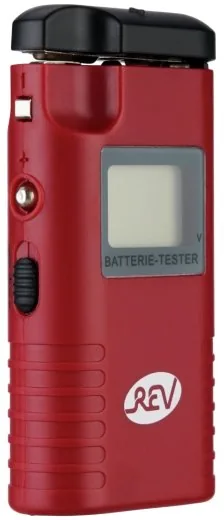
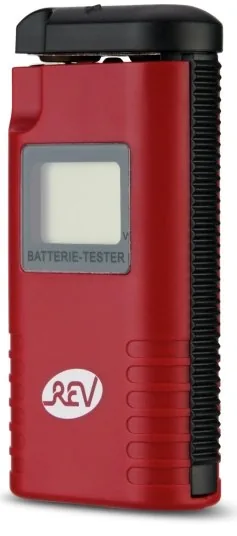
REV Ritter LCD Battery Tester Red: The Eco-Friendly Solution for Power Management

Are you tired of throwing away batteries that still have life left in them? The REV Ritter LCD Battery Tester Red is your ultimate tool for ensuring environmental responsibility and saving money. This compact device allows you to verify the actual capacity of your batteries before disposal, preventing unnecessary waste and protecting our planet.

Designed for versatility, this tester supports a wide range of battery types including NiMH, NiCd, Zinc-Carbon, and rechargeable options. It handles standard sizes like AAA, AA, C, D, button cells, and PP3 batteries with ease. Whether you are testing household remotes, toys, or larger devices, the REV Ritter ensures accuracy every time.

The user interface is intuitive and straightforward. Simply insert two AAA batteries into the back compartment to power the unit. Select your target voltage (1.2V, 1.5V, 3.0V, or 9.0V) using the function switch. Place the battery between the display unit and the test handle, ensuring correct polarity, and slide the handle down. Within seconds, the large LCD screen provides a clear readout of both the remaining voltage and the percentage of capacity left. A helpful histogram visualizes the battery health at a glance.

Safety and convenience are built-in features. The device automatically powers off after 30 seconds of inactivity to preserve its own power supply. Its robust design measures just 44 grams and fits easily in any toolbox or drawer. By using this tester, you contribute to a greener future by only discarding truly depleted batteries.

Important Notes

  • Always ensure the correct voltage is selected before testing to avoid inaccurate readings.
  • For 9V batteries, use the specific side contacts labeled for that purpose.
  • Store the device in a cool, dry place away from hard impacts.
  • Dispose of the unit according to local electronic waste regulations.

Key Advantages and Limitations

Pros

  • Measures multiple voltage levels including 1.2V, 1.5V, 3V, and 9V accurately.
  • Compatible with various battery chemistries like NiMH, NiCd, and Alkaline.
  • Visual histogram on LCD makes capacity assessment instant and easy.
  • Auto-shutoff feature prevents accidental battery drain during storage.
  • Compact and lightweight design fits conveniently in pockets or kits.

Cons

  • Requires two AAA batteries to operate which must be purchased separately.
  • Not suitable for measuring current output or internal resistance directly.
  • Manual voltage selection required; no automatic detection capability.
  • 9V testing requires specific contact alignment which can be fiddly.
  • Limited to standard voltages; does not support specialized high-voltage packs.
M: QW-35-FL

© Copyright 2026 Manual.ly