In accordance with European defaults used electrical and
electronics devices may no more be given to the unsorted
waste. The symbol of the waste bin on wheels refers to the
necessity of separate collection.
Please help with environmental protection and see to it that
this device is given to the for this purpose designated systems of
waste sorting if you do not use it any longer.
DIRECTIVE 2012/19/EU of the EUROPEAN PARLIAMENT AND OF the
COUNCIL of 4 July 2012 on waste electrical and electronic equipment
(WEEE).
Do not switch
devices from the
same outlet
08.17
Mechanische Tages-Zeitschaltuhr
mit Kinderschutz
1. Sicherheitshinweise:
Dieses Produkt ist für normale Haushaltsanwendungen geeignet; es
darf nicht als Sicherheitseinrichtung eingesetzt werden! Als Span-
nungsquelle darf nur eine ordnungsgemäße Netzsteckdose (230V~,
50Hz, mit Schutzleiter) des öffentlichen Versorgungsnetzes verwendet
werden. Bitte lesen Sie vor Inbetriebnahme dieses Produktes diese An-
leitung sorgfältig durch und überprüfen Sie das Produkt auf Schäden.
Bei Beschädigungen darf dieses Produkt nicht angeschlossen werden.
Achten Sie darauf, dass dieses Produkt nicht in die Hände von Kindern
oder unbefugten Personen gelangen kann. Betreiben Sie keine Geräte
deren unbeaufsichtigter Betrieb zu einer Gefährdung für Leben und
Sachwerte führen kann.
2. Funktion:
Das einprogrammierte Schaltprogramm wiederholt sich alle 24
Stunden (Tages-Zeitschaltuhr). Der kleinste Schaltabstand beträgt
15 Minuten.
3. Einstellung der Schaltprogramme:
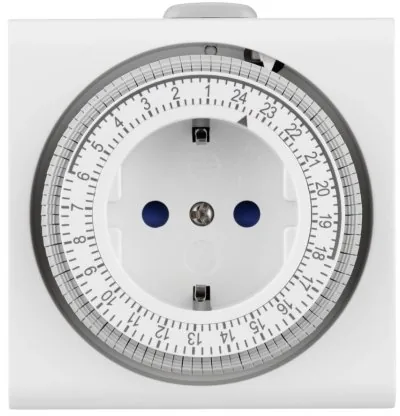
Die sich am Rand der Drehscheibe befindlichen Schaltstifte sind
bei Auslieferung alle nach unten gedrückt, also im eingeschalteten
Zustand. Ziehen Sie bitte alle Schaltstifte nach oben. Pfeil auf Tageszeit
drehen, für die zu schaltende Zeit die Schaltstifte nun nach unten
drücken.
Die Schaltstifte am Rande der Drehscheibe (jeder steht für 15 Minuten
Schaltzeit) bis zum Einrasten nach unten drücken. Damit wird der EIN-
Schaltzeitraum bestimmt.
EIN: Schaltstifte unten,
AUS: Schaltstifte oben
Beispiel: Die Zeitschaltuhr soll eine Lampe von 6.00 Uhr bis 10.00 Uhr
täglich einschalten. Dazu drücken Sie die entsprechenden Schaltstifte
von 6.00 Uhr bis 10.00 Uhr am Rande der Dreh-scheibe nach unten,
wobei ein Schaltstift einer Schaltzeit von 15 Minuten entspricht.
4. Einstellung der Uhrzeit:
Die Drehscheibe nach rechts drehen (im Uhrzeigersinn), bis die
aktuelle Uhrzeit mit dem Markierungspfeil übereinstimmt, dann die
Zeitschaltuhr sofort in eine Steckdose einstecken, damit das mechani-
sche Zeitwerk in Betrieb geht.
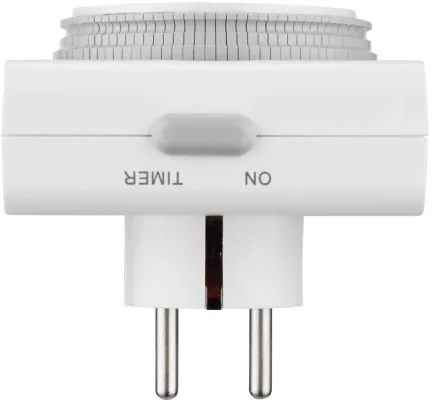
5. Seitlicher Wahlschalter:
Stellung Timer: Programmiertes EIN- und
AUS-Schalten
Stellung ON: Manuelles EIN-Schalten
Technische Daten:
96 EIN- / AUS-Schaltzeiten pro Tag (24 Stunden)
Manuelle Einschaltung möglich
Minimaler Schaltabstand 15 Min.
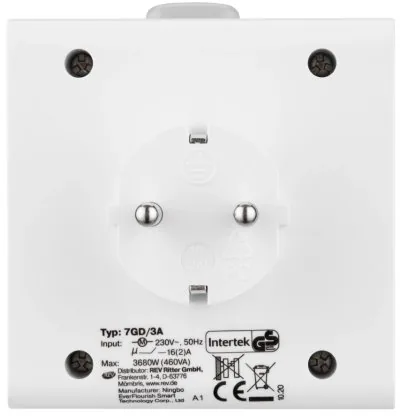
Nennspannung: 230V~, 50Hz
Maximale Belastung: 16A / 3680W
Induktive Belastung (z. B. Motoren, Pumpen...): max. 2A / 460VA
Integrierte Kindersicherung
WEEE-Entsorgungshinweis:
Gebrauchte Elektro- und Elektronikgeräte dürfen gemäß
europäischer Vorgaben nicht mehr zum unsortierten Abfall ge-
geben werden. Das Symbol der Abfalltonne auf Rädern weist
auf die Notwendigkeit der getrennten Sammlung hin. Helfen
auch Sie mit beim Umweltschutz und sorgen dafür, dieses
Gerät, wenn Sie es nicht mehr nutzen, in die hierfür
vorgesehenen Systeme der Getrenntsammlung zu geben. RICHTLINIE
2012/19/EU DES EUROPÄISCHEN PARLAMENTS UND DES RATES vom
04. Juli 2012 über Elektro- und Elektronik-Altgeräte.
Service:
Haben Sie Fragen zu unserem Produkt oder eine Beanstandung, dann
informieren Sie sich bitte im Internet unter www.rev.biz über die
Kontaktaufnahme und Retourenabwicklung oder senden eine E-Mail
an service@rev.biz. Wir weisen darauf hin, dass wir keine Sendungen
ohne Retourennummer bearbeiten können und deren Annahme
verweigern müssen.
WARNHINWEIS:
Nicht mehrfach
hintereinander
stecken.
ANL_25020-1.indd 103.08.2017 07:07:35
/2
%
Quick check
I'm not a robot
Incorrect answer, please try again.
Chat with your REV Ritter Compact Mechanical Daily Timer manual using AI
Get instant AI answers from your REV Ritter Compact Mechanical Daily Timer manual
Ask anything about the REV Ritter Compact Mechanical Daily Timer. Answers come from this manual, with the pages they are based on.
Ask a Question
0/1000
Do you recommend Compact Mechanical Daily Timer?
YesNo
Frequently Asked
Questions
A
Rotate the dial clockwise until the current time aligns with the marking arrow, then plug the timer into the power outlet immediately to start the mechanical clockwork operation.
Is this answer helpful?
A
The device supports a maximum load of 16A or 3680W for resistive loads, which is suitable for most household appliances like lamps and heaters.
Is this answer helpful?
A
Yes, but the inductive load must not exceed 2A or 460VA to prevent damage to the timer mechanism.
Is this answer helpful?
A
Yes, it features an integrated child protection mechanism to prevent accidental adjustments by young children.
Is this answer helpful?
A
There are 96 switching intervals available per day, each representing a fifteen-minute window.
Is this answer helpful?
A
Yes, a side switch allows for manual ON switching independent of the programmed schedule.
Is this answer helpful?
A
No, do not plug multiple timers into one outlet in a series chain to prevent electrical issues.
Is this answer helpful?
M: qwen/qwen3.5-flash-20260224
Advantagesand
Disadvantages
Advantages
Reliable mechanical operation without need for batteries or internet connectivity.
Integrated child safety lock prevents accidental changes by children.
High load capacity of 3680W handles most common household devices.
VS
Disadvantages
Limited precision with fifteen-minute intervals compared to digital clocks.
Requires physical dial adjustment which can be prone to manual error.
No remote control capabilities to change settings from another location.
Managing your home energy usage efficiently often requires simple, reliable tools that do not rely on batteries or internet connectivity. The REV Ritter compact mechanical daily timer stands out as a practical solution for homeowners seeking automation without complex programming or smart home dependencies. This white manual timer offers a straightforward approach to scheduling electrical devices, ensuring lights, heaters, or kitchen appliances turn on exactly when needed. It is a timeless choice for those who value mechanical reliability over digital interfaces.
Setting up the device requires a basic understanding of how mechanical switches function. The dial rotates clockwise to set the current time, which engages the internal mechanical clockwork instantly upon plugging into the mains. You can visualize your schedule using the removable pins on the outer dial. Pushing a pin down indicates active time, while pushing it up signifies off status. Each pin covers fifteen-minute intervals, providing decent granularity for daily routines. With ninety-six switches available per day, you have precise control over your appliance cycles across the entire twenty-four hour period.
Safety is a significant priority in this design. An integrated child protection mechanism prevents accidental resetting or tampering by young children, which is essential in family households. Additionally, the unit handles a maximum load of thirty-six hundred eighty watts, making it suitable for most standard household appliances like lamps or space heaters. If you wish to run a device immediately regardless of the scheduled program, a side switch allows for manual operation without disrupting the set timers.
Maintenance is minimal since this is a robust mechanical unit designed to withstand years of use. However, users should strictly adhere to environmental guidelines regarding disposal. When the device reaches the end of its useful life, it must be recycled separately from regular waste according to European directives. Avoid plugging multiple timers in series to prevent electrical failures or overheating issues during operation.
Important Usage Notes
Always consult the specific product manual for detailed installation details before connecting high power loads. Never cover the timer while in active use to prevent overheating or fire hazards. The timer works exceptionally well for lighting and passive heating but may require specific settings for inductive loads like motors. Ensure the timer is plugged into a grounded socket for best safety performance.