
Raspberry Pi Pico Manual
PDF manual · 32 Pages
English



Quick check
Incorrect answer, please try again.
Chat with your Raspberry Pi Pico manual using AI
Get instant AI answers from your Raspberry Pi Pico manual
Ask anything about the Raspberry Pi Pico. Answers come from this manual, with the pages they are based on.
Ask a Question
Do you recommend Pico?
Yes NoFrequently Asked Questions
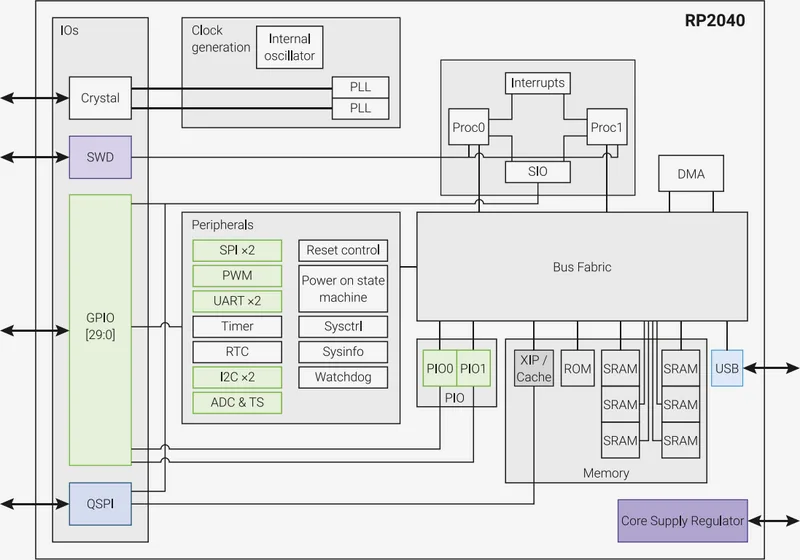
RP2040 features dual ARM Cortex-M0+ cores up to 133 MHz, 264 KB SRAM, flexible GPIOs, dedicated SPI/I2C/UART peripherals, programmable PIO, 4-channel ADC with temperature sensor, and USB 1.1 Host/Device support.
Is this answer helpful?
Provide a stable 3.3 V I/O supply (VSYS or VBUS) and rely on the on-chip LDO for the 1.1 V core. For USB device mode use host VBUS; for host mode supply VBUS from your board. Add recommended decoupling and place regulator capacitors close to pins.
Is this answer helpful?
RP2040 supports 25-series SPI flash with 03h serial read (24-bit addressing) for boot and XIP; required commands include 02h (page program), 05h (status read), 06h (write enable), and 20h (erase). Some quad modes require careful recovery sequences on reset.
Is this answer helpful?
Use PIO to output RGB data on contiguous GPIOs, convert digital outputs to analog with resistor DACs, ensure 75 Ω signal routing and correct HSYNC/VSYNC pins, and handle LSB sharing or button multiplexing during blanking intervals.
Is this answer helpful?
Yes; the demo uses pin-sharing and careful GPIO allocation (contiguous blocks for SD data, separate pins for audio PWM/I2S). Software pin multiplexing and PIO help manage multiple functions on limited pins.
Is this answer helpful?
Use controlled impedance traces with a nearby ground plane, correct trace widths/gaps for differential USB (target ~90 Ω), place series termination resistors near the chip, and consider four-layer boards for improved ground/power planes.
Is this answer helpful?
Use the Rescue Debug Port via OpenOCD (rp2040-rescue.cfg) to reset into a known state or force BOOTSEL. After rescue, reconnect with the normal OpenOCD config to load firmware; verify CHIP_RESET register bit 20 to confirm recovery.
Is this answer helpful?
Advantages and Disadvantages
Advantages

- High performance: dual Cortex-M0+ up to 133 MHz with DMA and 264 KB SRAM for demanding embedded tasks.
- Flexible I/O: 30 multifunction GPIOs and programmable PIO enable custom interfaces and peripherals.
- Low cost and compact: small QFN package and Pico form factor support affordable, space-constrained designs.
- Rich ecosystem: SDK examples, KiCad reference designs (minimal and demo boards), and OpenOCD support.
- Multiple audio/video and storage options: demonstrated VGA resistor DAC, SD card interfaces, and PWM/I2S audio.
Disadvantages

- Pin-limited: some advanced demos require careful GPIO multiplexing and trade-offs for shared functions.
- Hardware complexity: proper decoupling, crystal selection, and flash wiring are critical for reliability.
- Not for safety-critical use: explicitly disclaimed for high-risk or life-critical applications.
- USB signal sensitivity: board thickness and trace impedance must be managed for compliant USB operation.
- Flash XIP caveats: certain continuous-read modes can hinder boot probe recovery unless handled properly.
Product Specification
Format
Entry Level, Enhanced Features, Robot
Platform
Raspberry Pi Pico
Manufacturer
Raspberry Pi
MCU
Raspberry Pi RP2040 ARM Cortex-M0+, 2x 133MHz
Memory
2MB Flash (QSPI), 264kB SRAM
Operating Voltage
3.3V
Additional SoC
N/A
Product Description
Raspberry Pi Pico / RP2040 Controller Manual
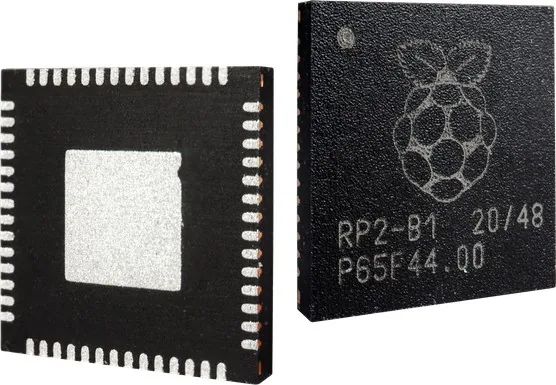
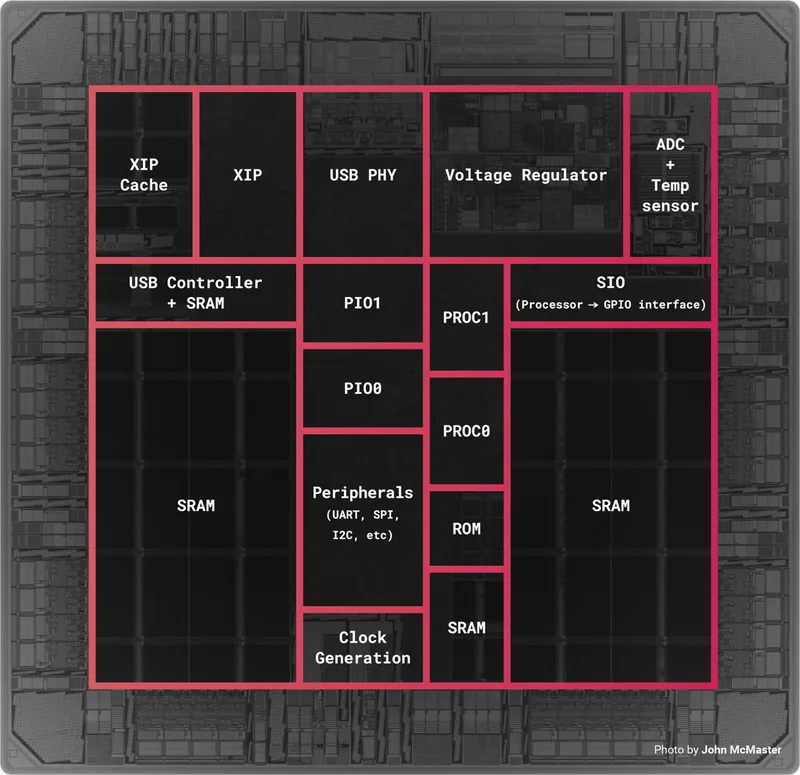
The Raspberry Pi Pico, powered by the RP2040 microcontroller, is a compact, low-cost development platform built for flexibility and performance. The RP2040 features dual Cortex-M0+ cores up to 133 MHz, 264 KB SRAM, a rich set of GPIOs, dedicated peripheral IP (SPI, I2C, UART), programmable I/O (PIO) for custom interfaces, and USB 1.1 Host/Device capability. Together with the Raspberry Pi Pico board, the RP2040 provides an accessible way to prototype embedded projects ranging from sensors and control systems to video and audio experiments.
This product description highlights typical hardware design considerations and recommended reference implementations. A minimal design example demonstrates the essential components required to run RP2040-based systems: power circuitry (3.3 V I/O and internal LDO for the 1.1 V core), external QSPI flash for code storage and XIP, a 12 MHz crystal or CMOS clock input for stable timing (important for USB), decoupling strategies, and IO routing best practices. The manual also covers a complete four-layer demo board integrating VGA output, SD card interface, and audio (PWM and PCM/I2S), illustrating how Raspberry Pi Pico can be used as a module or directly as RP2040 on a custom PCB.
Key hardware guidance includes careful decoupling placement, on-chip voltage regulator capacitor requirements, flash selection and boot strap considerations (QSPI_SS/USB_BOOT), and USB signal impedance and termination to meet Full Speed specifications. The VGA example explains converting digital GPIO outputs to analog via resistor DACs and managing pin multiplexing to share VGA LSBs with user buttons. The SD card and UART usage examples show contiguous GPIO requirements and flexible mapping (PIO or hardware UART). Audio examples demonstrate both analogue PWM with filtering and an I2S PCM path with a dedicated DAC, and the design notes emphasize clean analog power (audio LDO) and regulator operating modes affecting noise.
The manual also explains PCB manufacturing choices (two-layer minimal boards vs four-layer designs for improved power/ground planes and impedance control), options for mounting Raspberry Pi Pico (castellated edge soldering or 0.1" headers), and practical layout tips like keepouts and testpoint clearance under the Pico module. Debugging and recovery features such as SWD, the Rescue Debug Port, and OpenOCD rescue procedures are provided to recover bricked devices or load firmware. Appendices include supported flash command sequences, boot probe behavior, recommended component values, and a documentation release history.
Overall, Raspberry Pi Pico with RP2040 offers a versatile platform for hobbyists and professionals to build performant embedded systems with clear hardware guidance, reference schematics, and flexible I/O capabilities.
Notes
- Designed for skilled users; follow recommended decoupling and layout practices for reliable operation.
- Not intended for safety-critical or high-risk applications.
- Use the audio LDO and regulator PWM mode guidance when designing noise-sensitive analog circuits.
- Boot and flash behaviors vary by flash vendor; include optional pull-ups/pads for flexibility.
Search for 67,706 Manuals online


Type-in Brand or Model