
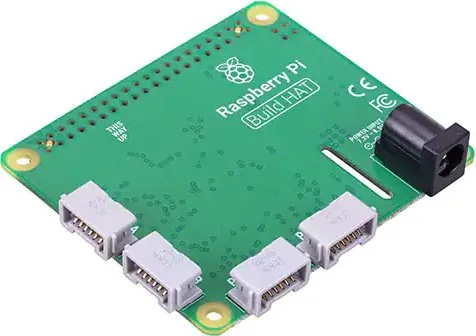
Raspberry Pi Build HAT Manual
PDF manual · 17 Pages
English



Quick check
Incorrect answer, please try again.
Chat with your Raspberry Pi Build HAT manual using AI
Get instant AI answers from your Raspberry Pi Build HAT manual
Ask anything about the Raspberry Pi Build HAT. Answers come from this manual, with the pages they are based on.
Ask a Question
Do you recommend Build HAT?
Yes NoFrequently Asked Questions
The Build HAT can interface with up to four LEGO LPF2 devices simultaneously. Each port (0 through 3) can independently host an actuator or sensor, allowing for complex multi-device setups.
Is this answer helpful?
Yes, you can interact with the HAT manually using a terminal emulator since the protocol is plain text. However, using the provided Python library is recommended for most applications to simplify control.
Is this answer helpful?
Direct PWM sets power output directly based on a value between -1 and 1. PID mode uses a controller that reads sensor feedback to adjust power automatically, maintaining constant speed or position despite load changes.
Is this answer helpful?
If a device draws excessive current, the HAT emits a 'Motor power fault' message. This condition latches in hardware and must be explicitly cleared using the clear_faults command after resolving the issue.
Is this answer helpful?
No. Raspberry Pi products are not designed for high-risk activities involving nuclear facilities, aircraft, or life support systems. They lack the fail-safe performance required for such critical environments.
Is this answer helpful?
You can enable echo mode by sending the command 'echo 1' to the command port. This allows you to see the characters you type in the terminal, making debugging easier during manual experiments.
Is this answer helpful?
Advantages and Disadvantages
Advantages

- Enables precise control of up to four LEGO motors and sensors simultaneously
- Supports advanced PID control loops for accurate speed and position management
- Features automatic device detection and status reporting over serial interface
- Includes independent motor drivers with built-in fault protection per port
- Compatible with both passive lights and active motors requiring feedback
Disadvantages

- Requires knowledge of serial protocols or Python libraries for optimal use
- Default power limit is low, requiring manual adjustment for full motor performance
- Not intended for high-risk activities or safety-critical applications
- Debugging requires understanding of hexadecimal commands and mode structures
- Some features depend on specific LEGO device IDs which may vary by model
Product Specification
Platform
Raspberry Pi
Format
Enhanced Features, Robot, Engineering
Manufacturer
Raspberry Pi
Connection
Platform GPIO Port
Power Supply
1x Barrel Jack
Wireless
N/A
LAN
N/A
Dimensions (WxDxH)
2.56x0.51x2.20in
Product Description
Raspberry Pi Build HAT: The Ultimate LEGO Interface
The Raspberry Pi Build HAT serves as a powerful bridge between the Raspberry Pi and LEGO Power Functions version 2 devices. This specialized board allows users to connect up to four LEGO actuators and sensors, enabling complex robotics projects with precise control. By handling hard real-time requirements, the HAT manages connection events and interrogates devices to determine their specific capabilities and properties.
Communication occurs over a dedicated command port using a simple serial interface at 115200 baud. While the protocol supports direct terminal interaction for manual testing, it is designed to work seamlessly with higher-level Python libraries for streamlined development. The board features independent motor drivers for each port, capable of delivering both standard logic power and high-power output for motors. It supports two distinct control modes: direct PWM for simple applications and PID for advanced feedback control using sensor data.
With built-in safety features like fault detection and clearing mechanisms, the Build HAT ensures reliable operation even under varying loads. Users can configure setpoints for constant speed or position control, utilizing waveforms such as sine, square, and triangle waves. Whether you are building a robot arm, a train system, or an interactive display, this hardware provides the necessary foundation for robust LEGO integration.
Key Features
- Supports up to four LEGO LPF2 devices simultaneously.
- Includes independent motor driver ICs per port.
- Offers both direct PWM and PID control modes.
- Detects connected devices automatically upon plugging in.
- Provides detailed status reports via a plain text serial protocol.
Note: Always ensure your Raspberry Pi firmware is updated before connecting new LEGO components to avoid compatibility issues.
Search for 67,706 Manuals online


Type-in Brand or Model