
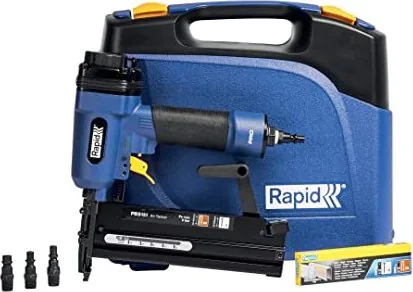
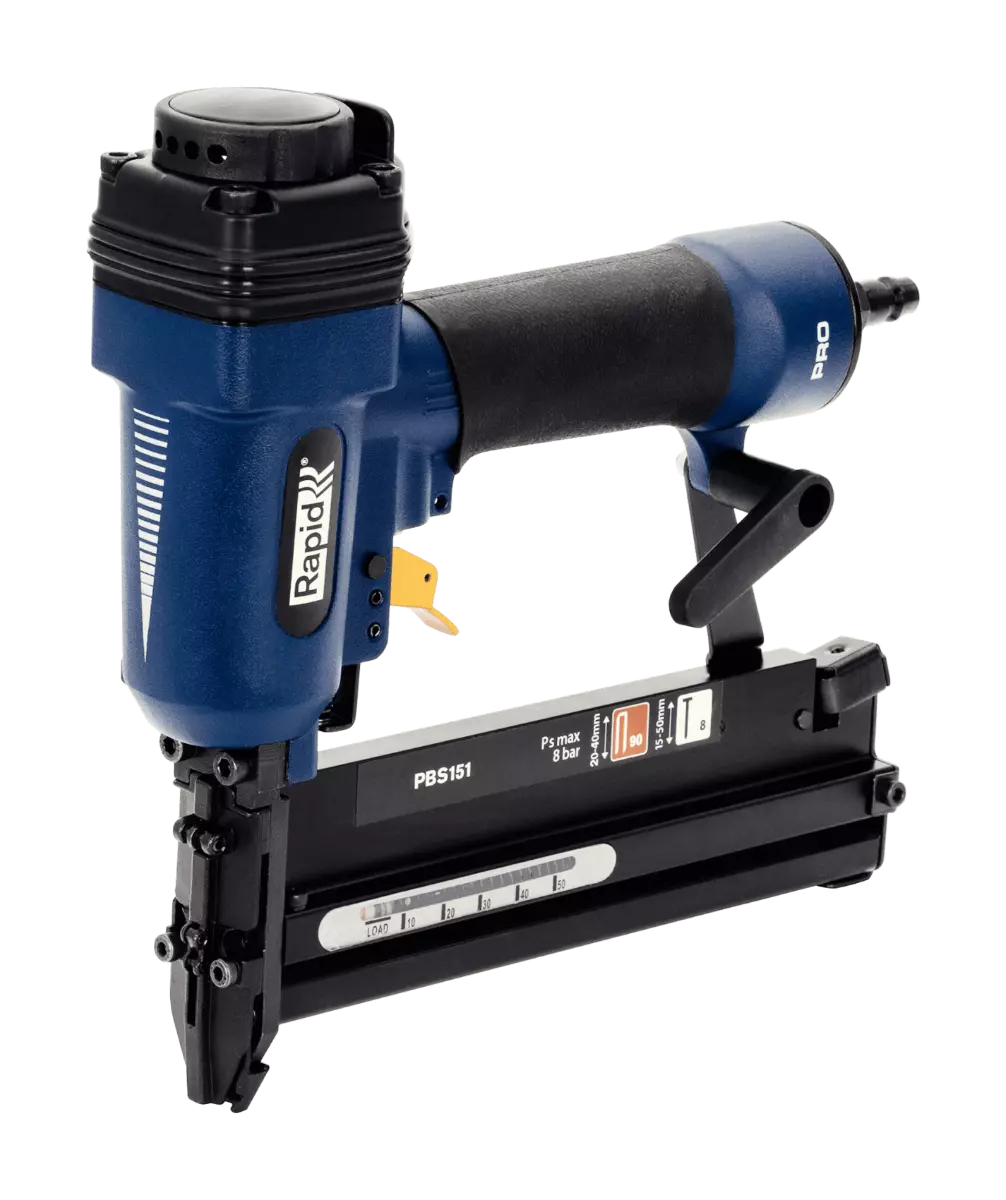
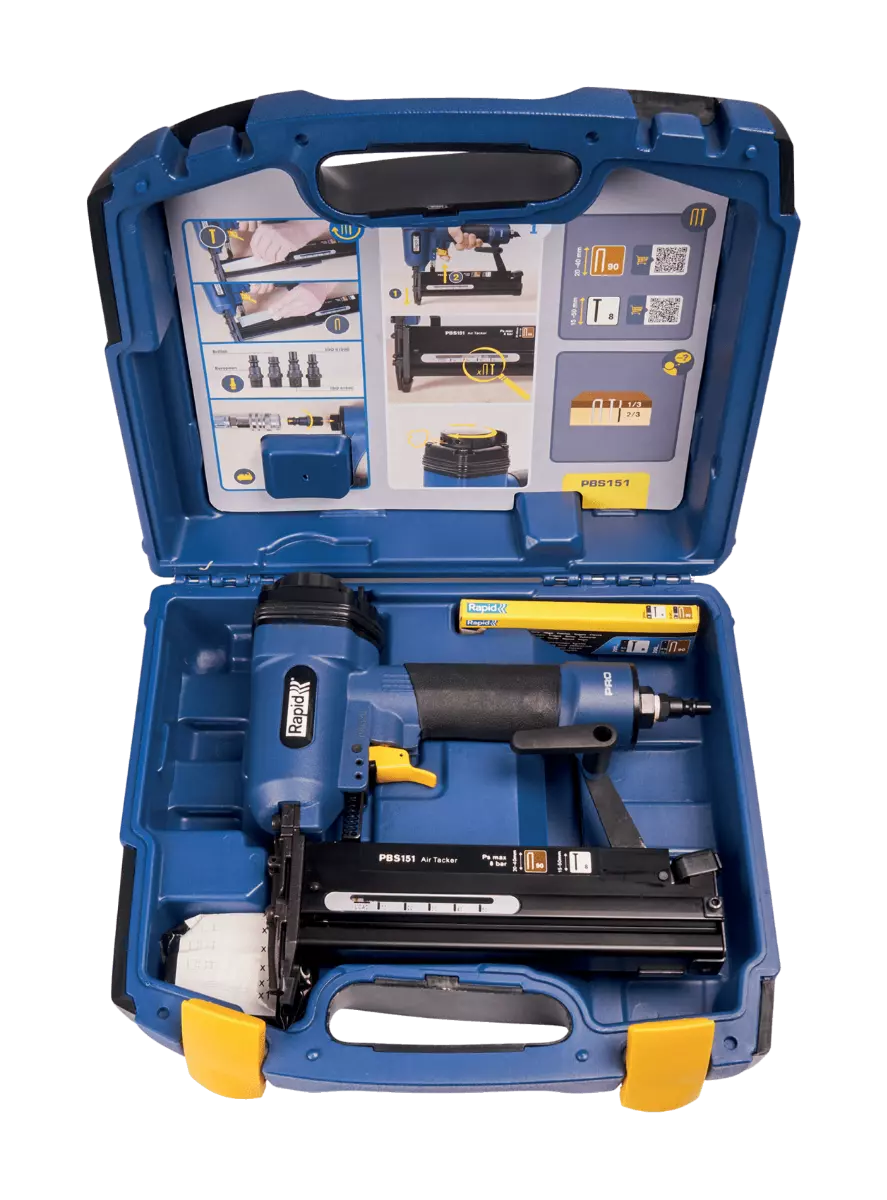
Rapid PRO PBS151 Manual
PDF manual · 124 Pages
English



Quick check
Incorrect answer, please try again.
Chat with your Rapid PRO PBS151 manual using AI
Get instant AI answers from your Rapid PRO PBS151 manual
Ask anything about the Rapid PRO PBS151. Answers come from this manual, with the pages they are based on.
PRO PBS151 Maintenance Schedule
With tool disconnected from air supply, check that the safety yoke and trigger move freely.
Add 2 to 3 drops of recommended hydraulic oil into the air inlet while tool is disconnected.
Verify oiler levels daily and refill with recommended oil if necessary.
Wipe the tool regularly with a dry cloth to keep it clean.
Occasionally lubricate the sliding parts of the magazine to prevent wear.
Ask a Question
Do you recommend PRO PBS151?
Yes NoFrequently Asked Questions
The PBS151 accepts RAPID no90 staples from 15 to 40 mm and RAPID no8 brads from 15 to 50 mm. Staple dimensions are 1.3 x 1.0 mm; nail dimensions 1.25 x 0.95 mm (18 Ga). Use only recommended fasteners.
Is this answer helpful?
Use a 1/4" air inlet with operating pressure between 5 and 7 bar; the maximum admissible pressure is 8 bar. Operate at the lowest pressure that properly penetrates the workpiece to reduce noise, vibration and wear.
Is this answer helpful?
Disconnect air before maintenance. Perform daily checks of safety yoke and trigger movement, keep screws tight, clean with a dry cloth, and add 2–3 drops of recommended hydraulic oil (ISO 46 or equivalent) via the air inlet daily or as needed. Major repairs should be done by qualified personnel.
Is this answer helpful?
Wear impact-resistant eye protection with side shields compliant with ANSI Z87.1, EN 166 or AS/NZS 1336 and hearing protection due to high noise levels. Use gloves that allow safe trigger control and consider face protection in jurisdictions where legally required.
Is this answer helpful?
Always disconnect the tool from air supply first. Release the magazine by squeezing the click lever; load staples or brads as directed (staples with points up when inverted; brads with points down). For jams, disconnect air, release magazine, slide rail back and remove jammed fasteners; consult the manual for alternate face plate removal if needed.
Is this answer helpful?
No. The manual explicitly advises against using the tool on ladders, scaffolds, scales, moving platforms or similar unstable positions due to increased risk of accidental firing and loss of control.
Is this answer helpful?
Tool-related noise values: LpA 97.1 dB (uncertainty ±2.5 dB), LwA 84.1 dB, peak LpC 106.7 dB. Vibration is 6.773 m/s² (uncertainty ±1.5 m/s²). Actual exposure depends on environment and usage—implement hearing protection, workstation damping and ergonomic practices.
Is this answer helpful?
Advantages and Disadvantages
Advantages

- High magazine capacity (110 fasteners) for extended production runs.
- Accepts both Rapid no90 staples (15–40 mm) and Rapid no8 brads (15–50 mm).
- Solid metal construction with balanced weight (1.45–1.53 kg) for durability and control.
- Clear technical specs and maintenance guidance reduce downtime and extend tool life.
- Includes case for safe transport and storage.
Disadvantages

- Relatively high sound level (LpA 97.1 dB) requires mandatory hearing protection.
- Vibration (6.773 m/s²) may cause operator fatigue during prolonged use.
- Requires filtered, dry and lubricated compressed air and occasional oiling.
- Contact actuation can be unsafe for certain applications (crate closing, transport securing).
- Not suitable for driving into very hard materials like steel or concrete.
Product Specification
Operating pressure
102 psi
Magazine compatibility
Staples (0.79-1.57 in, Width 0.16 in, Type 90), Nails (0.59-1.97 in, Type 8), ..
Magazine capacity
110 Nails, 110 Staples
Features
Softgrip
Weight
6.17 lb
Scope of delivery
Case, 200 Staples, 200 Nails
Product Description
Rapid PRO PBS151 Pneumatic Stapler/Nailer incl. Case Manual
The Rapid PRO PBS151 pneumatic stapler/nailer is a robust, professional-grade fastening tool designed for high-efficiency upholstery, pallet, furniture and general production work. Compact and well balanced, the PBS151 combines a durable metal body with contact-actuation control, delivering reliable, repeatable performance across a wide range of fastening tasks. It accepts Rapid no90 staples (15–40 mm) and Rapid no8 brads (15–50 mm) with a 110-piece magazine capacity, making it well suited for continuous work where speed and uptime matter.
Featuring a 1/4" air inlet and a recommended operating pressure range of 5–7 bar (max 8 bar), the tool is engineered to be used with filtered, dry, lightly lubricated compressed air. Weighting approximately 1.45–1.53 kg depending on fasteners, it provides a sturdy feel without excessive operator fatigue. Noise and vibration characteristics are documented (LpA 97.1 dB, LwA 84.1 dB, vibration 6.773 m/s²) so users can plan hearing protection and ergonomic controls to reduce long-term strain.
Practical maintenance is straightforward: daily checks for free movement of safety yoke and trigger, occasional lubrication with recommended hydraulic oil (ISO 46 or equivalent), and cleaning to prevent dust and debris ingress. The manual includes clear loading, unloading and jam-clearing steps, plus troubleshooting and a spare-parts listing (repair kits A, B, C), helping keep downtime to a minimum.
Safety is emphasized throughout: always disconnect air before maintenance, use appropriate eye and hearing protection, avoid using the tool on ladders or unstable platforms, and never power with oxygen or other bottled gases. The PBS151 supports contact actuation for production applications, but users are cautioned about applications where continuous contact mode is inappropriate (e.g., closing crates or securing transport systems).
Whether you’re fitting upholstery, assembling pallets or performing routine production nailing, the Rapid PRO PBS151 offers a blend of capacity, control and serviceability. The included case keeps the tool and accessories protected and transportable, and the technical manual provides comprehensive specifications so operators can set pressure, fastener type and maintenance routines correctly.
Notes
- Use the lowest air pressure necessary to drive fasteners correctly to reduce noise, vibration and wear.
- Wear ANSI/EN/AS/NZS-compliant eye protection and suitable hearing protection when operating the tool.
- Follow recommended oil type and add 2–5 drops via the air inlet if hose lengths exceed 10 m.
- Disconnect air supply before loading, servicing or clearing jams.
Search for 67,732 Manuals online


Type-in Brand or Model