

Omnitronic TM-250 Manual
PDF manual · 12 Pages
English



Quick check
Incorrect answer, please try again.
Chat with your Omnitronic TM-250 manual using AI
Get instant AI answers from your Omnitronic TM-250 manual
Ask anything about the Omnitronic TM-250. Answers come from this manual, with the pages they are based on.
Ask a Question
Do you recommend TM-250?
Yes NoVideo Manual
3 integ amp + mixer connection guide
Frequently Asked Questions
The TM-250 uses a single 9 V block battery. A fresh battery provides approximately six hours of operation. Remove the battery for long-term storage to avoid leakage, and always install with correct polarity.
Is this answer helpful?
The TM-250 is designed for indoor use and should be kept away from rain and moisture. Exposure to liquids can damage the unit and void the warranty; if liquid enters the device, have it checked by a qualified service technician.
Is this answer helpful?
Depending on your country and frequency plan, operation may require a license or frequency assignment. In Germany, for example, a single-frequency assignment from the Federal Network Agency (BNetzA) is required. Check local regulatory authorities for requirements.
Is this answer helpful?
The TM-250 is designed to pair with Omnitronic receivers VHF-250 and VHF-450 that use the same carrier frequency. Ensure both transmitter and receiver share the identical preset frequency for correct operation.
Is this answer helpful?
Use the transmitter's sensitivity (gain) control to set the input level. Reduce sensitivity if the signal is too loud and distorted; increase it if levels are too low and signal-to-noise ratio suffers. Monitor the receiver's AF indicator to verify audio presence.
Is this answer helpful?
Clean the unit with a soft, lint-free, slightly moistened cloth. Never use alcohol or solvents. There are no user-serviceable parts inside besides the battery; maintenance and repairs should be performed by authorized dealers using original spare parts.
Is this answer helpful?
The TM-250 uses FM (F3F) modulation, audio bandwidth of roughly 40 Hz–15 kHz (±3 dB), frequency stability <±30 ppm, maximum frequency deviation ±25 kHz, RF output about 8.5 mW, and T.H.D. <0.5% at 1 kHz.
Is this answer helpful?
Advantages and Disadvantages
Advantages

- Compact, lightweight design (106.5 x 64.5 x 31.5 mm; 80 g) suitable for discreet wear.
- Simple three-position On/Mute/Off switch and LED battery indicator for easy operation.
- Includes lavalier microphone and 3.5 mm screw connector for secure mic attachment.
- Runs on a single 9 V battery with approximately 6 hours runtime per fresh battery.
- Compliant with European standards and R&TTE; available in multiple preset VHF frequencies.
Disadvantages

- Low RF output (8.5 mW) limits range compared with higher-power wireless systems.
- Fixed VHF frequencies may require licensing or frequency assignment in some countries.
- Designed for indoor use only; not protected against heavy moisture or outdoor conditions.
- No internal rechargeable battery option; requires replacement batteries for extended use.
- Minimal internal serviceable parts—maintenance must be done by authorized dealers.
Product Specification
Type
Microphone system (Lavalier)
Carrier frequency range
211.70MHz
True Diversity
no
Channels
1
Battery life
6h
Audio transmission range
40Hz-15kHz
Consists of
Pocket transmitter, lavalier microphone
Product Description
Omnitronic TM-250 Pocket Transmitter
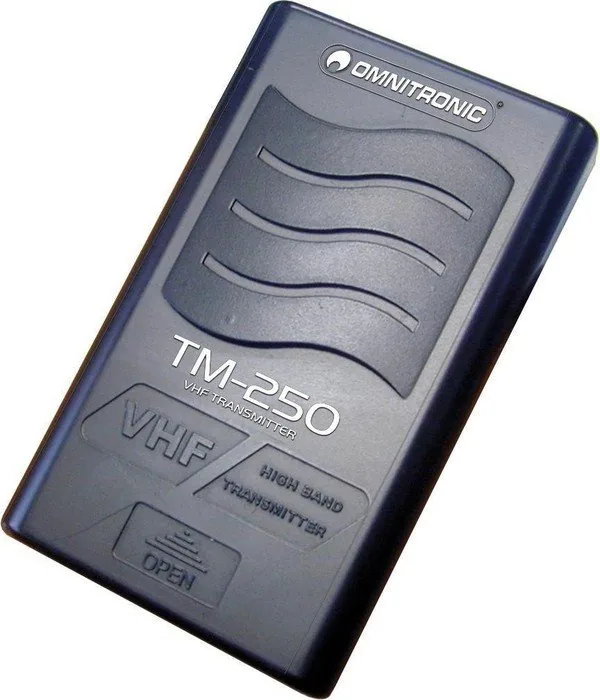
The Omnitronic TM-250 is a compact VHF pocket transmitter designed for reliable wireless audio in presentations, theater, teaching and small live events. Supplied as a set with a lavalier microphone, the TM-250 pairs with Omnitronic VHF-250 and VHF-450 receivers on fixed VHF carrier frequencies. Its small footprint and lightweight construction (106.5 x 64.5 x 31.5 mm, 80 g) make it unobtrusive when clipped to clothing or instrument straps.
Equipped with a 3.5 mm screw-type microphone connector, a three-position On/Mute/Off selector and an LED battery indicator, the TM-250 is engineered for simple, dependable operation. The transmitter runs on a single 9 V block battery, giving roughly six hours of continuous operation under typical conditions. A sensitivity (gain) control lets users optimize audio levels to avoid distortion or poor signal-to-noise ratio, while the AF and reception indicators on the paired receiver confirm audio presence and link status.
On the technical side, the TM-250 uses FM (F3F) modulation, offers a maximum RF output of 8.5 mW and audio bandwidth of 40 Hz–15 kHz. It’s available in four preset carrier frequencies (e.g., 174.100 MHz, 179.000 MHz, 211.700 MHz, 214.000 MHz) to suit region and regulatory needs. The unit conforms to European standards (EN 300422-2, EN 301489-01/09, EN 60065) and adheres to the R&TTE framework; in some countries, including Germany, frequency assignment or licensing may be required.
Practical usage notes include protecting the device from moisture, avoiding exposure to extreme temperatures and removing the battery when storing the transmitter for extended periods to prevent leakage. Cleaning is simple: a soft, lint-free damp cloth only—no solvents or alcohol. Internal servicing should be performed by authorized dealers; use only original spare parts to maintain warranty and compliance.
Whether you need a discreet wireless solution for spoken word, educational settings or small performances, the TM-250 offers a straightforward, affordable option with focused features for stable VHF transmission and easy day-to-day operation.
Notes
- Designed for indoor use; do not expose to rain or splashes.
- Use only recommended battery types and dispose of batteries responsibly.
- Do not remove the serial barcode; this may void warranty.
- For frequency assignment and local approvals, consult national authorities (e.g., Bundesnetzagentur in Germany).
Search for 67,706 Manuals online


Type-in Brand or Model