

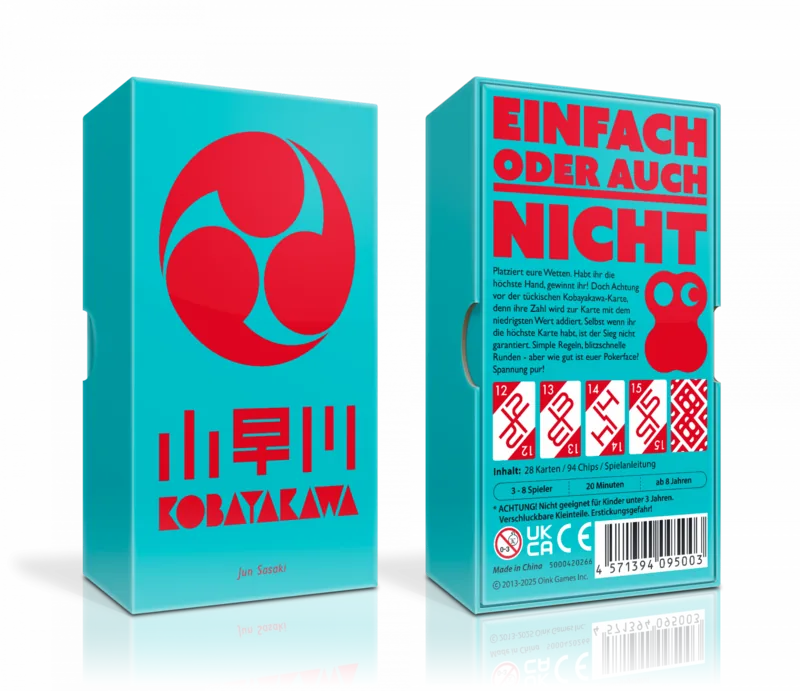
Oink Games Kobayakawa Manual
PDF manual · 4 Pages
English



Quick check
Incorrect answer, please try again.
Chat with your Oink Games Kobayakawa manual using AI
Get instant AI answers from your Oink Games Kobayakawa manual
Ask anything about the Oink Games Kobayakawa. Answers come from this manual, with the pages they are based on.
Ask a Question
Do you recommend Kobayakawa?
Yes NoFrequently Asked Questions
The objective is to have the most Kamons after the final round. Players earn Kamons by winning battles and collecting the extra reserve Kamons awarded to each round winner.
Is this answer helpful?
The player with the lowest revealed card adds the Kobayakawa card's value to their own card value. That adjusted total is compared against the other players' values to determine the winner.
Is this answer helpful?
A player can draw a card, keep one card, and place the other face up. Alternatively, the player can draw a card without looking at it and use it to replace the current Kobayakawa card.
Is this answer helpful?
A player who passes does not place a Kamon wager and does not participate in that round's battle. Passing can protect Kamons for later rounds.
Is this answer helpful?
That player wins the round automatically. They collect the wagers and the round reward without needing to reveal their card.
Is this answer helpful?
If multiple players share the highest final total, the winner is the tied player who placed a battle wager first during the bidding order.
Is this answer helpful?
Players who choose to fight normally wager two Kamons in the final round. A player with only one Kamon may still participate by wagering that single Kamon. The winner also takes the final two reserve Kamons.
Is this answer helpful?
Advantages and Disadvantages
Advantages

- Fast rounds create suspense without requiring a long play session.
- The Kobayakawa bonus makes low cards strategically valuable and keeps outcomes uncertain.
- Simple actions make the game approachable for new players.
- Bluffing, bidding, and visible discards add meaningful tactical depth.
- Compact components support easy setup and portability.
Disadvantages

- Player elimination can leave someone waiting while others finish the game.
- Luck in card draws can strongly affect a round's options.
- The small card set may feel repetitive for groups seeking complex strategy.
- Ties and turn order can have a major impact on close battles.
Product Specification
Type
Card game
Genre
Strategy
Players
3 to 6
Playing time
15 min
Recommended age
Ages 9 and up
Author
Jun Sasaki
Publisher
Heidelberger Spieleverlag, Superlude
Product Description
Kobayakawa - Read, Download & Print Free
A tense card game of shifting loyalty
Kobayakawa is a compact strategy card game set in feudal Japan, where rival samurai clans compete for influence and prestige. Every round asks players to judge their strength, read their opponents, and decide whether to risk precious Kamons in battle. The central twist is the Kobayakawa clan, an unpredictable ally that supports the player holding the lowest card value.
With only cards numbered 1 to 15, the game is easy to learn, yet every decision can change the outcome. Players begin each round with a hidden card, then choose whether to draw a second card and discard one openly or replace the current Kobayakawa card without looking at it first. This small choice creates a layer of bluffing, deduction, and calculated risk before the battle even begins.
Bluff, bid, and outthink your rivals
After every player has taken an action, the combat phase starts. Each player may either pass or enter the fight by placing a Kamon as a wager. Players who fight reveal their cards, and the lowest card receives the value of the current Kobayakawa card. The highest final total wins the wagers and gains an additional Kamon from the central reserve.
This clever rule means a low card is not always a weakness. A seemingly poor hand can become a surprise victory, while a strong card may not be enough to justify a risky bid. Because players can pass to protect their remaining Kamons, successful play depends on knowing when to commit and when to wait for a better opportunity.
Fast rounds with meaningful choices
Kobayakawa is designed for quick, suspenseful sessions. The battle continues across seven rounds, with the final round raising the stakes by requiring two Kamons from players who choose to fight. Players who lose all their Kamons are eliminated, making every wager important as the reserve shrinks.
The game supports a highly interactive experience where turn order, visible discards, and the changing Kobayakawa value all matter. Ties reward the player who bid first, adding another reason to watch the table and act decisively. Its minimal components and direct rules make it approachable for newcomers, while the constant uncertainty keeps experienced players engaged.
Notes
- The goal is to collect the most Kamons after the final battle.
- A player who is the only bidder wins automatically without revealing a card.
- The Kobayakawa bonus applies only to the player with the lowest card in a battle.
- The final round begins when two Kamons remain in the center reserve.
Search for 67,706 Manuals online


Type-in Brand or Model