
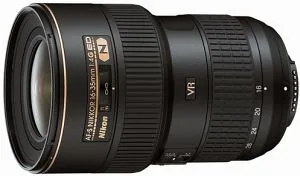
Nikon AF-S NIKKOR 16-35mm f/4G ED VR Manual
PDF manual · 164 Pages
English



Quick check
Incorrect answer, please try again.
Chat with your Nikon AF-S NIKKOR 16-35mm f/4G ED VR manual using AI
Get instant AI answers from your Nikon AF-S NIKKOR 16-35mm f/4G ED VR manual
Ask anything about the Nikon AF-S NIKKOR 16-35mm f/4G ED VR. Answers come from this manual, with the pages they are based on.
AF-S NIKKOR 16-35mm f/4G ED VR Maintenance Schedule
Use a blower brush for dust. For smudges, use a soft cotton cloth or lens tissue moistened with ethanol or lens cleaner, wiping from center to outer edge.
If the lens mount rubber gasket is damaged, take the lens to an authorized Nikon service representative for repair.
When storing the lens in its flexible pouch, attach both the front and rear lens caps.
Store the lens in a cool, dry place away from direct sunlight and chemicals like camphor or naphthalene to prevent mold and rust.
Ask a Question
Do you recommend AF-S NIKKOR 16-35mm f/4G ED VR?
Yes NoFrequently Asked Questions
The lens is a Nikon F‑mount G‑type AF‑S zoom compatible with both FX and DX Nikon DSLRs. Some functions (like VR, AF behavior, or exposure modes) may be limited on older film or entry-level models—refer to your camera manual for exact compatibility notes.
Is this answer helpful?
Vibration Reduction provides roughly 2.5 stops of stabilization under CIPA test conditions. Results vary by camera body, focal length, and shooting technique; VR is measured at the longest zoom position and may be less effective during wide panning or with certain camera models.
Is this answer helpful?
Switch VR off when the camera is mounted on a properly fixed tripod to avoid double-correction artifacts. Also disable VR for cameras that don’t support the lens VR function or when following manufacturer guidance (e.g., pronea models) to conserve battery life.
Is this answer helpful?
Minimum focus distance ranges about 0.28–0.29 m (approx. 0.9–1.0 ft) depending on focal length. Internal focusing maintains compact length during focusing but magnification is not true macro; use focus distance markings as guides, not exact guarantees.
Is this answer helpful?
Nikon’s Nano Crystal Coat reduces flare and ghosting significantly, but strong direct sunlight or bright highlights can still produce artifacts. Use the supplied hood and careful composition to minimize stray light; stop down if necessary.
Is this answer helpful?
Wide-angle AF can mis-prioritize background details when the main subject is small or low-contrast. Workarounds: focus-lock on a nearby subject at the same distance and recompose, or switch to manual focus for precision.
Is this answer helpful?
Keep CPU contacts clean, avoid organic solvents for glass cleaning, use a blower/soft cloth with ethanol or lens cleaner for smudges, attach front and rear caps when storing, and keep the lens in a cool, dry place to prevent fungus and corrosion.
Is this answer helpful?
Advantages and Disadvantages
Advantages

- Constant f/4 aperture for consistent exposure and depth-of-field control across 16–35mm.
- Vibration Reduction (VR) offers up to ~2.5 stops of stabilization for improved hand‑held shooting.
- High optical performance via 2 ED elements, 3 aspherical elements, and Nano Crystal Coat to reduce aberration and flare.
- Fast, quiet AF with Silent Wave Motor plus M/A manual‑override for quick focus adjustments.
- Durable, practical design: internal focusing, rubber mount gasket, 77mm filter thread, and included hood/case.
Disadvantages

- Maximum aperture of f/4 is not as bright as f/2.8 alternatives for low-light and shallow DOF.
- Vignetting and flash shading can occur at wide focal lengths; camera-specific minimum distances apply.
- Relatively heavy for some users (approx. 680 g) compared with smaller wide-angle primes.
- VR should be turned off on stable tripods and offers limited correction during intentional panning.
- Autofocus may struggle on very small or low-contrast subjects typical for wide-angle scenes.
Product Specification
Type
Wide-angle zoom lens
Focal length
0.63-1.38in
Aperture
F4.0
Optical design (elements/groups)
17/12
Aperture blades
9 (rounded)
Focus motor
SWM
Image stabilizer
VR II
Minimum focus distance
11.02in
Minimum aperture
F22
Max. angle of view
107-63 degrees
Max. reproduction ratio
1:4.00
Lens mount
Nikon F
Sensor compatibility
APS-C/Full-frame
Filter size
3.03in screw-on filter
Special features
sealed
Color
black
Dimensions
3.25x4.92in (DxL)
Weight
1.51 lb
Product Description
Nikon AF-S 16-35mm f/4G ED VR black Manual
The Nikon AF-S 16-35mm f/4G ED VR is a professional-grade wide-angle zoom built for versatility and consistent optical performance. With a constant f/4 aperture, this G-type lens combines Nikon’s Silent Wave Motor (AF-S) for fast, quiet autofocus, and Vibration Reduction (VR) to expand hand‑held shooting possibilities by roughly 2.5 stops. Designed for both FX and DX Nikon DSLR systems, it preserves excellent corner-to-corner sharpness across the 16–35mm range while controlling chromatic aberration using two ED elements and three aspherical elements. Nano Crystal Coat treatments further reduce ghosting and flare in challenging lighting.
This lens emphasizes practical handling: internal focusing (IF) keeps the lens length stable while focusing and enables a close working distance (down to ~0.28–0.29 m). The rounded nine‑blade diaphragm creates pleasant bokeh for subject separation even at moderate apertures. A robust yet relatively compact build includes a rubber mount gasket for environmental sealing, a bayonet hood (HB-23), and standard accessories such as LC-77 front cap and a soft case (CL-1120). The 77mm filter thread accepts protective or creative glass.
Operational guidance highlights how to get the most from the lens: use the M/A focus mode for quick manual override of autofocus, set VR to OFF on a tripod, and wait for the viewfinder image to stabilize when VR is active. Wide-angle AF behavior can be influenced by small or low-contrast subjects; recommended techniques include focus‑lock/recompose or switching to manual focus for fine control. When using the camera’s built-in flash, mind minimum distances to avoid vignetting at certain focal lengths—consult camera compatibility notes for specifics.
In short, the 16–35mm f/4G ED VR black is a reliable wide-angle tool for landscape, architecture, environmental portraiture, and event work where consistent autofocus, flare resistance, and stabilized hand-held shooting are required. Its optical corrections and coatings deliver clean, high-contrast results in diverse lighting, while ergonomic features and durable construction make it a solid choice for professionals and advanced enthusiasts.
Notes
- Constant f/4 aperture across the zoom range for predictable exposure and depth-of-field control.
- VR provides up to ~2.5 stops improvement (CIPA measured) but is ineffective during certain panning movements and when using the built-in flash while charging.
- Attach the hood properly to avoid vignetting; it can be mounted in reverse for storage.
- Clean CPU contacts carefully and store the lens in a dry, ventilated place to avoid fungus.
Search for 67,706 Manuals online


Type-in Brand or Model
Sven Keller
10 months ago
Is the distortion at 16mm really noticeable, and can it be corrected if I want accurate straight lines?
Manual.ly
10 months ago
Some wide-angle lenses can show mild to moderate barrel distortion at the shortest focal lengths (for example around 16mm). In the reviews, users mention it is acceptable and can be corrected in post-processing using standard lens-correction software. For best results, pair shooting profiles with your editing program's distortion correction, or apply the lens profile if available. If you stop down slightly, image quality and overall sharpness typically remain very strong, and VR helps when shooting handheld.