
Monacor TCB-22 Manual
PDF manual · 2 Pages
English



Quick check
Incorrect answer, please try again.
Chat with your Monacor TCB-22 manual using AI
Get instant AI answers from your Monacor TCB-22 manual
Ask anything about the Monacor TCB-22. Answers come from this manual, with the pages they are based on.
Ask a Question
Do you recommend TCB-22?
Yes NoFrequently Asked Questions
It is a two-channel audio signal balancer that converts unbalanced signals to balanced signals and vice versa using passive audio transformers. It does not require power.
Is this answer helpful?
No, the TCB-22 is a passive device. Signal conversion is handled by two audio transformers without external power requirements.
Is this answer helpful?
Yes, by setting the DIP switches to MONO, it can mix two mono signals or convert a stereo signal into a mono signal.
Is this answer helpful?
Inputs include unbalanced RCA jacks and a 3.5 mm stereo jack. Balanced signals use XLR jacks at the output ports.
Is this answer helpful?
No, the product is suitable for indoor use only. It must be protected against dripping water and high humidity.
Is this answer helpful?
Advantages and Disadvantages
Advantages

- Passive operation requires no power supply
- Galvanic isolation prevents hum loops
- Versatile input and output connections
- Lossless signal conversion capability
Disadvantages

- Indoor use only due to moisture sensitivity
- Limited temperature range of minus 20 to 50 Celsius
- Requires short cables for unbalanced inputs
- No external power indicator available
Product Specification
Type
DI-Box (passive)
Channels
2
Format
tabletop
Product Description
The Monacor TCB-22 Signal Balancing Solution
Overview of Professional Audio Conversion
The Monacor TCB-22 stands as a reliable choice for audio specialists seeking efficient signal conversion without active electronics. This passive device utilizes two audio transformers to manage signal balancing, ensuring high quality transmission across long cable runs. Many professionals rely on the information found in the Monacor TCB-22 Manual to understand its full potential before installation. It eliminates the need for a power supply, which simplifies setup in various environments. Users can convert unbalanced signals to balanced ones and vice versa without introducing noise or latency. This capability is essential for studios where signal integrity is paramount. By removing external power requirements, the unit avoids potential ground loop issues that often plague active converters.
Versatile Connectivity Options
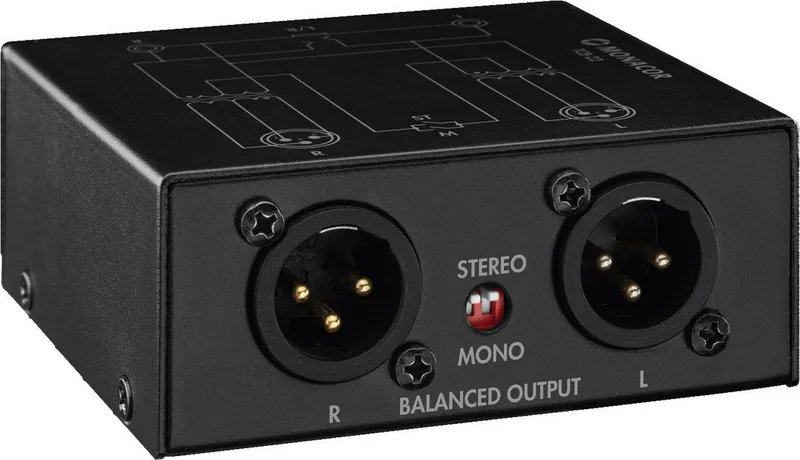
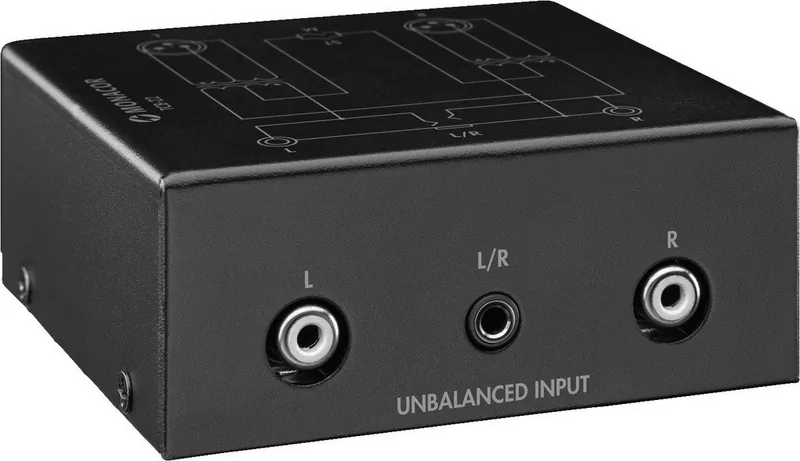
One of the standout features of this unit is its flexibility regarding input and output connections. The front panel offers RCA jacks and a 3.5 mm stereo jack for unbalanced inputs, alongside XLR connectors for balanced outputs. This allows seamless integration between consumer equipment and professional audio gear. For instance, adapting a stereo jack to dual RCA connections is straightforward. Additionally, the DIP switches provide control over stereo or mono mixing configurations. Switching to the mono position combines two mono signals or collapses a stereo signal into a single channel, useful for specific mixing scenarios. Lossless conversion ensures audio quality remains intact.
Technical Performance and Constraints
Understanding operational limits is crucial for optimal performance. The frequency range extends from 6 to 25000 Hz, covering most audible requirements effectively. Input impedance sits at 5.3kΩ, while output impedance is slightly higher at 5.4kΩ. These values support a 1:1 transmission ratio without loading the source. Indoor use is required, protecting the unit from moisture and extreme temperatures ranging from minus 20 to plus 50 Celsius. Cleaning must be done with a dry cloth to maintain longevity. The physical dimensions of 88 by 36 by 83 millimeters make it compact enough for rack mounts.
Important Usage Guidelines
Proper installation minimizes interference risks. Keep unbalanced connection cables between the source and the unit as short as possible to reduce noise. Galvanic isolation prevents hum loops between connected devices. When converting balanced signals back to unbalanced, reverse the connections and ensure DIP switch settings match the input type. Always verify that the setup complies with local disposal regulations if the device reaches end of life. It is designed for users with basic knowledge in audio technology to operate safely. Never use chemicals for cleaning or expose the unit to dripping water.
Final Thoughts on System Integration
Integrating this transformer into a system requires following established audio protocols. While it offers significant benefits like reduced interference and simple passive operation, users must respect environmental constraints. Whether for studio monitoring or stage mixing, the TCB-22 delivers consistent results when configured correctly. The build quality supports professional standards while remaining affordable. For detailed wiring diagrams and deeper technical insights, consulting the specific reference material remains the best practice for ensuring safety during operation. This ensures the investment lasts through long-term usage.
Search for 67,706 Manuals online


Type-in Brand or Model