Manual.ly Logo

Mirka ROS 325NV 77-2.5 Manual

0.0 · 0 Ratings

PDF manual · 136 Pages

English

M: QW-35-FL
page

/ 136

Loading...
7fa4eca1fb717b46bc681a7d5919e5742899 page 20
29
Closed Loop Pipe System
Sloped in the direction of air flow
Drain Leg
Ball Valve
To Tool Station
Filter
Drain Valve
Regulator
Lubricator
Ball
Valve
Ball Valve
Air Flow
Air Dryer
Air Compressor
and Tank
Air Hose
To Coupler
at or near Tool
Please Read and Comply with
Putting the Tool into Service
Operating Instructions
Work Stations
Proper Use of Tool
1) General Industry Safety & Health Regulations, Part 1910,
OSHA 2206, available from: Superintendent of Documents;

2) Safety Code for Portable Air Tools, ANSI B186.1 available from:
American National Standards Institute, Inc.; 1430 Broadway;
New York, New York 10018.
3) State and Local Regulations.
This sander is designed for sanding all types of materials i.e.
metals, wood, stone, plastics, etc. using abrasive designed for this
purpose. Do not use this sander for any other purpose than that
-
turer’s authorized supplier. Do not use back-up pads that have a
working speed less than 12,000 rpm free speed.
The tool is intended to be operated as a hand-held tool. It is
always recommended that the tool be used when standing on a


and footing, and be aware that the sander can develop a torque

Use a clean lubricated air supply that will give a measured air
pressure at the tool of 6.2 bar (90 psig) bar when the tool is run-
ning with the lever fully depressed. It is recommended to use an
approved 10 mm (3/8 in.) x 8 m (25 ft) maximum length airline. It
is recommended that the tool be connected to the air supply as
shown in Figure 1.
Do not connect the tool to the airline system without incorporating
an easy to reach and operate air shut-off valve. The air supply

regulator and lubricator (FRL) be used as shown in Figure 1 as
this will supply clean, lubricated air at the correct pressure to
the tool. Details of such equipment can be obtained from your
supplier. If such equipment is not used then the tool should be
manually lubricated.
To manually lubricate the tool, disconnect the airline and put two
or three drops of suitable pneumatic motor lubricating oil such as

the hose end (inlet) of the machine. Reconnect the tool to the air
supply and run the tool slowly for a few seconds to allow air to
circulate the oil. If the tool is used frequently, lubricate it on a daily
basis or lubricate it if the tool starts to slow or lose power.
It is recommended that the air pressure at the tool is 6.2 bar (90
psig) while the tool is running. The tool can run at lower pressures
but never higher than 6.2 bar (90 psig).
1) Read all instructions before using this tool. All operators must be fully trained in its
use and aware of these safety rules. All servicing and repairs must be carried out
by trained personnel.
2) Make sure the tool is disconnected from the air supply. Select a suitable abrasive
and secure it to the back-up pad. Be careful and center the abrasive on the back-
up pad.
3) Always wear the required safety equipment when using
this tool.
4) When sanding always place the tool on the work then
start the tool. Always remove the tool from the work
before stopping. This will prevent gouging of the work
due to excess speed of the abrasive.
5) Always disconnect the air supply from the sander before

pad.
 
aware of the torque reaction developed by the sander.
7) Use only correct spare parts.
 

 
carry the tool by its hose; always be careful to prevent
the tool from being started when carrying the tool with
the air supply connected.
10) Dust can be highly combustible. The vacuum dust
collection bag should be cleaned or replaced daily.
Cleaning or replacing of the bag also assures optimum
performance.
11) Do not exceed the maximum recommended air pres-
sure. Use safety equipment as recommended.
12) The tool is not electrically insulated. Do not use where
there is a possibility of coming into contact with live electricity, gas pipes, water
pipes, etc. Check the working area before use.
13) Take care to avoid entanglement of the moving parts of the tool with clothing, ties,
hair, cleaning rags, etc. If entangled, it will cause the body to be pulled towards
the work, and moving parts of the machine and can be very dangerous.
14) Keep hands clear of the spinning pad during use.
15) If the tool appears to malfunction, stop using it immediately and arrange for servic-
ing and repair.
16) Do not allow the tool to free-speed without taking precautions to protect any


Chat with your Mirka ROS 325NV 77-2.5 manual using AI

Get instant AI answers from your Mirka ROS 325NV 77-2.5 manual

Ask anything about the Mirka ROS 325NV 77-2.5. Answers come from this manual, with the pages they are based on.

ROS 325NV 77-2.5 Maintenance Schedule

Daily
Lubricate the tool with 2-3 drops of oil

Disconnect airline, add 2-3 drops of pneumatic motor oil to inlet, reconnect and run slowly for a few seconds.

Show in the manual (page 32)
Daily
Clean or replace the vacuum dust collection bag

Dust can be highly combustible. Clean or replace the bag daily to ensure optimum performance and safety.

Show in the manual (page 32)
Regularly
Check hose and fittings for wear

Inspect the air hose and connections regularly for signs of damage or wear. Do not carry the tool by its hose.

Show in the manual (page 32)
M: qwen/qwen3.8-flash

Ask a Question

0/1000

Do you recommend ROS 325NV 77-2.5?

Yes No

Frequently Asked Questions

A

The tool requires an air pressure between 6.2 bar (90 psig) and 6.5 bar (94 psig) for optimal performance. Ensure your compressor delivers steady airflow within this range.

Is this answer helpful?

A

Yes, the kit typically includes a vacuum bag and insert for capturing dust. However, for best results, connect it to a central vacuum system using the appropriate adapter.

Is this answer helpful?

A

The small 2.5mm orbit creates a fine, swirl-free finish that is ideal for final sanding stages. It removes scratches efficiently without leaving deep gouges on the surface.

Is this answer helpful?

A

While it has a non-vacuum shroud included, using it without dust extraction is not recommended due to safety and visibility concerns. Always connect to a vacuum source.

Is this answer helpful?

A

The handle features a soft grip designed for universal comfort. While not adjustable in length, the ergonomic shape accommodates most hand sizes effectively.

Is this answer helpful?

A

The sound pressure level is approximately 84.5 dB(A), which is relatively low for an air tool but still warrants the use of hearing protection during prolonged operation.

Is this answer helpful?

M: QW-35-FL

Advantages and Disadvantages

Advantages

  • Advanced SuperVac dust extraction captures 99% of particles
  • Lightweight design reduces operator fatigue
  • 2.5mm orbit ensures ultra-smooth finishes with minimal swirls
  • High 12,000 RPM speed for rapid material removal
  • Ergonomic soft-grip handle improves comfort
VS

Disadvantages

  • Requires consistent air supply and compressor
  • Non-vacuum shroud limits standalone dust collection
  • Noise level may require hearing protection
  • Hoses can be cumbersome in very tight corners
  • Initial setup time for air connections
M: QW-35-FL

Product Specification

Type

Orbital sander

Operating pressure

90 psi

Air consumption

17 cfm

No-load speed

12000 rpm

Disc diameter

3 inches

Oscillation amplitude

0.10 inches

Tool mounting

Hook and loop

Features

Dust extraction

Weight

1.12 lbs

Package contents

Sanding plate (3 inches)

M: QW-35-FL

Product Description

Mirka ROS 325NV Air-Powered Orbital Sander Overview

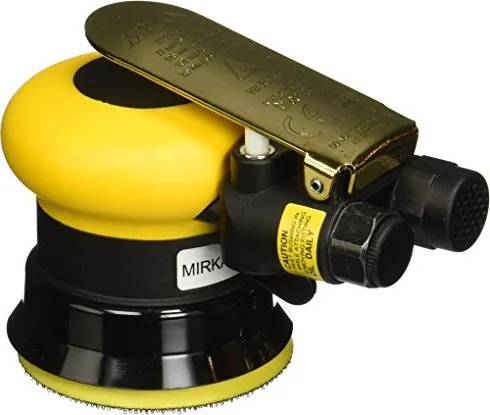
The Mirka ROS 325NV is a high-performance air-powered orbital sander designed for professional finishers who demand precision and efficiency. This tool features a 77 mm pad with a 2.5 mm orbit, delivering an exceptionally smooth finish that minimizes swirl marks. Operating at a no-load speed of 12,000 RPM, it provides the power needed to remove material quickly while maintaining control over delicate surfaces.

One of the standout features of the ROS 325NV is its advanced dust extraction system. The integrated SuperVac technology ensures that up to 99% of dust is captured directly at the source, keeping the work area clean and improving visibility. This makes it ideal for environments where air quality is a priority. The ergonomic design includes a soft-grip handle that reduces vibration transmission, significantly lowering user fatigue during extended use.

The unit is built for durability with a robust motor housing and precision-machined internal components. It operates efficiently on standard shop air pressure between 6.2 bar (90 psig) and 6.5 bar (94 psig). The lightweight construction allows for easy maneuverability in tight spaces or on large flat panels alike. Whether you are working on automotive refinishing, furniture making, or general woodworking, this sander offers the versatility required for top-tier results.

Users will appreciate the intuitive throttle lever that allows for instant speed control without needing to change settings. The tool comes equipped with a non-vacuum shroud as standard, though adapters are available for central vacuum systems. Its compact size and balanced weight distribution make it a favorite among professionals seeking reliability and superior surface preparation capabilities.

M: QW-35-FL

© Copyright 2026 Manual.ly